On our last full day aboard Southern Aurora we woke somewhere in NSW, with another early start. We were just sitting down to breakfast as we reached Albury railway station on our way back into Victoria.
Breakfast — fruit compote, yogurt, toast, cereal.
Buses were waiting for us when we got to Benalla railway station. Once again we were kept in our Covid bubbles and had each been allocated to a specific bus depending on our train carriages and dining room seating plan.
The buses wound their way up into Victoria’s high country where our first stop was Chrismont Wines, a cool-climate vineyard in Cheshunt.
The views from the balcony at Chrismont were gorgeous. If I lived there I’m sure I’d never get any work done. We had a birds’ eye view across the vines, to the road and mountains beyond.
rom the balcony at Chrismont Wines, Cheshunt, Victoria.
After a sampling of their best wines we all had lunch together before leaving to drive to Milawa, a small village in the heart of foodie country.
Our first encounter with Milawa was back in 1999, when our family spent a week in Bright. During our stay we drove around the Victorian Alps area as well as the gourmet areas nearby. Our cheese-loving daughter was delighted when we stumbled on Milawa Cheese Company. We’d also stopped in to Milawa Mustards and sampled some delicious relishes and mustards. As we were travelling with a family and on a tight budget, we bought mustards, relish and cheese, then stopped at the bakery for some crusty warm bread rolls. Then we drove out of town to find a quiet spot to have a family picnic on this glorious fresh local produce.
Gateau du fromage — Milawa Cheese Company stack of their best cheese wheels.
We’d told our now-adult children of our expectation to visit Milawa Cheese Company and knew they’d want us to ‘stock up’. The family favourite is Milawa Gold, almost impossible to find outside Milawa. It’s a creamy, strong-flavoured cheese, bold and with bite. Once tasted, it’s unforgettable.
We made a bee-line for the cheese counter and selected our favourites. The staff on the train had offered to store our perishable packages for us, in the fridges on board.
From Milawa we wound our way back on the buses through Wangaratta, to re-board the train in Albury.
Historic Wangaratta. Photo taken from the bus as we sailed through. Next time…
Before we left Albury there were more speeches, and a surprise (for me). I don’t know why I hadn’t realised, but the staff on board this historic train were volunteers. They worked hard, their service and courtesy was gold standard, but they were there because they loved the train and the historic railway journeys.
Waiting for dinner — all this was served by volunteers!
The journey back to Sydney could have been sombre, as our adventure on Southern Aurora was drawing to a close. But we still had dinner, and breakfast next morning, to keep our mood relaxed and golden.
Dawn somewhere around Moss Vale.Breakfast in Bundanoon? Bowral? Somewhere in the misty highlands…
The train was taking us through a damp and misty Southern Highlands as we enjoyed breakfast next morning. After packing, we moved to the lounge car to chat to our new friends and listen to their excited arrangements for their next trip with St James Rail (stjamesrail), and Owen Johnstone-Donnet.
There are tours which take you to wonderful places; there are tours where you get to knew some wonderful people. There are tours where they spoil you rotten. We’d just had all three. Can’t wait for more!
Journey’s end on Southern Aurora. For sixty years, this sign shone through the night between Sydney and Melbourne from the back of the train. No longer in public service, she’s now a touring train for heritage rail enthusiasts.
We’re ready to journey again.Back in our cabin again.
It was time to once again board the Southern Aurora and head north.
Dual gauge track at Melbourne’s Southern Cross station.In Melbourne, officials came out to watch the Southern Aurora‘s departure from Melbourne on this historic occasion. We were also on the evening news! That’s Owen Johnstone-Donnet on the right, the St James Rail Tour Director.
Violet Town is a small Victorian country town that under many circumstances you’d blink and you’d miss it. It’s a pretty place, as many country towns are, with a railway station and level crossing. It’s reason for existence was purely as a stop on the rail line to Melbourne.
But in 1969 all that changed. On 7 February at just after 7 am, the Southern Aurora collided head-on with a goods train at an estimated combined speed of 172 km/h. Nine people were killed and 117 were injured. Both drivers were among the dead. The fireman of the goods train jumped clear at the last minute. The locomotive of the Southern Aurora and several of the leading goods carriages became airborne. Spilled fuel caught fire and added to the problems. It was an appalling mess.
Immediately afterwards, volunteers got busy searching for survivors, setting up communication and transport and providing what assistance they could.
The Southern Aurora had gone through three red signals and should have been stopped on a siding waiting for the goods train to pass. Instead, it sailed through without a pause.
What happened? It took a while to work it out, but it appeared that the Southern Aurora driver had a heart attack and was either unconscious or dead at the controls. But there should have been a back-up — the fireman and the guard should have been watching the signals in case the train disobeyed them. The fireman should have alerted the driver and/or the guard, and the guard had the ability to independently stop the train.
Passengers gathered together at the Southern Aurora Memorial Gardens to learn more about the community response to the crash.
The inquest laid the blame with the Southern Aurora’s driver, fireman and guard. A bit unfair on the driver, since he was determined to have been dead at his post before the first signal was missed. It was believed the fireman had been boiling the kettle instead of checking on the alertness of the driver when the Vigilance Control alarm went off (after the train went through the first signal to stop) and the guard was claimed to have been dozing on and off and not watching the signals reliably. Other possible problems were not openly criticised but perhaps should have been. The doctor who cleared the driver to work even with a pre-existing heart condition. The Vigilance Control system should have been automated. The means for the guard and fireman to watch the signals needed cleaning and was difficult to monitor. And perhaps the relationship between the driver and the guard — the driver was in charge, the fireman may have been reluctant to challenge him or take control. That might have caused sufficient delay and confusion in the fireman’s mind, to allow the disaster to play out.
Following the inquest a number of improvements were made, notably to the Vigilance Control system, which now requires both driver and fireman to cancel it once triggered. The various factors which contributed to the Violet Town crash have been analysed and are no longer possible. Train travel these days is much safer as a result.
Due to the length of the train, it was unable to simply drop us off at Violet Town and wait. Instead, we were dropped off at Euroa railway station and took buses to Violet Town to have a good look at the Southern Aurora Memorial Garden there. We were met by local officials who explained what they have done here by creating the Southern Aurora Memorial Gardens.
The headlines of the day. This accident led to a lot of improvements in train safety nationwide.
The Gardens have a theme of Helping Hands, to honour all the people who stepped forward to offer assistance. Staff, passengers, injured, whole, locals, travellers — people just stepped up. The paths at the Memorial Garden are embedded with positive words reflecting the best of the human spirit. Courage. Hope. Generosity. Kindness. Love.
A central feature of this memorial is a sleeper carriage from a similar set to the ones involved in the accident. There are murals around the park, depicting various scenes from the 1969 incident.
The gardens are a place of peace, remembrance and recognition of what we all can do together when we step up to meet needs.
This is a small town where something big once happened. People came together to help under horrific and extraordinary circumstances and this should always be remembered.
The official notice is on the old Southern Aurora sleeper car in the gardens.
Our food-filled adventure on Southern Aurora took a different turn in Melbourne.
While Southern Aurora waited for us somewhere at a siding in rural Victoria, the tour group was spending Anzac Day 2022 on the historic Puffing Billy steam train in Victoria’s Dandenong Ranges.
We had an early buffet breakfast in the hotel. Plenty of choice, and freedom to move around and make our selections, so we felt no impetus to eat everything put in front of us as captive diners. As a result, I was beginning to feel less over-full as we set out from Southern Cross for Belgrave, on the Victorian METRO rail service.
When we got to Belgrave we left the suburban train and walked down a ramp through leafy bush to the Puffing Billy platforms.
The Puffing Billy station at Belgrave.There she is!Loading up. We were a train load of enthusiasts.
This narrow-gauge line was opened in December 1900 as a way to open up the remote areas in the Dandenong Ranges. It quickly became a tourist attraction, but it was a vital supply line to the people who chose to live in these hills. Not just mail and newspapers, but equipment, tools and even livestock. It made living in the Dandenong Ranges a viable concern. However, it was an expensive one and was eventually downscaled in importance as a result. When a landslide blocked the line in 1953, it was the final blow and the line was closed.
Public interest stepped in, boosted by media coverage. The Puffing Billy Preservation Society was formed and a combination of volunteers, CMF (Citizen’s Military Forces, these days called the Reserve Army) and also with a nod from the state government, bypassed the landslide and got the line reopened in stages.
At 11 am at Belgrave there was a short Anzac Day remembrance, and then we boarded the train. Again, in keeping with staying in our own Covid bubble as far as possible, we were allocated a carriage.
Fern fronds for peace. They were a bit sad by the time we got up to Lakeside, but there were plenty of fresh fronds to replace them.Simple, but heartfelt. Remembrance message chalked on the side of the engine.
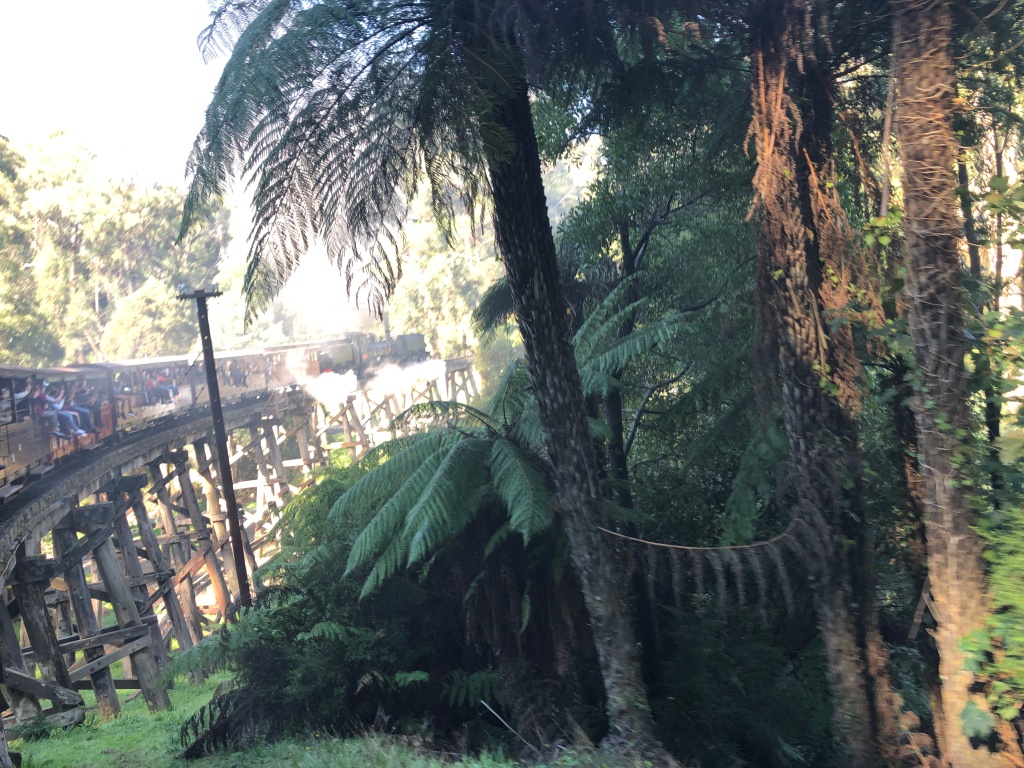
PuffingBilly’s carriages are open at the sides, a wide sill on each side with horizontal bars ensuring people can’t fall out, even if they choose to sit on the sill with their legs hanging out (surprisingly permitted along the first section of track where we were going).
The open carriages allowing people to sit on the sills, if they choose.…and we’re off! Thanks, mate.
As we wound up higher into the Dandenongs we could see small villages along the track, some of which were still having their Anzac Day services. People not involved with the services were waving to us as we passed, the little steam train clearly a local favourite.
Riding on the sills as we go over the trestle bridge is apparently a ‘thing’. Starting our wind up into the Dandenongs. Ours wasn’t the only train doing trips.The Anzac Walk parallels the train track.
There was a walking track for part of the way along the line as well, the commemorative Anzac Walk. QR codes allow walkers to hear the stories of the Emerald Anzacs who served. The vegetation varied between tall timbers or groves of palms.
The view of Melbourne from up in the Dandenongs.
Up at Lakeside we had lunch organised for us all (of course! More wonderful food!). We had some interesting speakers over lunch. One man, Graeme Legge, represented Emerald RSL (Returned Services League). He was born in Emerald, grew up there, his father served in WWI. He told us that 32 local Emerald men died in WWI and local communities developed the Anzac Walk to commemorate their sacrifice.
We had some time to wander around the beautiful and historic station, looking at some of the displays on the history of the Puffing Billy, before our return trip later in the afternoon.
In the small museum at Lakeside you can learn more about the history of Puffing Billy.Happy engineer.Yours truly, grabbing a moment on the footplate.Beautiful countryside. Plenty of fern fronds.
Back in Melbourne we took advantage of the complimentary dinner that our tour host had arranged for us, although we still didn’t have room for much.
Back at Southern Cross in time for dinner.
After dinner we decided to forgo the bright lights of Melbourne and instead avail ourselves of the free wi-fi (sadly lacking on the train) and catch up on emails.
Sitting with legs out the window is definitely not permitted on Southern Aurora.
We’d boarded this special anniversary run of Southern Aurora the evening before. A few wakeful moments but we slept fairly well and woke to dawn light streaming in our window, and southern NSW countryside flashing past. Just in time for breakfast. Because we’re early risers, we blessed being allocated to the first sitting.
The mist lay low on the paddocks as NSW countryside flashed past our window. Our table mates were a little late, there were a few missing heads in the dining room for the first breakfast sitting at 7 am.
We rolled in to Albury Station soon after breakfast (for us). The second sitting was going to be later, it had to wait until after the morning border crossing ceremonies.
Albury Station, NSW, in the early morning.
With the early morning sun splashing gold over the heritage-listed Italianate station buildings, we gathered to hear some short speeches including one from sitting Federal MP, Sussan Ley. She mentioned the previous MP, Tim Fischer, who was well-known for his obsession with trains, including Southern Aurora. Tim’s funeral train also passed through Albury, paying respects for the many years of hard work he put in there. According to his wife Judy, Albury Railway Station was one of Tim Fischer’s favourite places. We certainly admired it for its architecture, its planning and the amazing length of it — 455 metres, the longest in Australia!
Still travelling — the Boomerang Bag that also went round Europe twice. Albury Station, NSW. The longest platform in Australia! April 2022
We left Albury just as “second breakfast” began. Although it was for other passengers and not us, we were finding that the food on offer, both the quality and quantity, was making us feel like well-fed hobbits. Instead of thinking of food, I took the opportunity to attempt a shower, in a tiny cabin bathroom of a train on the move.
The trick to showering on the train is to strip off in the cabin, outside the bathroom. Leave your clothes within reach outside the bathroom door. Toiletries (soap, shampoo etc) can fit neatly on the shelf under the mirror. Go into the bathroom, close the bathroom door, then slide the shower curtain around to also cover the bathroom door. There was a very thoughtfully-provided grab rail to hold onto when the train was going around a bend. Because the bathroom is so tiny, it’s easy to reach whatever you need.
I was sitting in the lounge car sewing when we pulled in to Violet Town to be met by some local dignitaries for the occasion. Southern Aurora has a special connection with Violet Town, which I will go into in a later episode.
We left Violet Town just as the first sitting of lunch began. Lunch? Who’s got room for lunch? But it was so delicious we managed to force it down. Other passengers at nearby tables were exclaiming in delight at the food. “As good as ever,” they said. “These St James Rail tours are about the food as much as the adventure.”
We weren’t going to starve, then.
It was mid-afternoon when we finally arrived in Melbourne, at Southern Cross Station (formerly Spencer St Station). We were to spend two nights in Melbourne in a hotel across the road from the station, but coming back to the same compartment on Southern Aurora after that. The staff (who had been waiting on us with such professionalism for our meals) were going to stay on the train while it parked at a siding somewhere out in the country. I hoped they were going to get some well-earned rest.
Southern Cross Station, Melbourne. April 2022
We left our bigger bag in the cabin and took a change of clothes in our smaller bags to the hotel.
And at the hotel, we met our first glitch. They were not ready with all the rooms. Despite knowing how many were arriving, and when, despite the bookings having been made several months ahead, they were not ready. We actually didn’t mind very much because being fed so well and so frequently, we had a sort of detached attitude soaking into every pore. But the hotel staff were profusely apologetic, and invited us to partake of their Swiss-influenced ‘death by chocolate’ happy hour.
It’s amazing how much chocolate you can still stuff in, even when you are full as a tick.
While we were tasting little pots of mousse or indulging in chocolate truffles, our tour organiser Owen was working hard on our behalf. He couldn’t get us into rooms any faster, but he did manage to gain a concession.
“I’ve asked them to compensate you in some way for the inconvenience of having to wait for the room,” he began.
I downed another chocolate truffle. Inconvenience? Oh, yes, I suppose so.
“They’ve offered you a complimentary dinner in the dining room,” he beamed.
Dinner? Where would we put it?
“Tonight or tomorrow night, what is your preference?”
“Tomorrow. Definitely tomorrow.” We were very much in agreement. Maybe by tomorrow night, we’ll be able to squeeze in a morsel of food.
Our room was finally available, so we dropped off our bags and headed out to explore Melbourne. Along the way we decided to find something very light for dinner. Soup. We headed for Chinatown which we found was packed. Really packed. There were long queues outside some places. We weren’t keen on crowds (Covid makes a person a bit paranoid) so we kept moving on.
Melbourne, April 2022
Finally we found one place that seemed to have room. We had to wait, but that was okay. As we waited, I realised that it was the same place we’d visited in February 2020, just as the pandemic was starting in China. Back then, Melbourne’s Chinatown was almost deserted. We’d been the only customers for dinner in this very restaurant. Back then, we’d been served by an older Chinese woman who treated us like beloved children who needed to be nourished. And here she was again! Of course she did not remember us, but we remembered her.
A quieter Melbourne Chinatown, February 2020
I felt so bad for her when all we could order was one bowl of soup each.
She didn’t know that we were in no danger of starving.
This blog, as you will notice from the header, is supposed to be about writing and travel. That’s been challenging over the last few years due to Covid restrictions. Especially in Australia, some parts particularly, we’ve been very limited in travel, or even leaving the house. It’s been very isolating.
Choir rehearsal by Zoom, during the beginning of lockdown in June 2021. The background is from our travels in Greece in 2018.
I’ve been busy writing, I published two group anthologies while Sydney was in lockdown from late June 2021 to early October 2021, when there was ‘early release’ for those who have been double-vaccinated. I’m not going to discuss the rights and wrongs of the government directives. It just is, and merely sets the scene for what now follows.
I love to sing. I especially love close harmony, but that becomes increasingly challenging when ‘close’ conflicts with the need for social distance. I belong to two choirs which each give me something different, musically. One sings modern arrangements in a barbershop style while the other performs music from past centuries in multiple languages.
I’ve written earlier about my links with historical clothing. When we went into the latest, longest lockdown in Sydney, it was just after my attendance at Blacktown Medieval Fayre. I felt dissatisfied with my attempt at costume and resolved to do more. I wrote about this in Down the Rabbit Hole. https://wordpress.com/post/helenjarmstrong.home.blog/1529
First I repaired the medieval clothing of other family members who are regular historical reenactors. That gave me the confidence to try more.
Dressing/road-testing the new kirtle, about to go for a short walk in the neighbourhood.St Birgitte coif. The band is sewn from an old, torn chambray shirt.The coif, being worn. It hides a multitude of hair-colouring sins.
During the early part of the lockdown, I hand-sewed a 13th century kirtle (think, Maid Marian). Then I think I went a bit crazy. I had some old, worn fitted sheets with ‘dead’ elastic. I spread them out on the lawn in a desperate attempt to keep involved with life and hopefully say hi to any passing jogger. Cutting out fabric, I hand-sewed several chemises, learning more in the process. A coif or two as well, using an old torn shirt and a ripped sheet. I found myself binge-watching historical videos and clothing history sewing videos while I stitched. As I adapted the discarded fabric in my life, I channelled my inner Scarlett o’Hara (remember those green velvet curtains at Tara?). One way or another, as God was my witness, I would never be costume-less again.
Ready to cut.
As we began to come out of lockdown, our Renaissance choir (ROH Ensemble) was able to rehearse once more (under very strict conditions). I showed photos of what I had been making, and sat at rehearsal finishing the hand-stitching on another St Birgitte coif.
“Would you make me a ruff?” one male chorister asked.
I thought about it. That would be stretching my skills. “I’ll have to find out more,” I told him.
More binge-watching. The information was frustratingly scarce. The process seemed frustratingly tedious and painstaking. The more I studied, the more I realised that ruffs, while worn by ‘ordinary folk’, were very much a status symbol because of the effort (and therefore expense) involved in their making.
ROH Ensemble rehearsing as lockdown eased. (Cheat pic – taken back in February 2021)
I was determined to try, however. One video looked more useful.
The first day we were allowed to leave our local government area, we went to visit our daughter. She gave me an old cot sheet which I carefully unpicked. “While you’re sewing costumes,” she remarked, “Master Six wants to be able to dress up as a Tudor prince.”
Okay, another request for a ruff. And a Tudor cap. My to-do list was rapidly growing.
I visited a neighbour with whom I do a lot of community sewing. In her basement I rapidly machine-sewed a number of quick projects. Using her rotary cutter and very careful measurement, I cut the old cot sheet into as many lengths of 10-cm-wide strips as I could, then carefully machine-hemmed one side. The video had said there was no need to hem the other side. I’ve since found this is bad advice…
Learning by doing. Some videos were more helpful than others…Sewing the ruffles to the neck band. That raw edge was a bad fraying problem, it needs to be all done again.Finished ruff. For now… that curve is because I had to sew it to the band at an angle, because of the fraying.
As Bernadette Banner (noted dress historian and prolific YouTuber) so often says, “there is no such thing as true historical accuracy.” All we can do is study the past and try to extrapolate how it was done, and hope we can get as close as possible.
Back at home I sat and hand-stitched some more. I developed a technique of hand-stitching a ruff that let me carry it around in my pocket, so I could take it out and sew a little more wherever I was. I was almost manic in my zeal, when our choir director told us that we had two gigs in the city. We needed costumes! She was determined to improve the historical accuracy and the look of how the choir presented.
In our Renaissance choir, the look is very individual. We do not look like each other. Often, we’re not always from the same time period, our brief is medieval and Renaissance. I had originally planned for my own costume to be 13th century, but now I was sewing a ruff, that put my costume in the Elizabethan period. Late Tudor.
At my neighbour’s place again, I raided her stash of upholstery samples and made some pockets. These were worn in medieval and Tudor times either under an over-dress or on the outside. When you hear the child’s nursery rhyme, “Lucy Locket lost her pocket, Kitty Fisher found it”, it is referring to these old-style pockets which tied around the waist. According to reports, some women would even carry live chickens to market in their pockets. I figured I could use one to carry my medieval mobile phone and my medieval Opal card (public transport card). I sewed a couple more for other women in the choir.
I went shopping. Cautiously, wearing my mask and keeping my distance. Maybe I could make another dress… then I saw some lace, and some braid. I scurried home with my treasures. And did more sewing.
Kirtle with braid – it took exactly six metres. Trying to turn a 13th century costume into something that COULD be 16th century.
Another friend bought himself a new costume. There was nothing wrong with the old one, but he wanted a change. Unfortunately, it needed work. So that pulled me away. He also needed a Tudor cap, and in my fabric stash I found some royal blue corduroy and fuschia taffeta. An old music folder contributed some stiffening for the brim. It was brilliant. Sadly, too small (hopefully, it will fit Tudor-prince-loving grandson). So I started over, using two layers of plastic drawer liner as stiffener. This time — too big.
The lining and the outer layer — these are the same. We just tuck one inside the other and stitch together.The stiffened brim of a Tudor cap.Finished Tudor cap. This first one (too small) had to be finished in green bias binding, I was only able to use what I had in he house. No shopping permitted.
My other choir, Endeavour Harmony Chorus, was also booked to perform in the city, on the first night of the Sydney City Christmas program, which was very exciting. Getting the costumes organised was a lot easier for a choir where everyone dresses the same. The City of Sydney was providing t-shirts for us.
Endeavour Harmony Chorus performing Christmas carols by the Martin Place Christmas tree.
The City of Sydney also offered t-shirts to ROH Ensemble but our director graciously declined. It would have looked so wrong with a ruff.
Ready to travel, in costume. My character back-story is seamstress. Of course!Costumed and masked on the train to Martin Place in the centre of Sydney.
On the day our Renaissance choir performed Christmas carols in the city, we did our best to travel in as a group. With Covid restrictions still in place, there was nowhere sufficient, or with enough time, for us to fully change into our costumes so we travelled in to the city by train already in medieval and Renaissance costume. People were carefully not looking at us.
On Sydney’s public transport we still need to wear masks. Next to the performance area a hotel gave access to two toilet cubicles and a warm-up space. The hotel required QR check-in, proof of double vaccination and masks. But as performers, we also needed to put on some make-up. Masks make a big mess with lipstick, especially.
We managed. We managed it well, I think.
ROH Ensemble Choir at the big Christmas tree in Martin Place, Sydney. December 2021.Post performance. Will the rain hold off? Note the pocket. I also carried my musical instrument in there.
Endeavour Harmony Chorus has now performed twice this year in this Christmas tree space, and each choir has one more performance to go in the city. It’s been exciting, challenging (fitting in song sets in between the large city clock striking every quarter hour, and an over-enthusiastic programming of the giant musical Christmas tree). On our next Renaissance performance, apparently a nearby cathedral has brought in bell-ringers from around the state, and they will be enthusiastically pealing bells while we sing of Christmas. In costume.
It’s different. But it’s wonderful to sing again, and to be out and about. What a Christmas gift!
After our next performance in Renaissance costume, I’m taking the ruff apart. It needs more work to ‘floof’ it out a bit more. However, each time I do something or make something, I get better.
Tired after a busy day. Returning home on the train. The ruff didn’t come through too badly, but it needs more work.
I have a long way to go, but it will be a fun time getting there!
Last night one of the other sewer choristers gave me three boxes of fabric for costumes… *sigh*
An old doona cover. I’m thinking maybe red underskirt, brocade overskirt and boned brocade stomacher…
After some years in the steam equivalent of dry dock, after boiler problems whispered about darkly in machine sheds and steaming bays around the country, that iconic Australian steam train, 3801, is back, baby!
We had been on one of the last trips before she was mothballed, waiting for the replacement boiler. And now, at last, we would be on the very first public return trip on 13 March, 2021.
There were multiple trips planned for the whole weekend, a one hour trip south to Hurstville and back, with a diesel loco at the rear to haul everything on the return trip. For Covid-safe reasons, each compartment was sold as a bubble. We bought a compartment, sure we could fill it with either family or close friends. And so it proved — we filled five of the six seats just from our household, and a good friend, Jim, took the last place in our bubble.
With a 9 am departure scheduled for the first run from Central Station in the heart of Sydney, we left home at 7 am for Sutherland Station. Masks on public transport were compulsory, so we duly complied.
Sutherland Railway Station, at “sparrows” (aka “very early morning”).Between Jannali and Como — always a place to wonder…Como, crossing the river. Some of this is mist, some of it is dirty train windows.Jeff, inside the modern suburban train, on our way into the city.
During Covid we didn’t travel much, especially on the trains. We have to worry not just about Covid, but also about compromised immune systems. So we took the top level on the double-decker suburban carriage so we could get the best view as we crossed the river at Como.
We got into Central Station with plenty of time. The old sandstone edifice of Sydney Terminal still has soaring ceilings and some gorgeous art deco leadlight windows. The old neon advertising signs I loved as a child are now a fixture in the Powerhouse Museum. I used to love the McWilliam’s Wines sign with those impossible purple neon grapes dripping into a glass. Now we can see the old clock right next to the modern timetable board. The old one, with the regular trains and their evocative names such as the Fish, and its associated route, Chips, is also in the Powerhouse. One more nod to the past was the sign over the door to a restaurant — “Eternity”. A nod to Arthur Stace, who from 1932 to his death in 1967 walked the city streets in the wee small hours, chalking the one word, “Eternity” in various places around the city, a one word sermon and witness testimony.
Inside the old Sydney Terminal station, from where trains depart to travel the country.The new departure board with the old clock. Sydney Terminal is now a mix of old and new. Mask wearing was still compulsory on public transport.“Eternity” cafe. Not open for breakfast…
Our locomotive, 3801, was in pride of place in Platform 2. Next to her on Platform 3 was 5917, the picnic train, embarking on a day trip to Kiama. It was due to leave at about the same time, and as well as passengers, the platform was crowded with trainspotters, train crew and various reenactment groups from the history society, either playing music or going through the motions of a porter wheeling a large luggage trunk on a handcart accompanied by a couple dressed as if from the 1930s, looking for their compartment. This first public outing for 3801, the iconic steam locomotive of Sydney, was a festival of celebration.
Platform 3’s picnic train. A lucky kid in the train cabin before departure. Start ’em young.‘Play “Chattanooga Choo-Choo”!’‘I’m sure our compartment was back there…’Theatre and history combined.
There were some interesting people in the crowds. One man even had a tattoo on his arm of 3801 and was glad to let me take his photograph as he took his turn on the locomotive footplate before departure.
A young fan on the footplate shows off his tattoo.Steaming up. People everywhere!
On the platform we met up with Jim, our friend who was to share our compartment. Jim is a long-term train enthusiast and we have had many enjoyable conversations with him about many other shared interests. We also had our son and granddaughter with us, who had jumped at the chance to be included.
Once in the compartment we opened the old windows and took off our masks. We were back in our own bubble. While we waited, we shared stories of our memories of travelling in these old carriages. Back in the mid-1960s I travelled to Otford south of Sydney on a train commissioned by a church youth group, to attend a three day camp. We rode on a steam-hauled vintage train, which was part of the regular NSW regional run in those days, before more extensive electrification of the state rail system. We loved these old trains. My first experience of going over the Como rail bridge heading south was on that train. I remember looking out the window at schools of jellyfish in the river below. And in 1969, with raging bushfires on the NSW south coast, our summer youth camp was cut short as fire approached the campsite. We were herded to Otford railway station, a small regional platform surrounded by thick bushland and tall trees, to wait for a train that some warned might not come, due to possible fire damage to the train track. As we waited we saw the fire crest the hill above the campsite and people trying to fight it by flapping it with wet sacks. When the steam train rolled in to collect us, it was with the same vintage carriages also, which I loved. Old photographs screwed to the walls, soft leather-covered seats with built-in head rests and, joy of joys! A carafe of water, lid chained securely to the neck, and two glass tumblers. Sadly, the water was warm from the heat of the day. As the train hauled us through the still-burning forest, we would sometimes see groups of firefighters doing a rearguard mopping up operation, with trackside stumps still smouldering. We were very relieved to get back into Sydney’s Terminal station that day in January 1969.
There was a queue to get onto the footplate. This is a much-loved train.
In our carriage this day in 2021, all this history has been carefully preserved. The glass carafe and glasses are not there, they fetch high prices now in auction houses. But the historical photos are screwed to the walls, and when we examine the timberwork in the carriage, all the screw heads are lined up neatly, the subtle mark of a master carpenter.
Luxury compartment, very Harry Potter… Jim, Jeff and Rob.My son Rob still doing his Daniel Radcliffe look-alike feat.
With a loud whistle and a clank of carriages, the train pulled out. We moved past the old Mortuary Station from where funerals would depart for the ‘dead centre of Sydney’, Rookwood Cemetery where once a matching ornate sandstone station stood. It’s now mostly used as a picturesque wedding venue. From there the train dipped lower into the deep ‘rat runs’ where tracks could criss-cross overhead, and where generations of steam trains laid down a layer of soot. Now, ferns grow in whatever cracks they can find.
The train rose back to ground level again as we passed Redfern station. The Kiama Picnic Train chuffed past, with cheers and waving between both trains. The festive air continued with every station we steamed through filled with trainspotters with their long lenses and tripods.
Trainspotters at Hurstville station.
In the seat opposite, our granddaughter closed her eyes and sighed as she leaned back in her seat. As I watched her I remembered my own journey on a train like this, heading south to a weekend of adventure in the bushland on the south coast. I think that is where my love of trains, travel and adventure really began.
On the train to Melbourne, we crossed the border right on midday, SA time. Trying to type on the train is even more challenging on the Overlander. None of the long, straight sections of the Ghan. This was a rockin’, rollin’ ride.
Overlander train between Adelaide and Melbourne — there is talk of cancelling this service soon.Morning mist from the train. Paddocks are greening up from so much rain.Grain silos at Nhil. Seen from the Overlander.
With the rise of coronavirus, we’d noticed that Chinese restaurants on our trip were not well patronised, so we ate a lot of Chinese food. Once again we sought out Chinatown. And once again, the place was empty. We had a delightful meal with meticulous service, but we were the only customers.
Quiet streets in Melbourne’s Chinatown.A grey sunrise in Melbourne.
We picked up the car at the train station in Melbourne without much idea of where to go. ‘Out of Melbourne,’ was our mutually agreed choice. Not that we dislike Melbourne, we just prefer to not drive in big cities if we can help it.
We like the coast, we love the countryside, so we looked approximately in the direction of home (no rush, we had a week, and there are still flooding rains there) so we picked Bairnsdale, not expecting to get all the way.
Storms coming in to Bairnsdale, the river rising.
Trying to find a random motel, we pulled in to the first one we saw in time. I stayed in the car while Jeff went to enquire. ‘No, they have no vacancy. But they rang the motel down the road.’
As we drove out through a full car park, Jeff commented, ‘Cancer City.’
I looked around to see if that had been a slogan on the side of a vehicle. What would it be about? An anti-smoking campaign vehicle, perhaps? Odd…
As we moved back into the street, Jeff said, ‘Keep your eyes peeled for this motel.’
‘What’s it called?’ I asked.
”I already told you. Cancer City!’
‘Cancer City? The name of a motel? What kind of crazy town is this? Wait a minute…’
The motel in question came into view. Kansas City Motel. Yep. We stayed there. It’s actually really good!
The Loft in Bairnsdale. A wonderful meal, but again, not many customers. Not as empty as Chinese restaurants!In an antique shop in Bairnsdale. I used to own one of these!
Next morning (after a night of storms) we headed off, hoping to get to Bright or Beechworth. But an hour along the road, we came to a ‘Road Closed’ sign.
‘There’s about four truck loads of dirt across the road up there,’ the road worker on duty told us. ‘It all came down in the rain.’
This road closed off the centre of Victoria to us. Mud slide.
With no way through, we changed our destination and headed for Eden.
Although it had rained heavily the night before, and we drove through more rain, we drove past several smouldering stumps by the road. So much of the landscape was charred but, in typical Aussie bush fashion, regrowth and recovery had begun.
The remains of someone’s home, burned in the recent fires.
The bush recovers faster than human habitation, sadly.
Rebuilding is taking time.New growth in the burned forest, a misty rain falling.‘Welcome to New South Wales’. Fire knows no borders.
When we got to Eden, we had our usual afternoon look around. It was cold, the sun beginning to emerge from a watery sky. I found a cave on the far side of an inaccessible cove. From what I could see, there was absolutely no land access. However, it fitted the description in one of my stories so I spent a little timer trying to determine its name, its history and anything else. When I asked our landlord at the hotel she looked puzzled. ‘What cave?’
The harbour at Eden. A glimpse of sun after a day of rain.
I zoomed in on Google Earth and on Maps. No information.
My mysterious cave in Eden. It’s just like the one I described in the novel I’m currently writing.
Net morning we drove to Bega and met up with an old friend from our village. We talked to her about it. ‘There are loads of caves like that all along this part of the coastline,’ she explained. ‘Most are not named, especially the little ones.’
I realised, feeling a little foolish, that it would be like naming a rock pool.
Foraging in Rundle Mall, AdelaideRundle Mall, Adelaide
We arrived in Adelaide, but with no plans. The possibilities included hiring a campervan and driving in the general direction of home, exploring on the way. Or hiring a car, and staying in various places along the way.
It was early afternoon and we needed to find digs. We wanted a hotel close to the city centre, but did not realise how small Adelaide really is. Neither did Siri, it seems, when I asked for a hotel close to Adelaide’s centre. What we got was very good, but we had to walk two blocks to find a handy tram or bus. And, as you may have noted from this blog, I don’t walk too well…
We were over the road from the park, and also the cemetery. So if I dropped dead from a heart attack from too much walking, they wouldn’t have to take me far.
Adelaide sunrise from our hotel room
After checking in and plugging in our various electronic devices, we went exploring Adelaide. A free tram dropped us off at Rundle Mall and we wandered down there idly, looking for perhaps a cup of coffee. Various posters announced events for the upcoming Adelaide Fringe Festival, starting in various dates in late February. ‘A pity we’ll miss it,’ I said.
Then as we walked further along Rundle Mall we were handed a flyer. The Fringe started that day! But some of the events we liked the look of were on too late. We were both very tired and it would mean staying out until late, just to hopefully stay awake through some riveting performances. We felt we simply were too tired to do them justice.
Then we saw a poster for Tim Ferguson, with his presentation, ‘A Fast Life on Wheels’. I had enjoyed his lesson on writing comedy at our Writers Unleased writers festival in 2013. And here he was, a 6.30 pm session in the Garden of Unearthly Delights, a Fringe-only space occupying Rundle Park in the centre of Adelaide. It was only a short distance away.
Tim Ferguson in a fan boy moment at Writers Unleashed 2013. The costumed characters were there for a book launch. He went on to give a cracking good two hour tutorial in writing comedy.
After an early meal, we were sufficiently rested and nourished to be able to handle an hour with Tim Ferguson. We got tickets with twenty minutes to spare and were lucky enough to be in the second row.
Fringe crowds on the first night. Later it got busy!
The show was as good as I expected. Carefully crafted, but still with a sense of impromptu, dangerous humour. Tim Ferguson was very open about the impact that multiple sclerosis has had on his life and career in comedy. However, he says, ‘I don’t suffer MS, it suffers me.’ He confronted the pain and his faults head-on and went into the no-man’s land of political incorrectness. ‘I had my first spazz attack, and I’m allowed to call it that because the medical definition of my muscle problems include spasticity…’ There are a lot of fears about disability. Ferguson confronted those fears head-on, turned them upside down and made us laugh at those fears and ourselves.
Afterwards I was at last able to buy a copy of Cheeky Monkey, which I missed out on buying at Writers Unleashed in 2013 when it sold out.
We always find a city tour helps orient us when we arrive somewhere new, so the next day we headed out early for a city tour, and then a drive to Hahndorf in the Adelaide Hills.
Hahndorf humourTopsy-turvy seasons, wisteria flowering again in February. Hahndorf, Adelaide.
Along the way we stopped at Mt Lofty to enjoy the view, and were delighted to find a couple of wild koalas snoozing in a nearby tree. After all the destruction from the fires, these were a welcome sight.
Koalas — a welcome sight at Mt Lofty, Adelaide.St Peter’s Cathedral, the church of churches in this City of Churches.
We spent half a day wearing out shoe leather in the museum, followed by the art gallery next door. So much to see! Adelaide is a city very proud of its famous sons and daughters.
Sliced stromatolite (fossil blue-green algae) — at 660 million years old, this is one of the oldest fossils in the world, Adelaide Museum.Adelaide Art Gallery, combining old and new.Margaret Dodd’s film, This Woman is Not a Car (1982) and associated ceramic artwork, Adelaide Art GalleryAlbert Namatjira’s iconic work was a delight to see. Here, one of his paintings on a woomera. We had just travelled through this scenery of ghost gums and McDonnell Ranges in Alice Springs.
On our last morning we wandered across the roads to Lundie Gardens, one of the many parks in Adelaide, to find a group of people playing petanque. They had lost their usual Sunday playing space because the Adelaide Fringe had turned Rundle Park into the Garden of Unearthly Delights. Just beyond them, we could see some cricketers in a large open space. Adelaide has a great many parks and green spaces, perhaps more than any other city in Australia. And when you stop to smell the roses, you really can smell them! As we watched the petanque players, the park’s automatic sprinkler system turned on. ‘We had asked them to turn it off on Sunday mornings,’ one of the players told me.
Checking the final score in petanque.Temporarily relocated during the Adelaide Fringe festival.
Another player came over, his clothing soaked. He shrugged. ‘Looks like we need to tell ’em again.’
Beyond the petanque area, I could see the cricketers packing up for the same reasons.
Sadly, play was over for the day. Time to adjourn for lunch or a coffee somewhere.
The Adelaide Fringe festival is a valuable asset to the city, but it does bring some logistic problems in unexpected places!
We walked on through the park noting the many ways in which this green space is designed for the convenience of visitors. People walked, jogged, relaxed with a good book or met with friends. I could see myself relaxing with notepaper and pen, crafting stories.
In Lundie Park, automated toilet cubicles. Futuristic with interesting voice-over and muzak. Photo taken during brief moment when toilet doors happened to be open.Adelaide is a city heavily focussed on increasing its green spaces effectively for the benefit and enjoyment of all.
We could have stayed much longer and still not had our fill of Adelaide. But it was time to move on. In the morning, we had another train to catch…
As I gazed out of the train window at the red earth, the lapis blue sky and the grey spinifex, as I felt the searing heat of the 40C day, I was once more reminded of how difficult it is to dream up the fifteenth century winter of the novel I’m working on.
Writing on the Ghan — there was more room here in the lounge but my only accessible power point was in the cabin.
Trying to sleep for the first time ever in a train sleeper carriage was challenging. Despite sleeping with ear plugs, the sounds of the jolting and buffeting of the carriages seeped into my very bones. I had chosen to swap ends of the bed so I could be near to my phone and watch, so I could see the time in the night without needing to turn any lights on. Our eyes adapted to the dark and even in the desert night, no habitation anywhere, the sky outside was not pitch black. And when the moon rose, we could see even more.
The turn-down service in our cabin happened while we were at dinner in the Queen Adelaide restaurant on board.
We had no concerns about privacy from outside the train, so we raised the blind and let the night sky in. As a result, I could watch the sunrise from my bunk.
Sunrise from my bed on the Ghan.
Our bed was comfortable, if narrow, but on the whole the cabin was cramped. We had to take turns occupying floor space. However, since most of the activity took place in the lounge area and the restaurant car, we had no need to seclude ourselves. The bathroom was a tiny appendix to our cabin, there was absolutely no room for more than one person. However, you could use the toilet and wash your hands at the same time. At one point I sat on the toilet lid to wash my dress in the sink, then washed myself with a wet washcloth and soap.
To shower, you made sure the bathroom door was closed, then you pulled the shower curtain around to cover the door and the toilet. All clothing had to be left outside the bathroom to keep it dry. There was a sealed cabinet which could hold a towel, and a small soap dish beneath the tap. A quick shower was recommended. I did find that showering on a rocking train was a challenging experience, but after a few hours in an off-train excursion, any way to shower was welcome. It was still so hot that after I washed my dress, I simply put it back on, wet. Even though the train was blissfully air-conditioned, I did not feel cold. My dress was dry fairly quickly.
I was unable to write in the cabin, the space was too restricted. But the lounge was ideal. Every so often I would glance up at red earth and spinifex rushing past the window. However, errors do creep in when the train is rocking.
Arriving in ‘the Alice’.
We had three off-train excursions. I’ve already described the Nitmiluk tour and the drive around the town of Katherine. The next morning we pulled in to ‘the Alice’ and we all disembarked. Once again we’d had different trips to choose. Some went for the aerial views while we chose the local wildlife park. Searing sun, flies and humour. Even for us seasoned zoo junkies, this little place had some unexpected treasures. Have you ever seen a baby bilby up close? It’s a cuteness overload, with its long pink nose and rabbit-like ears. All the animals in this place were native to the area, although too many were only to be found in zoos. Programs trying to release these vulnerable creatures back into the wild are being thwarted by too many feral predators.
Free flight show at Desert Park in Alice Springs.
Each off-train trip lasted around three hours, while the train was serviced. All except the last trip, which was late at night, at a siding in the middle of nowhere. We all piled off the train (those of us wanting the chance) to explore the ‘outback experience’. They had set up a large bonfire for us, but in the hot weather nobody wanted to sit too close. Besides, the light from the fire was spoiling our night vision.
Once our eyes adapted to the dark, we could see the night sky with far less light pollution than we get in the city. We still had some light pollution, of course; mostly people who did not know how to turn off the flash setting on their camera. If you’re taking a photo in low light, and the photo is NOT of something nearby, turn off the flash, people! Do you think your camera shutter is going to wait for the light from your camera flash to return to you from Proxima Centauri (over four light years away)? All the flashing was doing, was interfering with people’s night vision. However, we could still see the stars well enough for me to fall into Banjo Patterson mode with Clancy of the Overflow.
And he sees the vision splendid of the sunlit plains extended,
And at night, the wondrous glory of the everlasting stars.
The Ghan in the desert night. The train staff supplied glasses of sherry and Bailey’s as a nightcap under the stars.
All too soon, we had to climb back on board and settle for bed.
Next day was our last on board, and, as we approached civilisation in the morning, we had to be more discreet about getting showered and dressed with the blinds open.
While at brunch the Ghan went through a very tight turn and it was possible to see both the front of the train and the back, at the same time. Here you can see the engines through the window.
We had time for a leisurely breakfast and a chat in the lounge with our fellow travellers. The very long train (the longest passenger train of any regular service run in the world) was to be split up into two sections. Each of the sections had their own lounge and dining car, so we sat and swapped travel stories until we were asked to return to our own cabins for the final arrival.
Two of the Ghan staff who looked after us so well.
Farewells were brief as we collected our large bags (not permitted in the cabins, due to space restrictions) and moved on to explore Adelaide.
We’d heard about this epic train, but nothing can fully prepare you for that first sight of the Ghan. It’s big.
Jeff, my personal ‘Mick Dundee’, according to the overseas passengers, with the bulk of the Ghan disappearing into the distance.
The company pulls out all stops to make this a full-on Aussie outback experience, and the train does not disappoint. A country singer entertained us on arrival at the station. ‘It’s Charles Darwin’s birthday today,’ he told us. ‘The city of Darwin was named after this great naturalist.’
A great way to be welcomed to this epic train trip.
Those in more distant carriages had the option of a bus to get them to their carriage. We were close enough to walk. There were 123 travellers with 47 staff to tend to our needs. Three crew cars, three power cars, a baggage car, a car car (ha!) three restaurant cars and three lounge cars. And guest carriages, of course. All hauled by two locomotives.
On board we were met by a cool breeze in the corridor as we were shown to our compartment. Everything we could need is there (apart from wifi!). Small bathroom, lounge seating which converts to bunk beds.
Our tiny cabin built for two on the Ghan.
The very next carriage to us is the lounge — open, relaxed and a good way to mingle. Beyond that is the dining room. Tables seat four, so if you’re travelling just as a couple you will find yourself meeting new people. Not all of them have English as a first language. The food was fabulous, need I say? And dietary requirements were most definitely catered for. Table service, menu selection, barista coffee from the bar, or anything else — all drinks on board were catered for, for the entire trip. Sherry nightcap? Certainly. Sparkling wine with dinner? But of course! Another? Don’t mind if I do.
The very comfortable lounge, with the bar at the far end providing any drinks on request.
With three scheduled stops along the way, we next had the pleasant task of deciding which off-train excursions to choose. Given how far I’d walked the day before in Darwin down to the rock-pool, I opted for the least physically taxing trip. The rock art tour of Nitmiluk National Park (formerly known as Katherine Gorge) was recommended.
Nitmiluk, formerly known as Katherine Gorge. It’s now completely owned and run by the traditional custodians of the area.
When the time came, however, we didn’t get to see any rock art because to get to it, we’d have had to change boats to one which had its jetty a few inches underwater from the recent metre-high river rise. Given there are crocs known to be in the area, this was considered too risky… instead, we relaxed, enjoyed the scenery and listened to the local ranger talk about the stories of his people. The area is called Nitmiluk, he told us, because in the local language ‘nitmi’ is the word for the type of cicada that makes a pulsing sound. ‘Nit…nit…nit…’ and ‘luk’ means ‘land’ or ‘place of’. It’s two words, not one, but when written down by English-speakers, it was written as one word. Even as he explained this, we heard the cicadas start up. ‘Nit…nit…nit…’
Can you see the crocodile in the rock? It was the only one we saw.
On the way back to the train someone remarked on some areas of recent fire.
‘That’s backburn,’ we were told. ‘That one was about two weeks ago.’
We expressed surprise at how much regrowth there had been in such a short time.
‘Yeah, it grows different up here,’ the ranger assured us. ‘We backburn in a checkerboard pattern, but only a cool burn. Never when it’s too dry, like it has been for so many areas over east. That’s when even a cool backburn can get away from yer.’ He went on to describe cool burns in the morning, when there is still dew on the ground. The checkerboard pattern allows for re-seeding of those native plant species that need fire to germinate, while still allowing adjacent areas to remain unburnt as a refuge for wildlife.
Ye’ve had a bad time over in the eastern states,’ he said. ‘Some areas that had been recently backburned burned again, several times. It’s been far too dry for too long.’
Due to the change in boat tour, we had a bit of extra time so driving back through the township of Katherine, the bus driver detoured. We were amused to hear him talk about how the push for solar panels for the town’s power supply ‘can’t come soon enough.’ We’d been led to believe that in this part of Australia where mining has been so important to the local economies, people were against renewable energy. Someone asked the driver that question.
‘Don’t get me wrong, mining has been good to this town. But we need something to transition to for when the supply runs out. And up here, we’ve got loads of sunshine.’
Another motivation, I suspect, is a chance to not have to rely on bigger territory-based energy supply from outside the town. Looking after their supply themselves, not having to rely on others. The people who make their living up in the north of Australia are fiercely independent and resourceful. If any people can make a good living up here, not just a scratched-out one, it’s these people. Territory people. They’re proud of their history, proud of their ability to pass their living onto their children and grandchildren. They are finding innovative ways to do this. The future generations up here are assured.




 Helen Armstrong - writing on the move