Duelling Carols

It’s that time of the year again.

Bedraggled, tired chorister on the train home — from December 2021

As background, I’m in two choirs. One is a choir specialising in ‘old’ music, medieval and Renaissance in a number of different languages (including various archaic English dialects). We perform in costume (see other articles of mine here about going slightly nuts during various lockdowns when making historic clothing).


The other choir is a female close harmony acapella group.

I love singing with both these choirs, each has a very different style and is focussed on performance with a difference. The look, and the sound, in each case is part of the public appeal.

When performing out in the open, it is much more challenging to be heard. There is a lot of background sound from traffic, people passing by and even birds (it’s the time of year for the dreaded koel and channel bill cuckoo, both predatory cuckoos that make a lot of noise). Sound can simply dissipate into the wide open spaces, so performance is harder work. The payoff, however, is seeing random members of the public stop and listen.

Informal carols performance in the street — our last rehearsal for the year. 2022

Around Sydney there are multiple performance spaces for Christmas. The prized location is by the Christmas tree in Martin Place, Sydney’s answer to New York’s Times Square. However, it also brings challenges. The chiming clock, for one. The old GPO (General Post Office) is one of Sydney’s historic landmarks. The GPO is now the Fullerton Hotel, but I have fond memories as a small child going to the GPO with my mother, and hearing the clock chime out the hour to be heard around Sydney. It’s a Westminster chime that calls out the quarter hours too.

The Renaissance choir was one of the first choirs to help launch Sydney’s 2022 Christmas entertainment program at midday on 26 November. We’d done the same gig in 2021 and had experience of the challenges as well as the delights. Competing with the clock is one challenge. The Christmas tree is a whole other level of loud kitsch.

This year at that first gig, we had random members of the public, generally children and some other individuals with no social filter, come and stand next to us mid-performance to take selfies. One young woman actually ‘conducted’ the choir while standing next to the choir director who, amazingly, maintained her composure.

ROH at the big Christmas tree, Martin Place, Sydney, November 2022


The public are wonderful, appreciative and enthusiastic. Some more so, especially those flying high on various substances with dubious legality. We soldiered on and chalked it up to experience, and learning how to value every member of the public who is happily enjoying our performance each in their own way.

We’d travelled to this gig by car, as I was a bit frail. I had a small stool to sit on, a challenge in a Tudor gown, but it got me through. It was thankfully not as hot as it can get in a Sydney summer, but we were facing into the western sun and we had to manage.

The gown is a work in progress. So’s the hair. Martin Place, Sydney, November 2022.

For this first gig we had access to a changeroom, but for most of these, we have to turn up already in costume, often having travelled by public transport. Renaissance clothing is not always compatible with train travel, so a lot of us have basic clothing which simply goes underneath the costume.

Martin Place was a venue for other performers too. Immediately we finished, we heard a violinist (well amplified) playing carols on the other side of the Christmas tree. He had very considerately waited until we were done.

My other choir had a performance two weeks later, in the Sydney Botanic Gardens (New York analogy again, think Central Park). Getting there was more difficult than usual. There was trackwork on the nearest railway station, but thankfully the light rail was in operation. My costume was a white pantsuit (sparkly scarf on top) and I didn’t want to risk it getting dirty on public transport so I wore a voluminous dress over it all as a sort of protective smock. I had a short walk from the light rail terminus past the Sydney Opera House and up a set of steps to the Botanic Gardens. There was a pleasant evening breeze blowing from Sydney Harbour. I found the destination and removed my cover-all at last, and put on the sparkly red scarf. Visually, we’re a lot about bling!

The performance space here has been decorated with perfectly conical Christmas trees coated with sparkling LEDs, a veritable forest of delight. Around this was an array of market stalls. Another larger sound shell was the main performance space. The area opened up to the public at 6 pm, and mike checks and technical run-through was set for 5 pm.

The performance space in Sydney Botanic Gardens. Christmas 2022. My masked main groupie on far left.


Both stage areas.

Here is where we began to feel we were in a duelling match. Of course both performance spaces would need to do their sound checks at the same time, the other performers in the sound shell were scheduled to start at 7 pm, just as we finished. We still had choristers arriving and needing to be added to our sound check, while we could hear the loudly-amplified rehearsal from the big sound shell of various Christmas songs. They also had a brass section — very good players, but very loud. There was a lot of overlap in repertoire — we heard the other performers singing some of the same pieces we had also scheduled to sing. Different arrangements, thankfully. Our acapella choir had microphones provided but we needed to place our singers in such a way that the sound would be balanced. We also needed to hear the pitch pipe notes, and when the sound shell was loudly playing, “We Need a Little Christmas”, this was challenging. However, after so much Covid lockdown and cancellations over the last few years, we definitely felt we needed a little Christmas at last.

By the time the gates officially opened at 6 pm, all sound checks had been finished. Our performance got under way with no competition from the sound shell. Everything was actually well-organised and timed to perfection.

When we perform, our energy is up and we’re focussed both on watching the director for cues, and ensuring the audience has a good time. As a result, there is a performance high that follows. When our last set finished, we heard the sound shell start up with their show. Our audience evaporated and headed towards the new entertainment, and we followed, audience ourselves now. We had time now to shop for fudge and floss, to sing along in the crowd and just generally relax.

Fudge and fairy floss (aka cotton candy for those in the US) do not a meal make, so hubby (my main groupie) and I headed back to Circular Quay to find food. We avoided the Opera House concourse which is not only potentially expensive, but populated with roving gangs of marauding seagulls. “Nice seafood basket you have there,” you can imagine them saying. “Shame if something happened to it.” But as with most protection rackets, throwing them a few morsels only serves to encourage them. I’ve eaten sushi there in the past, having to eat with hands constantly covering the food and still almost losing my lunch to the feathered fiends.

We found a quiet corner inside City Extra, a 24-hour eatery originally founded to feed the media packs and hacks of yester-year. Outside the window we watched the Manly ferry on its regular commuter runs across the Harbour while the sun set over the Sydney Harbour Bridge.

Last night the Renaissance choir was back at Martin Place. I had asked the director in jest if she’d permit me to wear red glitter nail polish for the performance, because the modern acapella choir had performances bracketing the Tudor one. Her response was expected. “Rich fabrics yes, glitter nail polish no. It was not a thing in the Renaissance.”

This time I arrived by public transport with my main groupie, about 45 minutes before our call (which was itself an hour before performance). Plenty of time for coffee, and to get changed.

Again, what we wear when travelling is directed by what we need to wear during performance. I travelled wearing my white puff-sleeved pirate shirt (another lockdown sewing project) and green linen pedal-pusher pants. My tie-on pocket was useful for easy access to my phone and travel card (payment is a simple tap-on, tap-off) and would remain for access under my Tudor gown. Hair tied back in bunches. Not too weird for a Sydney summer.

The street-ready under-gown wear. The pirate shirt doubles as chemise. The pocket hangs from a belt and is accessible under the Tudor gown via pocket slits. Note the fallen bark from the gum tree — Australian trees are snarky in summer, they trash the yard.

We ordered the coffee while I was in pirate-garb, then while we waited, I unzipped the costume backpack and started to put on the layers. Underskirt (it ties on front and back apron-style). Then the outer skirt, and this is where people began to notice. The outer costume was once upon a time a quilt cover. It’s red-and-silver brocade, and very full.

Sewing the Tudor gown at my pop-up driveway sewing station.


The bodice is boned (half a packet of cable ties) and doesn’t allow the wearer to lean back in an armchair, for example. So I waited and enjoyed my coffee. Other bits went on instead. Wrist ruffles (stitched to elastic bands, easy to pull on). A ruff. The two parts to a French hood (red satin and black velvet). Finally the bodice. I had begun to hand-sew this while in hospital a few weeks earlier (kidney stone) and managed to finish the costume at midnight the day before the first performance on 26 November.

Hospital bed sewing — cable ties as boning. Laptop had some useful instructions. Nursing staff were very understanding.

Completed boned stays (‘pair of bodies’) ready for brocade outer layer.


I laced on the bodice at last. I must have been eating too much — the front of the bodice seemed to have a wider lacing gap than usual. However, by the time I’d finished my coffee, the lacing was loose as my body warmed up the boning. I laced in tighter with no difficulty. I’m still learning how to wear this gown.

Lacing up over coffee in the Fullerton Hotel, Martin Place, Sydney. December 2022.

By this time, other choristers had arrived and were costumed. We made our way to the warm-up space and met our ‘handler’ from the organisers. She looked about 40 Kg wringing wet. “I know I’m tiny, but I’m feisty. If anyone hassles you, I’ll be there keeping them away.”

We made our way to the now-familiar position by the large, green and red Christmas tree. It’s huge. And, as we know, it’s wired for a sound and light show to start at 8 pm. We were to perform four sets of 25 minutes each from 6 pm, ensuring to pause over the hour so we weren’t competing with the GPO clock striking the Westminster chimers in full plus the hour.

We swung into our sets and quickly gathered an audience. One of our choristers is a very strong bass, he led two of the ancient carols in Latin and despite being completely unaccompanied and unamplified in an open space, was easily heard through the entire area. He is very impressive.

As with our first performance there, we not only had an appreciative audience, we also had a few interesting interlopers. We were very impressed when our handler deftly redirected a small child who was running around the choristers. A group of women already well-lubricated for a fun night in the city posed for selfies, but far enough away to only attract a single step forward from our handler. But she was ready. The partying women joined in and sang along with one of our better-known carols, but were not disruptive.

Then a tanned cowboy ambled up. Bare chest the texture of old boots, wearing only threadbare jeans with decorative buckle. And a cowboy hat. He came right up to our harmonium player then tried to lean over to inspect the mandolin. Our handler came in fast to redirect him, but he was determined. However, she was polite but firm. We paused our performance while the audience was being distracted by the alternative floor show. Finally Cowboy began to make his way from our space, but suddenly he fell and lay on the ground, not moving.
Our handler held up her hand to us, asking us to stop. We’d just blown the pitch note for our next song, but paused. And waited. Our handler signalled for a security man to come over. Phones were out, possible calling for an ambulance. Cowboy started to sit up and dust himself off. He appeared mostly unhurt despite landing hard on cobbles with absolutely no fabric protecting his upper body. He had a large bruise rapidly developing on his elbow, which swelled alarmingly fast. Alarming to me, that is. Cowboy didn’t seem to notice, he was clearly feeling no pain.

The audience waited patiently, but also were watching the whole show closely, as if perhaps wondering if Cowboy was part of the entertainment. He was finally led off towards the first aid area so they could check him over. All told, the organisers managed the event safely and efficiently, with consideration and compassion. Our handler was back with us even as we began our next song.

We finally sang what we thought was our last song, only to hear our handler say, “You have two more minutes.” So we began “Pastime With Good Company” (written by Henry VIII) but only got one verse in before, behind us, the huge Christmas tree woke up and began to sing. We were finished. For the evening, and for the year, with the Renaissance choir. As we assembled for one final photo, we heard the amplified violinist start up, as soon as the Christmas tree was finished its set.

Group shot after the performance. Time to put the costumes away for a few months.

Tomorrow I have two performances with the acapella choir. I’m looking forward to it. I’ve almost finished applying multiple coats of glitter red nail polish. There are two more acapella performances after tomorrow (including another one at the Martin Place Christmas tree, which I now know to be set to go off two minutes early — duly warned).

Red glitter, tinsel, bling, sparkle. Because We Need A Little Christmas indeed.

Down the Rabbit Hole…

In Sydney, Australia, thanks to Covid and the outbreak of the delta strain, we’ve been stuck in isolation for nine weeks so far, with the prospect of another nine to go, at least.

What’s a writer to do?

Bunting on the tourney field. Blacktown Medieval Fayre, 2021.
The excitement of a medieval faire — Skill-at-Arms at Ironfest, Lithgow 2017. That’s a kirtle the lady warrior is wearing.


On 22 May, a few weeks before the lockdown, we went to Blacktown Medieval Fayre. We went with my friend, the director of the Renaissance choir, and we wore costumes from our choir performances, blending in totally. However, as is often the case, I felt my dress was a little too modern, I felt a bit of a medieval fake. Once again, I resolved to do some sewing. I bought a hat, a capuchon with a long liripipe, it looked easy to sew another like it. But I also knew that there are many ways to wear a capuchon. Very exciting! The capuchon was very much headwear for all weathers. it could be worn over the face in cold, wet weather, or rolled back in warmer weather. And to be different, it could also be worn upside down, in much the same way as a baseball cap these days is deliberately worn backwards.

I spent some time looking at displays with relevance to my Scottish ghost story, where my protagonists have to live off the land in an effort to survive harsh conditions.

Woodwork, medieval-style. Making a leg for a stool. Blacktown Medieval Fayre, 2021.
Falconry — Australian wedge-tailed eagle (Zoro), a bird fit for royalty. Blacktown Medieval Fayre, 2021.

There have been some things about my fifteenth century Scottish ghost story that have been bugging me. Did they have chimneys in farm cottages in Scotland in the fifteenth century? What about clothing?

I had thought I’d had it right, but going back over my manuscript, I realised that some details were too modern. But, of course, the more I researched, the more I found that was peripheral to my area of study.

Family selfie at Blacktown Medieval Fayre, 2021. Myself, hubby and hairy older son (a Templar).


With nothing else to do (other than edit two anthologies, neither of which can be launched during lockdown anyway) I explored everything and discovered some wonderful personalities in the process.

I can now also make an egg fried rice that Uncle Roger would acclaim. But that’s another story entirely.

They say write what you know. So when we went into lockdown, I knew there was no time like total isolation in the present to immerse myself in the past via the internet and YouTube and really get to grips with all the life skills I might need in order to survive a fifteenth century Scottish winter.

While looking up exactly how to wear a capuchon (would my protagonist have worn one, perhaps?) I found other videos only peripherally connected to my area of study. But outside the house, the days were short and cold, so I snuggled under heavy clothes and studied on. Meanwhile I grabbed the medieval costumes of family members that were sadly in need of repair, and got to work with needle and thread.

One video I found which I went back to, was Elin Abrahamsson and how to sew a medieval kirtle. Worth a try.

https://www.youtube.com/watch?v=fRvzUQ8v9Ss

Along the way I learned that hand-sewing could actually be very strong. In medieval times and even later in the Renaissance, clothing was kept carefully, what people wore was a reflection of their status and, unless you were nobility, people made their own clothes. How hard could it be?

I rummaged through my fabric stash. Hmm. Not much there. Shops closed, so no trips to Spotlight. I rang a friend who has a larger fabric stash and asked for help. We did a Covid-safe fabric hand over, and I found some heavy cotton fabric, a sort of tan-coloured canvas.

The instructions on the video were simple — don’t waste fabric. Rectangles and triangles. You measure how high you are, how round you are, work out how much hem you want and calculate it out. Then mark it on the fabric with chalk and a ruler, then cut it out.

I got out the sewing machine. The only place I could set it up in our crowded house was the driveway, on a sunny day. Hubby hung a sail overhead and I did my best. I really tried. But the sewing machine needs to be serviced. Again, not possible in lockdown.

Sewing in isolation, in the driveway.
Sketching in the desired neckline with a pencil.
Cutting out the neckline.

I had to sew by hand. With one sewing needle left and no matching thread, again I had to make do. I chose a thread colour as close as possible in tone, but darker. I sat and hand-stitched long seams in every spare minute. Watching TV or looking over my husband’s shoulder while he fell down the same rabbit hole as me. We started with Vikings, worked our way through Queen Victoria’s cuisine (there was a lot of it) then worked our way back again. As I worked my way through the Tudors I noticed some detail on various styles of headwear worn by the women. I’d had plans to make one of those box-style headwear things worn by various wives of Henry VIII until I found out how they’re put together. That’s a big NOPE from me. You needed a dresser, a seamstress and a large packet of pins just to get dressed each morning. Nothing elaborate for me. After the dress I’m going to sew myself a light linen coif, the small white cap that all people wore on their heads, men and women. Underclothing, on body and on head, was necessary in order to keep the more expensive outer wear clean and in good condition.

King St, Newtown, July 2021. Eerily empty roads due to lockdown.
We only were permitted to be there because we were visiting a vaccination centre at RPA Hospital.
Hand-stitching while I wait in the car for my son to get his Covid shot. It was a wait of several hours each time.


In lockdown we have had strict limits on where we could go. One exception (and I rang officials to check) was getting vaccinated. On the day my son had to get his first Covid vaccine, he had to go into inner Sydney. Public transport would not be a good idea, so I drove him. Of course I stayed in the car, listened to the car radio and sewed the seams on my kirtle. He got needlework done on him (Covid vaccination) while I did my own needlework. Travelling there and back was strange, driving on empty roads which normally would be choked with traffic. We shopped for groceries on the way home and it was his turn to wait in the car. Only one person per household permitted to shop. One person per day.

Back at home, after some long study of the Plantagenets (the Henrys, with a few Richards and a John thrown in) my husband was working his way through Scottish history, notably the border rievers. It felt oddly familiar to be hand-stitching a kirtle while watching a docudrama about Rob Roy. The dress I was sewing looked like the ones in the video.

Hand-felled inside seams for added strength.
Attaching sleeves. Again, pin while wearing and adjust fit individually.

One thing I learned through this whole process was that history is so often about the rulers, the leaders, the manipulators. Whereas I am writing about the ordinary people, the day-to-day lives of the majority. I felt glad to immerse myself in the process of sewing my own dress.

The finished kirtle. Finished except for ornamental trim.
Kirtle with capuchon. Our friend thought I had dressed as St Benedict. Apparently it was the right day…

I’ve now started to go back through my novel (the Scottish ghost story from the fifteenth century) and refine the details on clothing and lifestyle. When I mention the young woman mending her brother’s undershift by the fire, I want people to feel the scorch of the fire on their faces, hear the crackle, see the flash of firelight on needle and smell the burning peat. Writing has to be immersive, if the reader’s experience is to similarly be so.

Capuchon upside down. Needs work.


With inside seams finished, I sewed the hem of the dress during a Zoom writers meeting this afternoon. When we went outside to photograph the dress, an old friend was walking his dog past our fence. He didn’t bat an eyelid when he saw me in kirtle and capuchon. Perhaps he was questioning my sanity, after so many weeks of lockdown. We chatted from a safe distance while we got ready to take our photos.

Of course, the dress project is not finished. There’s still another nine weeks to go, at least, in this lockdown. And now it’s time to trim the dress. I’m going to have a go at tablet weaving. But first, that coif…

3801 — Steam On!


She’s baaack!

After some years in the steam equivalent of dry dock, after boiler problems whispered about darkly in machine sheds and steaming bays around the country, that iconic Australian steam train, 3801, is back, baby!

We had been on one of the last trips before she was mothballed, waiting for the replacement boiler. And now, at last, we would be on the very first public return trip on 13 March, 2021.

There were multiple trips planned for the whole weekend, a one hour trip south to Hurstville and back, with a diesel loco at the rear to haul everything on the return trip. For Covid-safe reasons, each compartment was sold as a bubble. We bought a compartment, sure we could fill it with either family or close friends. And so it proved — we filled five of the six seats just from our household, and a good friend, Jim, took the last place in our bubble.

With a 9 am departure scheduled for the first run from Central Station in the heart of Sydney, we left home at 7 am for Sutherland Station. Masks on public transport were compulsory, so we duly complied.

Sutherland Railway Station, at “sparrows” (aka “very early morning”).
Between Jannali and Como — always a place to wonder…
Como, crossing the river. Some of this is mist, some of it is dirty train windows.
Jeff, inside the modern suburban train, on our way into the city.

During Covid we didn’t travel much, especially on the trains. We have to worry not just about Covid, but also about compromised immune systems. So we took the top level on the double-decker suburban carriage so we could get the best view as we crossed the river at Como.

We got into Central Station with plenty of time. The old sandstone edifice of Sydney Terminal still has soaring ceilings and some gorgeous art deco leadlight windows. The old neon advertising signs I loved as a child are now a fixture in the Powerhouse Museum. I used to love the McWilliam’s Wines sign with those impossible purple neon grapes dripping into a glass. Now we can see the old clock right next to the modern timetable board. The old one, with the regular trains and their evocative names such as the Fish, and its associated route, Chips, is also in the Powerhouse. One more nod to the past was the sign over the door to a restaurant — “Eternity”. A nod to Arthur Stace, who from 1932 to his death in 1967 walked the city streets in the wee small hours, chalking the one word, “Eternity” in various places around the city, a one word sermon and witness testimony.

Inside the old Sydney Terminal station, from where trains depart to travel the country.
The new departure board with the old clock.
Sydney Terminal is now a mix of old and new. Mask wearing was still compulsory on public transport.
“Eternity” cafe. Not open for breakfast…

Our locomotive, 3801, was in pride of place in Platform 2. Next to her on Platform 3 was 5917, the picnic train, embarking on a day trip to Kiama. It was due to leave at about the same time, and as well as passengers, the platform was crowded with trainspotters, train crew and various reenactment groups from the history society, either playing music or going through the motions of a porter wheeling a large luggage trunk on a handcart accompanied by a couple dressed as if from the 1930s, looking for their compartment. This first public outing for 3801, the iconic steam locomotive of Sydney, was a festival of celebration.

Platform 3’s picnic train.
A lucky kid in the train cabin before departure. Start ’em young.
‘Play “Chattanooga Choo-Choo”!’
‘I’m sure our compartment was back there…’
Theatre and history combined.

There were some interesting people in the crowds. One man even had a tattoo on his arm of 3801 and was glad to let me take his photograph as he took his turn on the locomotive footplate before departure.

A young fan on the footplate shows off his tattoo.
Steaming up. People everywhere!

On the platform we met up with Jim, our friend who was to share our compartment. Jim is a long-term train enthusiast and we have had many enjoyable conversations with him about many other shared interests. We also had our son and granddaughter with us, who had jumped at the chance to be included.

Once in the compartment we opened the old windows and took off our masks. We were back in our own bubble. While we waited, we shared stories of our memories of travelling in these old carriages. Back in the mid-1960s I travelled to Otford south of Sydney on a train commissioned by a church youth group, to attend a three day camp. We rode on a steam-hauled vintage train, which was part of the regular NSW regional run in those days, before more extensive electrification of the state rail system. We loved these old trains. My first experience of going over the Como rail bridge heading south was on that train. I remember looking out the window at schools of jellyfish in the river below. And in 1969, with raging bushfires on the NSW south coast, our summer youth camp was cut short as fire approached the campsite. We were herded to Otford railway station, a small regional platform surrounded by thick bushland and tall trees, to wait for a train that some warned might not come, due to possible fire damage to the train track. As we waited we saw the fire crest the hill above the campsite and people trying to fight it by flapping it with wet sacks. When the steam train rolled in to collect us, it was with the same vintage carriages also, which I loved. Old photographs screwed to the walls, soft leather-covered seats with built-in head rests and, joy of joys! A carafe of water, lid chained securely to the neck, and two glass tumblers. Sadly, the water was warm from the heat of the day. As the train hauled us through the still-burning forest, we would sometimes see groups of firefighters doing a rearguard mopping up operation, with trackside stumps still smouldering. We were very relieved to get back into Sydney’s Terminal station that day in January 1969.

There was a queue to get onto the footplate. This is a much-loved train.

In our carriage this day in 2021, all this history has been carefully preserved. The glass carafe and glasses are not there, they fetch high prices now in auction houses. But the historical photos are screwed to the walls, and when we examine the timberwork in the carriage, all the screw heads are lined up neatly, the subtle mark of a master carpenter.

Luxury compartment, very Harry Potter… Jim, Jeff and Rob.
My son Rob still doing his Daniel Radcliffe look-alike feat.

With a loud whistle and a clank of carriages, the train pulled out. We moved past the old Mortuary Station from where funerals would depart for the ‘dead centre of Sydney’, Rookwood Cemetery where once a matching ornate sandstone station stood. It’s now mostly used as a picturesque wedding venue. From there the train dipped lower into the deep ‘rat runs’ where tracks could criss-cross overhead, and where generations of steam trains laid down a layer of soot. Now, ferns grow in whatever cracks they can find.


The train rose back to ground level again as we passed Redfern station. The Kiama Picnic Train chuffed past, with cheers and waving between both trains. The festive air continued with every station we steamed through filled with trainspotters with their long lenses and tripods.

Trainspotters at Hurstville station.

In the seat opposite, our granddaughter closed her eyes and sighed as she leaned back in her seat. As I watched her I remembered my own journey on a train like this, heading south to a weekend of adventure in the bushland on the south coast. I think that is where my love of trains, travel and adventure really began.

Spring is Sprung — Wildflowers of Royal

For nearly two months, our road access has been limited and when we need to go to “the mainland” as we call the city, it involves a much longer drive. But as we emerge from winter, the signs of new life are all around us.

Fringed lily — a special find!

When you live in a place like this, you get to know the secret spots, the wildness. The Aboriginal people described six seasons, and the flowering of certain plants would herald a season change. Each area had its own signals for season and its rules to follow. The time of Ngoonungi, for example, is heralded by the flowering of the waratah, and signalled time to move towards the coast. That’s supposed to be September and October, but with climate change the seasons are starting differently, flowers are out of their proper time. The waratahs began to flower this year in August.

Waratah — highly visible.
Gymea lilies in bud.

Also notable in our area are the Gymea Lilies. The name sounds so pretty and sedate, like something you might find as a potted plant in a Victorian palm court. The reality is far more shocking. These bright red, untidy flowers the size of your head grow at the end of a stalk that can be 6 metres (20 feet) high. The base of the plant looks like flax, with lime-green strappy leaves in a clump from which the single stalk rises through winter with a tight bud at the top. Then at the end of winter the bud bursts open in a glorious splash of crimson. In the wild they are not known anywhere else but on Sydney sandstone, but they are so amazing to look at that the plant has been cultivated and exported more widely. There is nothing coy or polite about this plant. It screams its existence as it dominates the landscape. When the flower stalks are spent, they darken and blend in with the tree trunks around them. If fire comes through they will briefly flare again perhaps, or drop to the forest floor to decay and feed the next generation. The heat of the summer days splits open the seed capsules and the seeds fall to the leaf litter below.

Flowering from August are the tiny dancing ballerinas of the blueberry ash, Eleocarpus. They hang on the tree like corps de ballet from Swan Lake but soon change to small, purple berries.

On the side of the road, all these flowers in profusion.
Watch where you put your feet! Colour is everywhere.
A touch of sunshine.

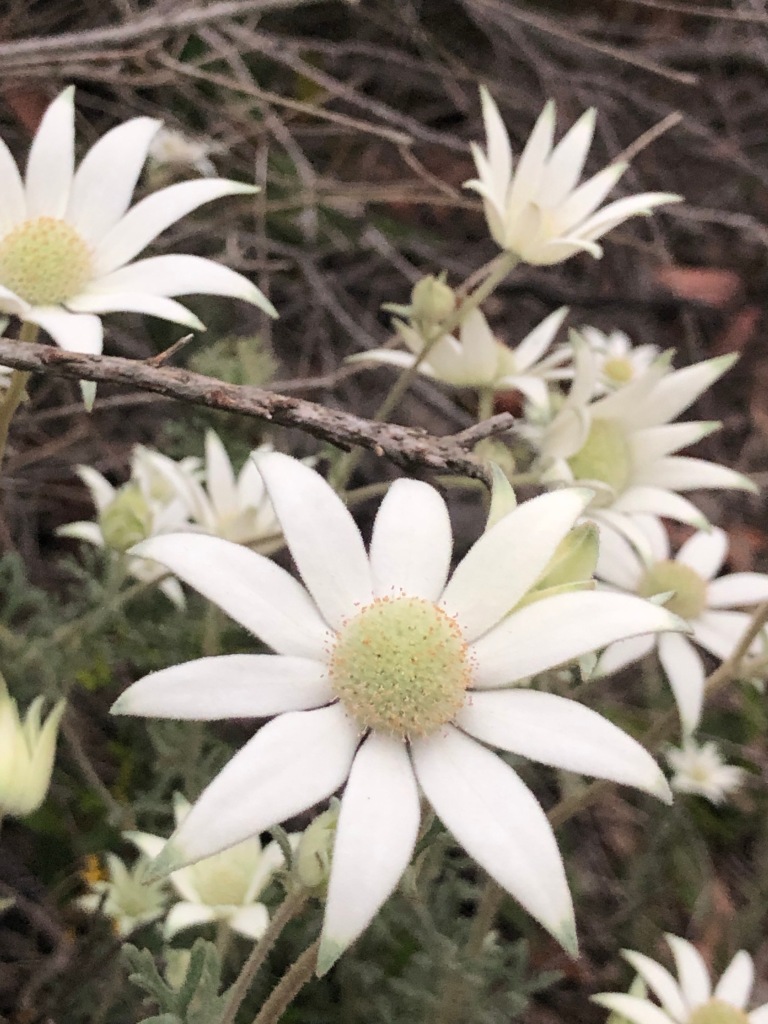
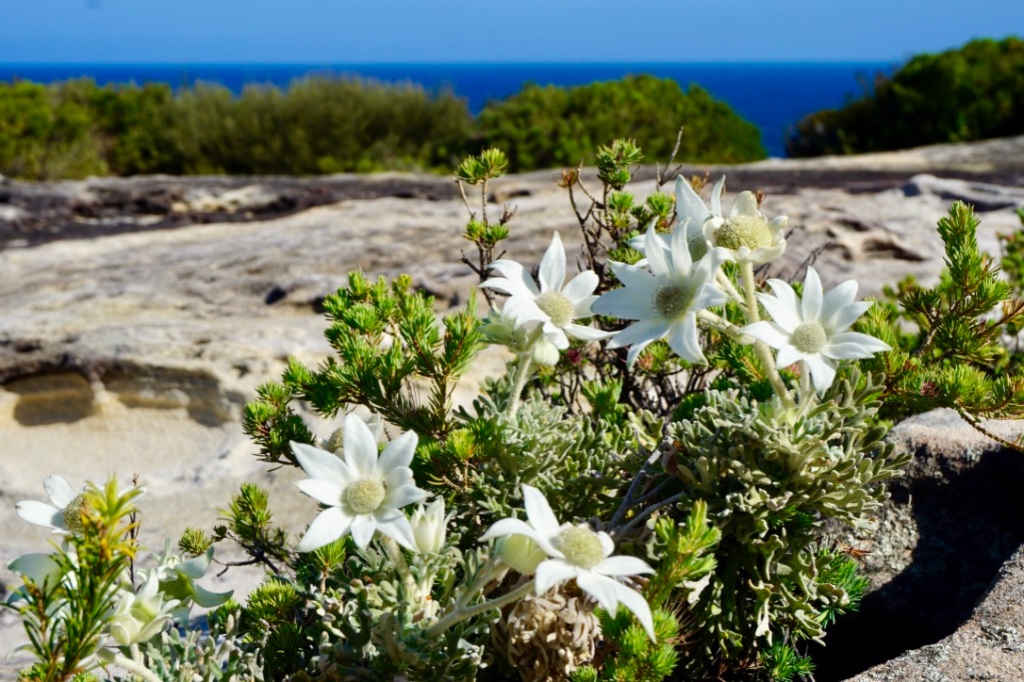
Flannel flowers were always highly prized in my childhood. With their creamy-white star shapes and grey-green foliage, they seem so insignificant and plain, until you touch them and you can feel the soft, velvety fabric feel that gave them their name. On close inspection you can see the pale green tips to each petal, and an echo of the same pale green in the centre of each flower. The daisy-like flowers point to the sky and a profusion of flowering occurs in spring and continues through to Christmas. However, in some secret places, I have found flannel flowers almost the whole year round. When the plant has finished flowering, it is almost impossible to find, even when you know where to look. Often there are other white flowers that distract and confuse — white spider flowers, for example. For me, the flush of flannel flowers lifts my heart because my favourite times are the warmer days, and flannel flowers give me notice to prepare for holidays and sunshine.

Fabulous flannel flowers!
Eucalypt flowers like a bridal veil.


From the late winter flowering of “eggs and bacon” which continues through the summer, to the various wattles which light up the bush with gold that looks so much better where it grows then even in a photograph. As a child I wanted to bring some home to my mother, who loves flowers. The springy, tough branch wouldn’t pick easily and I had to twist it, to wrench it free (losing a lot of the fluffy yellow blossoms in the process). When I arrived home with an armful of flowers for my mother, she immediately ordered me outside with it. Wattle drops flowers when in a vase, and my mother also blamed much of her asthma problems on wattle flowers. We now know, erroneously.

Wattle in bud — macro photo.
Deep inside a wattle bud — microscope photo.

At any time of the year, wattle is in flower, one variety or another. It is so distinctively Australian, our “green and gold”, like the sunshine of summer.

Fragrance is not something we usually associate with Australian flowers, but wattle, and even eucalypt, has a strong honey perfume when in flower. Australian honey (made by European honey bees which were imported in the early days of colonisation) has a stronger flavour than the delicate European floral honeys.

Many Australian native animals, birds and furry creatures, often feed on the abundance of nectar from many Australian flowers. Waratahs and Gymea lilies can visibly drip with nectar. And if you ever get the chance to get up close and personal with a brushtail possum you can smell the honey on its breath.

In our backyard, which has remnants of native trees and shrubs which we never cleared, the Christmas bush is in the first white flush of flowers. Most people know the Christmas bush as a profusion of tiny salmon-red bracts, overflowing vases on the Christmas dining table. But the true flowers are the white buds which cover the trees from September.

Christmas bush flowering early. The salmon-pink bracts come later.

As we drive through “the bush” we watch the seasons ebb and flow. There is always something in flower at any time of the year, and we watch the landscape change in colour and form, and mark the passage of time.

Flannel flowers on Sydney sandstone.