Italy and the Selfie Queen

When travelling to different places it’s important as a writer to watch and listen. It also helps to get to know people, to find out about their understanding of the place. Maybe they live there; maybe they’re new to the place too. It’s all useful. Even time spent waiting can be put to good use. Writers should never pass up the opportunity to investigate a new character.

We had met fellow travellers on arrival at the airport in Rome. We sat with our bags, each with the distinctive red tag of the tour company identifying us as members of the same group. One man was travelling with his teenage grandson and we chatted to them both while we waited for our transfer.

At our hotel we met our first interesting Roman character — the tour company representative. Glamorous in a Zsa Zsa Gabor way, she called us all ‘darlink’ and had a very picturesque way of talking. She explained the benefits of being part of an official tour group. ‘My darlinks, in Rome on tours we have ze happy line and ze sad line. You will see zat ze sad line is very long, you wait in ze sun for hours. But you, my dears — you vill be on ze happy line!’ And she clapped her hands in delight.

And so it was. Organised tours would be allowed to arrive before the official opening times and be ushered to a special gate while individual tourists waited in the heat and glared at us.

Our tour guide in Rome was delightful and informative. Dapper and chill in a white linen suit and sunglasses, he showed us the safest way to cross the road in Rome. Of course, use a pedestrian crossing, but don’t assume the cars will stop. ‘You step out,’ he said, ‘and glare at the cars. Hold up your hand to indicate “stop”. Then you sneer, maintain eye contact, and walk across the road boldly, with confidence. That is how we do it in Rome.’

On tour we got thrown together with other members of our party. Besides the grandfather and teenage grandson who sat with us at Rome airport, slowly the group assembled. Later on the coach we chatted across the aisles in the stop-start heavy traffic.

The glory of Rome is easier to see on tour.

One woman on our tour was memorable. Before taking a selfie in front of yet another Roman monument she would use her phone as a mirror, adjusting her hair, the angle of her sunglasses and touching up her lipstick. Then she would take time to carefully position herself and suddenly paste on a happy smile. Click! Maybe again. Then she would stand a little longer in front of the monument in question while she checked that she had caught precisely the look she was after. Only when satisfied to her exacting standards would she move out of the way and let the rest of us in to take the snaps we wanted of the monument.

I grew to really hate selfies. At Trevi Fountain there were so many people doing the same thing that you couldn’t get near it. All the people standing beside the fountain had their backs to this marvellous work of art and were smiling idiotically into their phones.

Trevi Fountain, Rome. So much beauty and they have their backs to it, looking into their phones.

We had been warned of the crowds when we went to the Vatican. Zsa Zsa had organised ‘ze happy line’ for us but even that snaked around several corners. There were thousands of people there already, many more in ‘ze sad line’ which did not open until an hour after our special early entry. During the day there would be tens of thousands more, all queuing in the intense summer heat. Offer your suffering up to God, my children …

The early morning queue for the Vatican, Rome. The bright scarves on the end of selfie stick poles are the tour guides’ way of keeping track of their charges. This, believe it or not, is ‘ze happy line’.

Once we got in, the magnificence took our collective breath away. The coolness from the thick stone walls was also welcome. The guide explained that the Pope was away on tour, and our selfie queen lost it. She thought ALL tours included an audience with the Pope. I have since checked the website (easy to do — why hadn’t she done it?) and found that if you want to see the Pope (even from a distance) you can either attend Angelus at midday on Sunday, or come to St Peter’s Square in the Vatican at 10 am on a Wednesday. Tickets are free but need to be booked months in advance. Security is tight, you arrive two hours before the Pope arrives and he is there (as are you) for about ninety minutes. The advice is to find an observation point where you can see a big screen, because the Wednesday audiences in St Peter’s Square can have up to 300,000 people. A chance to press the Papal flesh is most unlikely.

Our entire tour of the Vatican was ninety minutes. It was nearly much shorter, as our selfie queen became increasingly shrill and demanding. She MUST meet the Pope! Some purple-and-orange-clad Swiss Guards moved in and suggested that if the selfie queen could not behave with decorum, she would have to leave. She tried to explain that she had travelled from America to Rome, on a sort of personal pilgrimage, having told her friends and family of her intention to meet the Pope who, she was sure, would undoubtedly recognise and value her piety and humility. The Swiss Guards were unimpressed, they had seen it all before.

Swiss Guards are not just decorative. They are a highly trained security force.
Never underestimate the funny pants.

Later that day our selfie queen was back in control of herself. During a quiet moment on the bus, she told us of her uncle who was a bishop, and how she attended church every Sunday and was a good Catholic. The tour guide walked past doing the bus head count and the selfie queen broke off from talking to us mid-sentence, to impress her self-importance on our preoccupied guide.

We were glad to leave Rome (and the selfie queen) behind. She was taking the leg of the tour going to Florence, while we continued on to Venice with Grandpa and Grandson. We spent a happy time with our new friends on the train and once again were sharing a hotel, a lovely converted Benedictine abbey near the Grand Canal. We spent an enjoyable three days but on our last evening we returned to see the next tour group arriving. And there in the group in the hotel foyer which we had to walk through, was the selfie queen. We pulled our hat brims down, muttering, ‘grazie,’ as the crowd let us through. We did not want to attract her attention and hear again about her uncle the bishop.

Venetian masks. I wished I was wearing one when we crossed paths again with Selfie Queen.


Next morning at breakfast I was horrified to see Selfie Queen sitting at the next table, an elbow jog away. We determined to eat quickly and go, we had a train to catch and didn’t want to get buttonholed into a long conversation about personal holiness. Towards the end of our meal I went into cold sweat mode when she leaned across to me.

‘Can you pass the salt?’ she asked.
‘Certainly, here you are.’ I handed it over.
There was not a flicker of recognition.
It figures. She only ever saw herself.

Beggars, scammers and pedlars

They say travel broadens the mind. It also shrinks the wallet. They also say a fool and his money are soon parted.

The same goes for tourists.

We met a lot of beggars in our travels. Many of them were strategically placed to maximum impact in the most touristy places. The most photogenic and/or the best performers were in places like the entrance gates to the Vatican, or outside the main cathedral of a city. Prime position. We watched two beggars arrive at the Vatican. We had arrived early, part of an organised tour that was beating the queue. These two walked in, clearly friends. One was a double amputee and was wearing curious round leather slippers over his stumps. The other had some very picturesque lumps on his head. When we next saw them, as our queue to get past the queue (Rome is a funny place) snaked past these guys, they had transformed themselves into exhausted, starving, desperate individuals. The amputee was sitting, crouched prostrate across his stumps, his slippers hidden underneath him. He lay there sobbing, moaning and begging for coins. The cap in  front of him was filling. The man with the lumps on his head was similarly distraught on the cobbled courtyard, wailing and sobbing. Our tour guide said to us in disgust, ‘He tells people those lumps are cancerous tumours and he has only a few months left to live. He’s been saying that for the last five years. And those lumps change position.’

The queue to get into the Vatican gave us ample opportunity to observe beggars and pedlars.

That night I did an online search for ‘Vatican beggar amputee lump’ and got hits mentioning both these men, including claims that they were often seen arriving in taxis.

In various European countries it is actually illegal to buy anything from street pedlars, just as it is illegal for them to be begging or selling items on the street. In hot weather, bottles of water are often offered for sale, at two Euros each. But it pays to check — when you buy a bottle of water, especially at such prices, it should be properly sealed. These gypsies will pick empty bottles out of the bins and refill them from the many free water sources for which Rome is famous. So for your own safety, check that the bottle is sealed. And best of all, buy from a shop and not a street pedlar.

Many years ago a friend of ours who worked with street people in Sydney warned us, ‘Never give them money. It’s often not what they need anyway. Give them food, buy them a coffee, but don’t ever hand over cash.’ So we’ve followed that principle even in our travels.

In Paris the street pedlars were everywhere. They had their wares spread on blankets on the ground, various cheap trinkets, models of the Eiffel Tower that flashed multi colours. The blankets had discreet handles on the side so if the tourism police came by, the pedlar could sweep everything into his blanket, grab the handles, and run.

A visit to the Louvre means running the gauntlet of many aggressive pedlars.

Tourists are prime targets. We’re suckers for souvenirs, we don’t necessarily know the local laws, we’re generally feeling right with the world and approaching our novel experience in a generous spirit. So it was no surprise to me on an early morning bus tour of Paris, to see the pop-up street vendors set up shop so promptly on our arrival. Our bus arrived at Napoleon’s Tomb at 8.30 am, with deserted streets. Within minutes of us getting out to take photos, several hawkers were set up and selling flashy Eiffel Towers and one pedlar had a neat stand-up portfolio of artwork for sale. Even our bus driver was tempted, calling over the art seller to haggle over a poster.
We drove off after fifteen minutes and a glance out the window showed the street pedlars efficiently grabbing their goods and moving on, texting on their phones. When we arrived at the Eiffel Tower fifteen minutes later, other pedlars arrived within seconds. I think they had been told of our next destination by their friends at Napoleon’s Tomb.

Pedlars moving on when the busload of generous tourists moves on. Napoleon’s Tomb, Paris.

On another occasion we were walking by the Seine, just the two of us. The gravel path was wide and we saw an unusual woman approaching a gold ring on the ground. She had yellow hair, with distinctive close-set almond eyes. We saw her stoop and pick it up. ‘Oh, so lucky!’ she exclaimed. ‘Here — I give you this luck!’ She showed me the ring. It felt heavy and as I examined it closely, I could see a hallmark inside.

‘I give it to you!’ she said again.

‘I can’t take this, it looks like a man’s wedding ring,’ I replied. ‘It looks valuable.’

She continued to urge me to take the ring. ‘No, it good luck. Your good luck. Your lucky day!’

I said, ‘We should take it to the police, hand it in.’ Yes, I was by now very suspicious, but the ring did look valuable.

At the mention of police, she shrank back. ‘No, I no go police. No papers.’

So I said, ‘Fine, I will take it to the police myself.’

She nodded and smiled, then as we began to go, she said, ‘I am very hungry, I have no food for three days.’ Now, she looked very well nourished, absolutely no way was she starving. But she was increasingly demanding and standing in our path. She wanted a couple of Euros from us for food, she said. Normally I would carry an apple or bread roll from breakfast to give to a beggar who wanted money for food. This time I was caught short. It was also clear that if we left with the ring, it would go badly for us. She could accuse us of theft, she might have an accomplice tail us and get the ring back from us. Or worse. So I reached into my pocket (where I had put the ring) and took it out, palming it so she would think I was handing over money. I pushed the ring into her hand and folded her fingers over it. ‘Take this to a café,’ I said to her. ‘Give it to them. They will give you bread.’ Then we walked on, not daring to look back.

When we later looked up the scam, it came in a number of guises. If we had given her money, someone nearby would undoubtedly have been watching to see which pocket we kept our money in. The ring was likely to have been a crafted fake, made of brass and stamped with a fake hallmark. Other scam-busters have rubbed rings like this on a nearby rock to scratch it and identify the base metal. This also ruins the ring for repeat scams and incurs screaming rages from the scammer.

Later that night we were walking back to our hotel and heard someone following us in the dark. A nearby tourist stall was brightly lit and we stopped in the light, going in to look at the wares. As we entered I turned to see a couple of men, heads covered with hoodies, walk past. Then a minute later the same men walked back. We waited a few minutes then quickly moved on.

This brazen pedlar leaned against a ‘Do not buy from street sellers’ sign as he tried to sell us tickets to the Louvre.

We had no pockets picked in our travels although we did get sort of scammed by a couple of children in Athens (‘pretty lady, you want flower?’ and then demanded money). It was early in our travels and I didn’t know any better. The kids had probably filched the flowers from a compost heap somewhere …

We saw few beggars in Greece but a lot of people trying to sell flowers, painted rocks or their dubious musical talents. One old man in Paros sang a song about someone called Maria. He would sing a few bars then play the clarinet for a few bars, then repeat ad infinitum until people paid him to go away.

On our last night in Paris, our tour group went to dinner for a French experience. As we arrived, we were serenaded by a piano accordionist with the same unusual yellow hair as our gypsy lady with the fake ring. The guy attached himself to me and, once he found out I was Australian, kept calling me Skippy. I thought he was employed by the café, but then he passed the hat around. We’d all been scammed, with the connivance of the café. With so many American tourists in our party, the guy made a lot of money from his informal gig. And no overheads!

One thing I’ll say for him — what he lacked in talent, he made up for in volume.

When in Rome, be a Roman candle…

Travel tips for writers

Travelling and writing means having to deal with the conflict between, ‘There’s so much to see!’ and ‘I want to write, there’s so much to jot down!’

To maximise your chances of packing in as much of both as possible, here are some tips.

Learn the language. I’ve already written about this. It enhances your experience and often it saves a lot of time and frustration. It shows respect. There is an added benefit in learning a little more of the stories around you, and the people you meet. Even a chance conversation can be an adventure.

My husband, with some of Athens’ finest. One of these young men was from Crete and we chatted about his island and the people. They had a busy day coming up but were happy to give us a quick chat.

Listen to the people around you. Some people are tourists, some are locals. Some speak English. Many don’t. Even if you don’t understand the language, listen to their tone. Watch their body language. Even the horrible people you encounter will add value to your writing. We were in a tiny hotel in New Caledonia and two young women were on duty on the desk that doubled as the servery for the restaurant. They were clearly in charge of the music for the restaurant and were thoroughly enjoying what I can only describe as French Country & Western. They were unable to disguise their joy in it as they jigged around behind the counter while watching to see if we needed anything. We were in beef cattle country on the island and they served the best steak, and the worst music, we’d had in a long time.

Pack layers — weather may vary considerably from what was expected. Several lightweight layers will not only provide a lot of warmth, you can shed one or more if it warms up. I found a thick shawl that also kept off a light rain. When not needed, lightweight layers can pack in tiny corners and be used to wrap delicate souvenirs.

Piling on every possible layer in the cold. T-shirt under the dress, jeans and leggings, last-minute-packed cardigan, , heavy wool shawl which doubled as blanket on the plane. Scarf, hat, gloves. It’s summer, folks!

Get a local SIM for your mobile phone. Check, before you leave home, that your phone will still function after you change SIMs. If it’s network-locked and shouldn’t be, sort it before you leave. If it can’t be sorted, borrow a phone that can take the local SIM. We used our phone for local calls, for SMS (to a phone using an Australian SIM on roaming, which can receive SMS but not respond to it).
If you try to use local data on your Australian roaming phone, be aware that if your phone gets thrown off the local network you’ve patched into, you might unknowingly activate your daily roaming. Even at only $10 a day, that can be expensive on a long journey.

Using local data, you should be able to access navigation on your phone. We also had a GPS with us which was a surprise on the high speed trains. We had intended to use it to see when we crossed borders, or to pinpoint our location. It was an unexpected giggle to be told that at 300 km/hr we were in excess of the speed limit for the freeway beside us.

Read the Terms and Conditions. The most commonly told lie in the world is, ‘Yes, I have read the terms and conditions.’ But when I checked the fine print in Hong Kong (we arrived the day before the first big demonstration) I realised that the level of surveillance was set to Extreme Mode. ‘We will monitor your Cookies and browser usage for your protection.’ Needless to say, I was very careful about anything I posted.

Plan your writing time for long train trips or plan trips. Any long waiting time. Don’t forget to look up occasionally and admire the scenery. Have your laptop, notepad or Dictaphone in easy reach and ready to put away fast. My laptop has its own shell that lives in the top of my cabin bag. When travelling, it’s the first thing I can reach when I unzip my bag — easy access at airport security. On a plane, there’s always the cabin bag. On a long train trip we’d have all our bags with us. Laptops would come out and I’d already have planned what I could do with the battery time available. On some trains in Europe as well as many planes, you can plug in to power, so a six-hour trip could be very productive.

Snow in summer, in the Alps. Shot from a moving train.
Always remember to look up from your writing now and then.

Take a power board for your home plugs and then you only need one adaptor, not loads. Check voltages too — some countries have lower voltages so charge times may be longer. If you’re going to a country that has very low voltage compared to what you’re used to, you are likely to need a voltage converter as well, although most electronics these days will manage.

Explore unfettered. At the destination I would leave the laptop in the hotel room and go out to explore with just a small bag containing my phone, my camera and, nestled in my pocket, a small sound recording device. Take plenty of photos — not necessarily to show other people, but to remind yourself of the details later on. You’ll be able to walk further with less to carry.

Normandy landing beach, St Laurent-sur-Mer. Divest yourself of baggage and just explore…
By the way, same dress as cold London, but without the layers and the jeans.

Eat local. Be prepared to try the local food. It’s often cheaper, it’s likely to be fresher, and if it’s what the local people eat and they’re giving the restaurant repeat business, it must be acceptable. Over the road from our apartment in Chania in Crete was a small baker with the best bougatsa. That’s a delicate, flaky warm pastry filled with mizithra, a ricotta-like cheese made from goat’s and sheep’s milk. Sweetened, spiced with cinnamon and served warm with a strong Greek coffee or Nescaf frappé, it was a perfect breakfast.

Sharing a perfect bougatsa in Chania, Crete.

Eating local can also let you down a bit, but it’s all experience. In New Zealand, I had a memorable lunch when I tried whitebait fritter sandwiches in a small railway café in Greymouth. I can’t blame the whitebait, but putting the poor things in a fritter and serving it between two slices of soft white bread was Stodge City. I can say I’ve tried it, I know to not repeat that experience.
Satay in Singapore was best at the Satay Club, a collection of street stallholders down near the harbour. It was by far our cheapest meal, and one of the most memorable, looking across to the Merlion, the symbol of Singapore, cooled by a breeze off the water and sipping fresh coconut water.

In London on a cold, rainy day, we warmed ourselves by the fire in an old English pub and ate beer-battered cod and chips while we shamelessly eavesdropped on conversations.

We’ll be dining out on our travels for a long time.

For adventure — learn the lingo!

If I’m travelling to a place, I will try to learn some of the language. You don’t have to become fluent, but there are some useful basics and it’s good PR to try. I always say, if you learn, ‘yes’, ‘no’, ‘please’, ‘thank you’, and ‘where is the toilet?’ in the language of your destination, it will be very useful.

Of course, a little more than that is even better. Being able to order a meal in a restaurant, to check into a hotel, to catch public transport — there are so many situations where a little of the local lingo goes a long way.

I did study French and German at school, but for years it was so rusty as to be almost useless.

‘Beware of the Dog’ in French; translates directly as ‘attention wicked dog’.

About ten years ago we had a two-week stay in New Caledonia — a French-speaking colony in the South Pacific. I had a free CD from a Sydney newspaper with a one-hour language lesson. In New Caledonia we quickly found that, once away from the main city (Noumea) people did not speak English. The one-hour lesson had included phrases to help you book a hotel or order in a restaurant. However, we found there were local differences. Rather than being daunted by these, we had to approach them from a sense of adventure. Want coffee with milk? The lesson said to ask for ‘café au lait’. But in New Caledonia, that got us black coffee. So we learned to ask for ‘café avec du lait’ specifying ‘avec’ = ‘with’. This meant that now half the time we got coffee with milk. An improvement. As it turned out, there is no fresh milk on New Caledonia, which is why they drink their coffee black. They only have powdered milk and condensed milk. The swankier hotels provide jugs of reconstituted powdered milk. All the cattle we saw, beautifully kept beasts, were for the beef industry there.

Most of the hotels had free wi-fi, but away from the hotel there was nothing. We had no functioning mobile phones. But we did have access to Google Translate so when communication needs became more technical in hotel check-out, we sat in the hotel lobby and typed in English and showed the French translation to the hotel staff member. She read it, nodded and smiled, then typed her response — in French. Google Translate gave us a close enough interpretation of her words so that we could understand.

That was us managing with a little bit of French. On our way back to Noumea, we stayed in a small hotel in a regional town. The hotel front desk was also the servery for meals in the restaurant. Next morning as we were checking out, we saw a New Zealand couple having breakfast at their table right next to the check-in counter. They were there to see the war museum. The old man was struggling with the language barrier. ‘Excuse me, love,’ he said to the receptionist. ‘Do you have any lait?’

The girl looked confused.

‘You know, lait for my coffee. Ya got any?’

We stepped in and translated. ‘Avez vous du lait pour cette homme?’ (Have you any milk for this man).

The girl smiled, nodded and disappeared into the kitchen, returning with a jug that we were certain had been made up from powdered milk.

‘Ah, lovely,’ the bloke said to the girl. Then he turned to us. ‘I knew if we insisted, we’d get some fresh milk at last!’

We didn’t tell him. It would have been like kicking a puppy.

When travelling, I planned ahead. Once we knew when we were leaving, I started studying. Our first trip in years — Greece, then working our way across Europe to a family wedding in England. So from the time we booked the trip, I started studying Greek. Not easy. It’s an old language, it’s had millennia to get complicated. Thanks to my science/maths background, I already knew the alphabet. Online lessons with DuoLingo are free and can be done in as little as five minutes. Whenever I felt disheartened by Greek, I brushed up my French and German.

When we arrived in Athens, everyone spoke English. But on the islands older generations struggle with English and our old friends spoke no English at all. Their children did, thankfully. But when we were without a translator, we relied on non-verbal communication plus the few words we had managed to learn. ‘Καφέ? Ναι, σας παρακαλώ.’ (Coffee? Yes, please.)

About a week before leaving Greece, I stopped my online Greek lessons and switched to Italian. Then, a few days before leaving Italy for Austria, I started studying German. Then in Switzerland, I made the change to French.

By the time we arrived in France, I thought I was ready. But as I opened my mouth to speak to the taxi driver at the train station, my brain froze as a jumble of Greek, Italian and German began competing with French for my head space. The taxi driver then abused me for not speaking French. ‘You tourists — why do you not try to learn a little of our language, eh?’ he spat. ‘You are in France — you must speak French!’

Cette chauffeur de taxi étais un cochon…

‘You are in France, you must speak French!’ Even a little — un peu— is worth the effort.

This year on a tour of Normandy, we also saw the Bayeux Tapestry. Our tour guide, who did her best to hammer some useful French words and phrases into our collective brains, explained, ‘it is the BAYEUX Tapestry, like “by-yer”, not the BAYOU Tapestry. It is not about a swamp.’

Despite this, all around me many of the other travellers were talking about the BAYOU Tapestry.

I quietly said to a fellow traveller on the tour, ‘I think I’ll draw our tour guide a picture of the BAYOU Tapestry.’

My friend said, ‘Oh, you’ve seen it before? You can draw it from memory? Wow!’

I replied, trying to hint broadly, ‘Once you’ve seen one swamp, they all look alike.’

On the bus I quickly sketched the cartoon on hotel notepaper. The tour guide chuckled quietly and tucked it into her notebook. At least her pronunciation lesson had reached one person.

‘They are looking at the Bayou Tapestry’. Quickly scrawled on the bus using hotel notepaper.

I hope it made her day. We really were a very trying bunch of tourists.

A Special Reunion

I mentioned six weeks ago that the culmination of this trip was to be a reunion of Armstrongs, on historical, traditional lands in Scotland, on the fiftieth anniversary of Neil Armstrong landing on the moon. Sounds potentially dull, doesn’t it?

It was anything but.

It is daunting to travel halfway around the world. It is even more so, when the people you’re going to meet are all strangers. We’d corresponded with maybe five or six of them over the years.

This was also our first time in Scotland. When we first arrived we’d travelled to Invergarry to meet up with cousins (who, sadly, were not going to the reunion). They gave us our first taste of Scotland. But the highlands are very different.

We’ve worked our way around UK and France before heading back to the reunion. We drove the last leg from York, arriving on the Thursday afternoon. The events were all due to start on the Friday evening, but we wanted our own preview of the countryside and Armstrong sites.

The reunion was held in Lockerbie, a border town in Scotland which received notoriety it never wanted when a terrorist brought a plane down in December 1988. We drove through the damp evening streets on Thursday, trawling for food. The place was quiet, empty. A few cars were parked, we didn’t see any people around on the street. A couple of fish ‘n chip takeaway shops were open. We grabbed some food and headed to a nearby hillside to eat before going back to the hotel. The town of Lockerbie felt like it still has a generation-sized hole in its heart.

Gilnockie Tower in Dumfries, Scotland. Recently restored, a delight to visit.

The next day we drove to some of the places we’d come to see. I wanted a tartan shawl to wear to the clan gathering and the best place to get Armstrong tartan would be Gilnockie Tower.

Gilnockie is a pele tower, a kind of fortified multi-storey house which was the seat of operations for Johnnie Armstrong, also known as John o’ Gilnockie. This area is in the Debateable Lands where, for a time, neither the laws of Scotland nor the laws of England were followed. It was lawless there, with theft, pillage and racketeering rife. One of the biggest racketeers was Johnnie Armstrong and his clan. It was survival in a lawless area. Livestock would be raided from south of the border, and then be raided back in turn. Allegiances would ebb and flow with the seasons, the tides or any other random variable. Gilnockie Tower was attacked numerous times but it was a strong fortress. Finally James V, who saw the lawless Armstrongs as a threat to his power, invited Johnnie Armstrong and his retainers to a formal welcome event, a celebration. They walked into an ambush, a grand necktie party. It turned out that what James V intended celebrating was the death of Johnnie Armstrong.

At Gilnockie Tower, we saw preparations in place for the weekend celebrations. Down in the meadow below the tower, a marquee was being erected. Portaloos (also called ‘Border Loos’) were being delivered.

The tower itself is one large rectangular prism of stone, rising from the hilltop. It has been thoroughly and lovingly restored. There is a shop on the ground floor where we found various items including the tartan. They invited us to go upstairs, waiving the usual entry fee because we were members of the Armstrong clan. The ground floor, in Johnnie Armstrong’s day, would have been the kitchen and perhaps at times, somewhere for the animals and/or guards to sleep on the coldest nights or when under siege. On the first floor was the great hall, where soldiers would eat, sleep and live also, and where plans were made, plots thickened and raids organised. The spiral staircase was completely enclosed in one corner of the rectangular tower.

I could happily spend the night in the laird’s bedchamber.


On the next floor was the laird’s bedchamber. There we found a garderobe — a medieval toilet that would have been behind a curtain in the day. As with the staircase, the garderobe was also was completely enclosed within the tower wall.

The floor above the bedchamber was a museum to the history of the Armstrongs, including the building of the tower and right up to Neil Armstrong. NASA had sent the clan a footprint from Neil Armstrong’s space suit. This is proudly displayed in the museum room, along with photos of Neil Armstrong visiting Lockerbie and being given the key to the town. There is a story that Neil Armstrong took a piece of Armstrong tartan to the moon and left it there. This is a strongly held belief in Armstrong territory, but it is difficult to confirm. However, it is nice to think that ours is the first (and only) tartan on the moon.

The next level was just under the tower roof; this weekend it was a ham radio station. We had been warned to not disturb these guys, but they welcomed us in when they realised Jeff was a former signaller in the Australian reserve forces.

From this attic room, there is a door leading to the guard walk just outside. The views are spectacular, but the parapet is very narrow. A higher railing had just been installed, not even officially open.

The restoration of Gilnockie Tower is very complete. Apart from the lack of modern plumbing, it is very liveable. In these modern times the prospect of siege is unlikely, so to reduce draughts the windows and arrow slits have been double-glazed.

Back in the shop, we made our purchases and left, knowing we would be back over the weekend.

As we drove around looking at the sights, we saw the name ‘Armstrong’ on a number of businesses. The clan is going strong. As we arrived back in the hotel we saw people gathering there. Some were checking in, others were staying at a nearby hotel and had come for dinner.

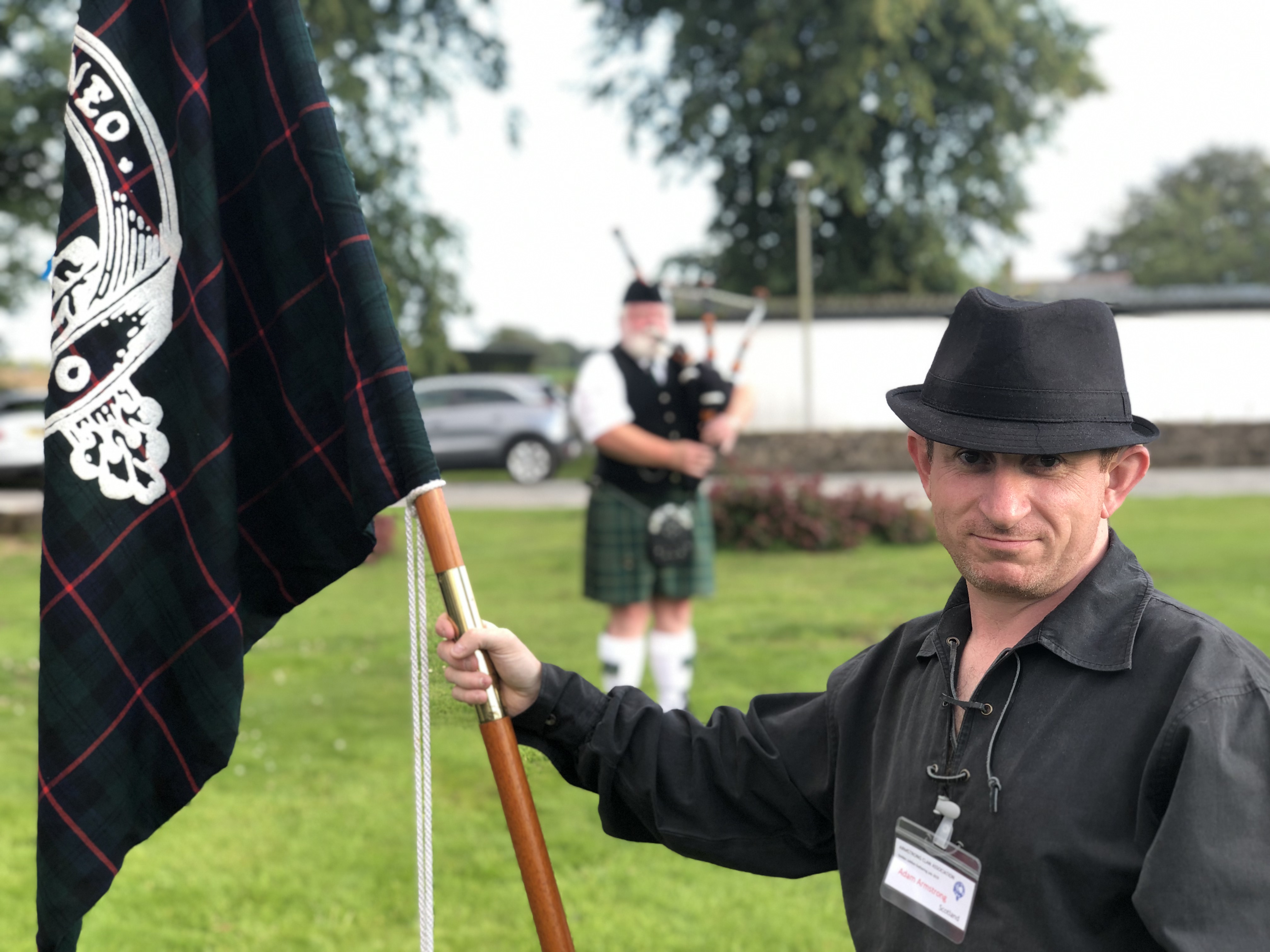
As we were piped in to dinner, Adam Armstrong-crisp, local historian and tour guide, proudly led the way.

It was an amazing weekend. Although we arrived not having met anybody, by the end of it we had become firm friends with so many Armstrongs from around the world as well as in the local area. There were celebratory dinners and a festival back at Gilnockie Tower on the Sunday.

We had to leave on the Monday — sad to go. On our way out of Lockerbie we stopped off at the cemetery where there is also a memorial to those killed when the Pan Am plane crashed into the town. Most of those killed were on the plane, but the scar still runs deep.

Someone dropped a painted rock in the Lockerbie Memorial Garden.

There are many scars in this area that run deep through history. The plane crash is still fresh, but town pride and clan pride go back for centuries. It’s a beautiful place, with hidden treasures. Healing can take a long time, but the Armstrong motto is always in mind. Invictus Maneo — I remain unvanquished!

Guédelon Castle — Living Archaeology

We’ve seen ruined castles from long ago, modern follies built with modern materials, and archaeological digs which need a lot of imagination and understanding to work out what it must have once looked like. Some are simply castles in the air. But Guédelon — this is a castle firmly planted in the earth.

Guédelon is a castle being built now (construction began in 1997) but in keeping with 13th Century design and using 13th Century materials and methods. A lot of these methods are having to be re-learned. But nothing is permitted to be used (including knowledge) unless it was known to those in the 13th Century.

How do you get scaffolding and shaped stone to where it’s needed? The treadmill is the medieval crane. Here are two treadmills side by side.

Often when you visit a historical site and there are people wandering around in appropriate period costume, they are actors playing a role. If you take their photo they sometimes carry on as if you’re stealing a piece of their soul. Ask them how to get a job like theirs, and they answer in character. But at Guédelon, while they may in various ways be characters, they are very much themselves. This is real. Carpenters, blacksmiths, carters, rope-makers, millers, weavers, bakers and more, all actively practicing, and learning, how it was done way back when. And this knowledge is having unexpected bonuses.

To build a castle takes a town. And in the building of a castle, a town will form and grow. First you need the desire. Then you need the stonemasons and carpenters. The carters to haul the loads; the blacksmiths to forge the nails, to make the hinges and other metalwork and to shoe the horses; the foresters to cut the wood, to produce the charcoal for the blacksmiths and the other crafts; the cooks and gardeners, to feed the people; the fullers, weavers and dyers to clothe them. And so it grows, and so Guédelon is a working example of all these crafts learning by doing. A number of these crafts have to work in cooperation — carpenters, stonemasons and blacksmiths all work as a team to make a door. We watched a carthorse back a cart precisely so the workers could shovel rubble on board to take it away from the construction site.

The side passage to the private quarters from the great hall. See the glimpse of the great hall to the left. There is also a chapel accessible in the tower at the end of this walk.

We continued our exploration, heading down to the new mill where we also saw a pole lathe set up. The miller was there, explaining the problems they’re experiencing with the mill during times of low water levels. We discussed torque, energy conversion rates and maintenance issues. You can buy milled wheat from Guédelon, the grain is grown there too. It’s all part of the exercise, in learning to understand all the issues around building a castle in the 13th Century.

The mill. It is adaptable. It can grind grain (for which the castle would charge a tax), it can drive a lathe or a saw.

They have discovered, however, that they need a back story. The fictional lord who has arranged for this castle to be built, needs to be kept in mind. He is a fairly ordinary feudal lord who was given permission to build a castle. But he is not immensely wealthy, nor does he have a huge army. So the work has to reflect his lack of wealth. For example, they found early on that the stonemasons were doing too perfect a job for someone of our fictional lord’s status. The work began in 1228 (fictionally) and for each year that passes in construction today, a year passes in the fictional world. So the castle is expected to be completed in 2023 in our world, which will be 1253 in the 13th Century world.

As with the fictional lord, the site for Guédelon was chosen because of the availability of raw materials — timber, stone, sand and running water.

Guédelon is described as a Chantier — a construction site. And that is very much what it is. When you see scaffolding being built, or bread being baked, it is not just for show. The bread feeds the workers — when the bell rings at 1 pm, the workers stop for lunch.

The oak ceiling in the great hall. The room is set up for a banquet.

The scaffolding is a genuine aid to construction. In the Great Hall we saw an oak hammerbeam ceiling. It took a forest of oak trees to build, a lot of swearing and discussion, a lot of cooperation with blacksmiths (because who else maintains the edge on tools?) and, at the end of it, a lot more knowledge gained. And when historical buildings need repair or restoration, the skills and knowledge will be there. We have been told that authorities have already spoken to experts at Guédelon about what they will need to begin replacement of the oak hammerbeam ceiling in Notre Dame, so tragically damaged by fire a few months ago.

Guédelon Castle — an exciting glimpse into construction of the past.


There is no better way to really understand history, than to live it.

For further reading, check out:
https://www.guedelon.fr/en/

Wartime Remembrance

On our tour of France, we covered a lot of French history, mostly medieval and renaissance. But occasionally we passed a war memorial and our tour guide made reference to it. As we drove into Tours, the US war memorial was emblazoned, ‘1917–1918’ and I thought, ‘Another war the US was late to.’ But perhaps that is a bit simplistic. If the US had entered both world wars sooner, what would have been the outcome in each case? It’s not such an easy answer.

On our second-last full day of the tour we started our study of war with a visit to the Bayeux Tapestry. It’s surprisingly detailed and graphic. In a sort of MAD Magazine, Sergio Aragones style, the borders of this embroidery work at first showed hunting birds, animals and trees. But as the battle developed into its full fury, the border below is littered with bodies and pieces of bodies. The final scenes show these bodies stripped and abandoned. Perhaps this is one of the earliest well-known examples of war propaganda.

Bayeux Tapestry. Harold gets it in the eye after breaking his oath to William and stealing the crown. Justice from heaven…

After this we went to Utah, the first of the D-Day beaches. Since most of our tour members are from the US, the focus was exclusively on the US involvement in D-Day. We were prepared for an overload of emotion and jingoism, but there was none of that. Quiet respect, primarily. And from all tour members, including the Aussies.

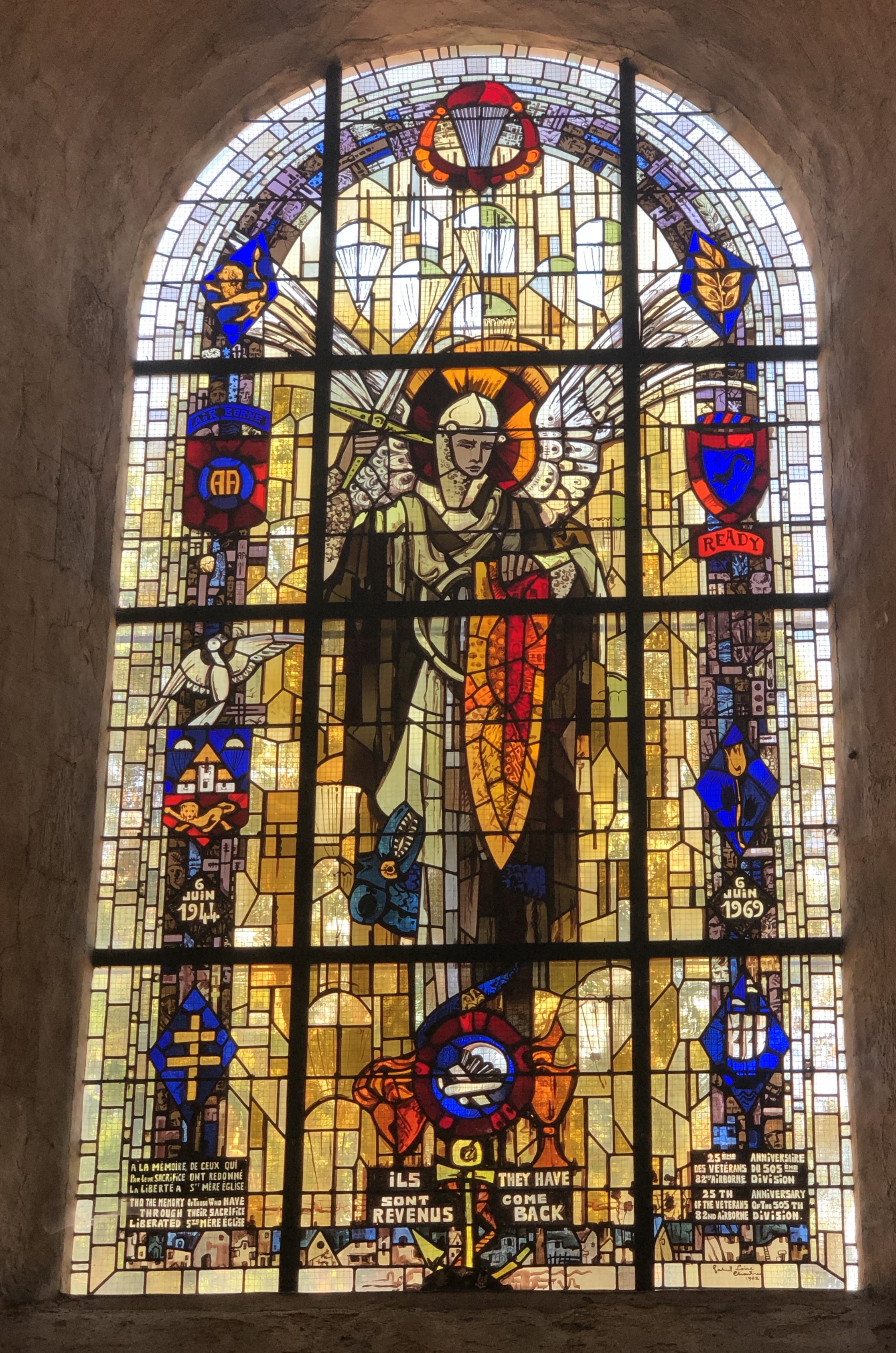
Inside the church are some lovely stained glass windows. Not unusual, you say. But one shows the Virgin Mary and baby Jesus, protected by US paratroopers. Another window shows what looks like a medieval crusader, winged. But the caption says, ‘Ils sont revenus’ or ‘They Have Returned’. Beside this is written, ‘to the memory of those who through their sacrifice have liberated Ste-Mère-Eglise’. A winged crusader re-imaged as representative of the US paratroopers who liberated this little town from German occupation in WWII — it brought home the strength of feeling in France.

The crusaders from the sky returned to rescue France from occupation, 1944

Our last visit was the US military cemetery at Colleville-sur-Mer. It was the end of our day, and the end of the day for the cemetery too. From the path we could see the sea, the English Channel where many of these men had come to liberate a foreign country. It was this liberation that in turn led to freedom for prisoners of war of Germany — another story I plan to work on. So all this has a strong relevance to me personally, in the story of one man in particular I have been following — my father-in-law.

The tour guide handed out flowers that we all hoped to be able to lay on the graves (it turned out to not be possible — the graves were roped off). She then said she would read ‘a poem’ which turned out to be the Ode, as it is known in Australia. Many of the US tourists among our group did not know it. The Ode is an extract of ‘For the Fallen’ by Lawrence Binyon. In RSL clubs in Australia, at Remembrance Days in Australia, New Zealand, UK and in some other locations, the extract is completed by adding the words, ‘Lest We Forget’ which are actually from Kipling’s poem, ‘Recessional’. These words are repeated by those present.

I listened to the Ode and found my lips moving in memory of the words. As a child at school, we had also learned the words to the previous verse.

They went with songs to the battle, they were young,
Straight of limb, true of eye, steady and aglow.
They were staunch to the end against odds uncounted,
They fell with their faces to the foe.

And then the Ode:

They shall grow not old, as we that are left grow old;
Age shall not weary them, nor the years condemn.
At the going down of the sun and in the morning
We will remember them.

From ‘For the Fallen’ by Lawrence Binyon

When we had finished, I walked away to a quiet corner. My throat was tight and my face was wet.

We stayed for an hour, listening to birdsong and watching the many tourists there. I heard many voices, most speaking French. There were children, young families, older people. At five minutes to 5 pm, the peace was shattered by two fighter jets zooming in formation from west to east — the direction of the freedom for France that followed D-Day. The planes bracketed the two flag poles surmounted by US flags. Then at 5 pm, we heard the lone trumpet of The Last Post, and the first flag slowly lowered. Through the trees we could see the care with which the officials handled the flag. They caught it carefully, folded it neatly so no part of the flag was at risk of contact with the ground, and packed it away safely.

Then the second flag slowly lowered.

The two flagpoles now rose empty in the late afternoon. People who had stood to watch respectfully, turned and made their way back along the path. There must have been hundreds. My throat felt tight again.

I spoke to a couple of people from our tour. ‘They showed such respect. This is a foreign country, this is not the US. But they do this every day. Here. And it’s been seventy-five years. And it’s not a weekend, it’s a weekday here. Just another day. But this — this is ongoing respect.’

I commented on the careful way the flag had been folded and my US friend said, ‘This is a US cemetery, they’re probably using US officials.’ He smiled and move to speak to another.

As I made my way back to the bus, I saw the golf buggy come past with the formally-dressed officials. They were all speaking French.

None of this was war propaganda. None of this was done for public show for the tourists. Most of those present were not tourists. This was just another day, but every day this is done.

Saint-Laurent-sur-Mer, code-named Omaha Beach on D-Day. The memorial today.

In Australia every day at 6 pm in RSL clubs, the trumpet note sounds and everything stops. All those present stand and face the memorial flame in the west wall while the Ode is read. We finish by repeating, ‘Lest We Forget’. Then we go about our business again.

They say those who forget the past are condemned to repeat it.

Let’s all remember, eh?

In Search of Castles …

While we have a number of different reasons for travel this year, the chance to visit and explore castles (modern, ancient, ruined, intact) was just too good to miss. Along the way a refresher course in cathedrals is not going astray. Castled out? We have come close at times, but there’s something always fascinating about castles. While there may be a type, the location and terrain means that castles are each unique.

My particular focus has been Scottish castles, one of which features prominently in my current novel in progress. But herein lies a problem — in the 14th Century, Robert the Bruce ordered the destruction of almost all Scottish castles built in stone. There had been a proliferation of castle building and he could not risk any castles being impregnable, in case their lords decided to turn hostile to him. Those castles not destroyed by the Bruce have decayed with time. There are a few exceptions which I’ve already mentioned, but even those have been heavily remodelled by later generations, making it more difficult to get a sound understanding of what a working castle in the 14th Century might have been like. When a stone castle is damaged and left to fall apart, it rapidly gets pillaged by people living nearby. Can’t let all that good, dressed stone go to waste.

Invergarry Castle ruins, in the Scottish Highlands — it’s the one closest to the one in my novel, and also
the first one we saw. But studying others has helped me understand this one so much more.

But there are English castles, and churches…

True. But there have also been wars. The Wars of the Roses did a lot of damage in the 14th Century, along with incursions from the Welsh (hey, with all this squabbling there could be some spare plunder for the neighbours). In the 15th Century Henry VIII made a lot of money out of dismantling abbeys and associated churches. A number of castles which were held by Catholic families were confiscated and handed out to the king’s favourites (who often lost their heads later on in all the excitement). The buildings that survived, especially those with rich ornamentation, caught the frown of disapproval from Oliver Cromwell’s forces in the 17th Century and were often scraped bare. As a result, of the many castles that we know existed, most are gone. Apart from a few exceptions, all that remains are a few plain parts of some old buildings, hidden amid all the new ornamentation of the late 17th Century modifications.

It was all rather sad, really. We found the signs of the old buildings that had been there and torn down. We followed signs and saw some wonderful walls and gates, but the castles inside were too often just empty shells.

Beeston Castle — a wonderful example of a Double D gate. Much changed, however, and with little more to see.

However, across the channel there are castles galore. True, there are some stylistic differences, but the functions are primarily the same — fortified structures designed for defence. We trawled the French countryside, seeing random castles on hills and sometimes entire fortified townships. The architecture was exquisite, the detail just brilliant. On one particular day, we had a detailed look at two churches, toured two royal castles and had a long-distance look at a third (we’d simply run out of time).  

Were we ‘castled out’? Perish the thought. A particularly amazing ‘squee!’ moment came when we approached Carcassonne and saw the shining confection of castle surmounting the clifftop, like some child’s fantasy birthday cake. Our hotel was inside those walls!

Sadly, we were only staying one night. But in the next 20 hours we did everything castle that we could. First we explored the main castle. Although it looked fairytale, it was very much a fort: with walls within walls; arrowslits carefully tooled to allow maximum coverage by archers of vulnerable approaches; multiple murder holes from which large rocks could be dropped onto any enemy foolish enough to make the attempt; courtyards overlooked by battlements from which archers could rain down further attack on anyone who made it that far.

As we walked the battlements we noticed our hotel courtyard almost within touching distance. The weather was scorchingly hot, and the hotel pool beckoned.

As I floated on my back, trying to cool off after borderline heatstroke, I could see the towers of the castle and a few stragglers still trying to find their way out. There was a music performance about to start in the main castle courtyard, and I could hear them setting up.

The next morning we were met by perhaps the most romantic sight — a breakfast table set on the balcony, champagne chilling next to the fresh fruit, with the conical castle tower roof shining in the morning sun.

Breakfast on the hotel balcony, overlooked by Carcassonne Castle, France.

What a pity the reality of castles was far less romantic … given the complexity of women’s dresses back in medieval times, and the narrowness of those spiral stairs, once a woman reached her quarters in the tower she was unlikely to leave very readily. Not without a lot of help. And as for the latrines … they were a small room with a wooden seat over a hole. Bodily wastes delivered through the hole would drop down either into the moat (festy!) or into a pit which some poor serf had to dig out. Often there were multiple latrines almost above one another (but not quite, of course) on each level of a tower, so one column could deal with the accumulated waste for one tower. In the delightful photo above, note the square column to one side of the central tower. There would have been a series of latrines down that column. (Enjoy your romantic breakfast, guys).

We have been told that expensive garments for the gentry were often hung near these latrines so the smell would keep away any insect life likely to damage the clothing. Perhaps that is why the aristocracy favoured strong perfumes?

As we continue our tour of castles through the Loire valley, the part of France with more castles than anywhere else in the world, I again think about the difference between circumstances in different countries. The United Kingdom castles suffered repeated depradations through different ruling regimes, while damage to French castles was on an individual basis depending on who was invading whom at the time. As a result, it is the French who can give us the best examples.

Ah, well. More castles tomorrow.

Bring it on!

‘It’s Been a Good Dirty Weekend…’

We’d had trouble finding accommodation in the Lakes District, it seemed every man and his dog, literally — these towns are very dog friendly — had gone for a weekend holiday. But we finally found a small B&B overnight. In the morning we headed for Shrewbury, determined to find accommodation earlier in the day and avoid the risk of nowhere to stay.

Why Shrewsbury? We’re fans of the Brother Cadfael series by Ellis Peters, which was made into a TV series starring Derek Jacobi. While the books are fiction, the history and the places described are very real.

Still looking at castles, and not locked in to any particular accommodation, we followed our noses to Beeston Castle. It had a lovely Double D towered gate but we simply didn’t have time, or the energy, to climb a steep hill to the castle itself, which was just a shell anyway.

Beeston Castle Double D gates

In the gift shop we chatted to a volunteer who advised, if we wanted lunch, a nearby pub. So we went there, ordered lunch and waited. And waited. Then waited some more…

While waiting, and beginning to worry about not getting accommodation this late in the afternoon, I searched for B&Bs and found a farmstay on our way. I started the booking process and saw they had vacancies but was reluctant to pay a deposit over a mobile phone, so we drove there on spec. This is very much the ‘on spec’ part of our journey.

Once we’d eaten (and just as the rain started again) we got under way and decided to detour a little to check out this farmstay. Soulton Hall. It looked a little grand in the photos, but hey, how grand can a farmstay be?

As we turned the corner and saw the place, Jeff began making sounds reminiscent of Graham Kennedy’s famous crow call. A more polite Aussie translation is, ‘Bloody hell!’

Soulton Hall — Elizabethan glory

The place is gorgeous. The current building is Elizabethan, late medieval/Tudor. However, parts of the property go back to Saxon times. The original building burned down sometime in the 15th Century, possibly due to conflict in the Wars of the Roses or perhaps Welsh incursions into English territory. This building is on a new site on the same property, a bit further away from the water.

We chose to stay, with choice of two rooms. One room was larger with a canopy bed. The other room was smaller but in an older part of the building with a floor that perhaps slopes more than is healthy; timber-panelled wainscoting; a secret door into the bathroom that creaks like a horror movie and tiny casement windows with deep sills. It screams, ‘Atmosphere!’

The ‘secret door’ to the bathroom in our room.

Downstairs mine host (John) brought a much-needed cup of tea. He apologised for the distractions: a team of archaeologists had spent the weekend digging what was thought to be a barrow, or could be related to an earlier structure. While we sat sipping tea we overheard a discussion between one of the team and the owners of Soulton Hall about the findings. It was just a preliminary, investigative dig: crowd-funded and staffed by enthusiastic volunteers, overseen by professionals. If you ever watched the Time Team series on TV, these are the people who continued on with the work after the cameras stopped rolling.

We invited ourselves in to the debrief talk to the team. What had been thought to be a barrow initially seemed to be just a pile of heavy clay, but tantalising pieces of pottery were found, some dating back to 12th Century. A pipe was found which could be identified by a stamp as coming from a nearby factory from the 16th Century. Some animal bones have also been found but need identifying. We offered to take a look.

‘It’s been a good dirty weekend,’ the archaeologist announced. Their clothing bore witness to the hard work of shifting heavy clay, but they all looked like they’d enjoyed every minute of it.

Enthusiastic archaeologists of all ages

The other interesting angle to this place —  in the Brother Cadfael books there are references to places such as Salton, Eaton, Frankwell, Pulley, Beiston and Ludlow. Could this place be one of those referenced? The previous manor house would have been here in that time. In Ellis Peters’ book, ‘An Excellent Mystery’, the manor house of Salton is described as upriver from Shrewsbury. Soulton Hall is upriver from Shrewsbury by about the same distance and we know that the author was thorough with her research.

So, for a place where we dropped in away from our route, while exploring, it appears that once more we found a historic treasure with some side stories.

Life is an adventure. Travel doubly so. Research opportunities never stop but keep landing in our laps.

For more information about this and other archaeological digs, look up digventures.com. Worth a look!

Love the shirts, fellas!

What is a Traitor?

I was sitting on a bench at Stirling Castle, catching my breath and chatting to a US tourist next to me.

‘Are you team Wallace or team Bruce?’ she asked me.

I replied that I didn’t think they were in opposition.

‘But Wallace was a traitor, so we’ve been told,’ she replied.

And there began a brief discussion on what makes a traitor, and what makes a hero. It comes down to who writes the history, and that generally is the winners.

William Wallace was born in 1270, Robert the Bruce in 1274. At a time when Scotland was without a monarch after the death of Alexander III of Scotland, and then his only heir, Margaret of Norway. The Scottish nobles argued amongst themselves and eventually invited Edward I of England to come and help decide who should rule Scotland. This was, unfortunately, like inviting the fox to come in and guard the henhouse.

There was a lot of to-ing and fro-ing, but Edward I was clearly working towards annexing Scotland to the English throne. William Wallace, a minor noble but a physical giant of a man according to legend, fought against the loss of Scottish freedom. While Robert the Bruce’s father and grandfather were English allies, they also were in line for the contested Scottish throne. Robert Bruce wanted Scottish freedom but was prepared at times to side with the English if it seemed in Scotland’s best interests to do so. Wallace, on the other hand, never swore allegiance to Edward I.

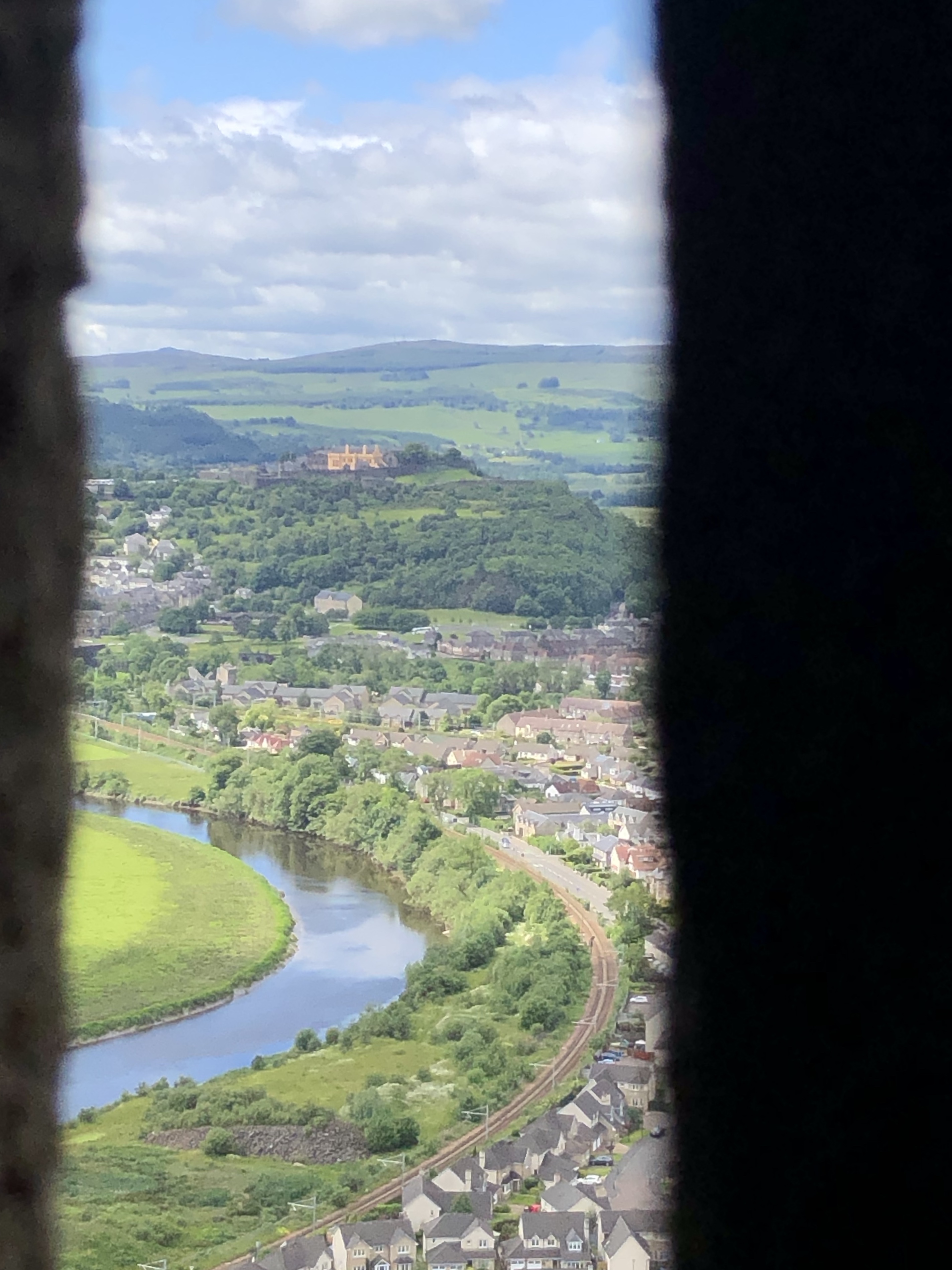
Stirling Castle as seen from the Wallace Monument, through one of the arrow slits in the staircase. You can see the loop of the river where the English troops were trapped by Wallace’s army of Scots in the battle of Stirling Bridge.


When the Scottish nobles rebelled against Edward I, Robert the Bruce was among them. So he was with William Wallace at the Battle of Stirling Bridge in September 1297 when the English were soundly defeated.

In the absence of a king, the nobles appointed William Wallace as Guardian of Scotland, to rule until a king was decided upon from those claiming the hereditary right. Among the claimants was Robert the Bruce and John Comyn (aka ‘the Red Comyn’).

In April 1298 Wallace was defeated by Edward, but escaped. He resigned the Guardianship, to be replaced by Robert the Bruce and John Comyn. They were rivals for the throne and it was not a workable relationship. Eventually, they resigned the position.

Meanwhile Wallace was negotiating across the Channel with the French but Edward had got there first. All the Scots got was a free passage back home.

Wallace, back on Scottish soil, was a marked man. But for a year he was harrying the British until he was betrayed and handed over to Edward I. The English king was determined to wreak vengeance on the man who had fallen into his hands and all his rage at all the Scots who rebelled was taken out on Wallace. The mighty Scot was accused of treason against the English even though he had never sworn allegiance to Edward I, unlike the Bruce. Wallace was given an appalling traitor’s death at the hands of the English. Hanged by the neck but cut down while still alive; castrated, disembowelled and his entrails burned in front of him while still alive (they’d have to be quick) then quartered — head and limbs removed and sent to different places. It was the kind of death reserved for traitors and one which Edward I also meted out to one of Robert the Bruce’s brothers when he got his hands on him.

Robert the Bruce, on the other hand, killed John Comyn and was crowned King of Scotland a year after the death of Wallace. He continued a deliberate, steady war against the English to win the astounding victory at Bannockburn in 1314 which led to Robert the Bruce taking Stirling Castle.

Stirling Castle — inside the walls, a beautiful garden.


Bruce continued to strengthen his power base with guerrilla warfare against his enemies, the Comyns and the English. However, he also was able to negotiate peace with the English with Edward III, among other diplomatic achievements.

Was Wallace a traitor or a hero? One can only be a traitor if you have previously been trusted, and broken that trust. Wallace had never made any pact with Edward I and his only cause was Scotland’s freedom. Robert the Bruce fought for Scotland, but it could be argued also for his own ambition. While he was at times allied with Edward I, in the end his cause was his country’s, and Scotland benefited.

Stirling Castle was a fascinating place to explore. Much of what we see now has been adapted over the centuries, but the strategic position is clear. The double D towers at the gate still have the garderobe/latrines in there, a small hole which would have had a wooden bench across it, from where the excrement would fall to below the castle walls. This sort of lavatory arrangement was common in castles for the nobility. However, in the gate towers the arrangement would have meant that the guards could stay put and not have to leave the tower for ‘comfort stops’. There are even arrow slits next to the latrine, so a guard technically could have kept an eye on proceedings even during — well, proceedings…

In Stirling town, the wealthier people lived higher up the hill, with the poorer people living lower down. The lowest dwelling-places were at the very bottom of the hill, called ‘Dirt Raw’ (or Dirt Row). That was where the refuse in general would wash down if it was not carted away in time before it rained…

A number of Scottish rulers were crowned here, born here and died here. Notably Mary Queen of Scots was born here and crowned here. Her son James VI of Scotland was actually born in Edinburgh Castle which we’d visited the day before, but was crowned and grew up in Stirling. Again, an amazing place rich with history and wonderfully preserved.

He said he was a Campbell but we won’t hold that against him…


From Stirling Castle we could look across to the Wallace Monument, built in 1869 to memorialise the efforts of William Wallace and his heroism for Scotland. It stands on the hill from where Wallace assessed the movements of English troops before the battle for Stirling Bridge.

Hero or traitor? By his own standards, there is no question. And for the Scottish people, there is no doubt. Both William Wallace and Robert the Bruce are valued as heroes of the Scottish people.

The flag at Bannockburn where there is a statue to Robert the Bruce.