Adorable Doors part 3 — Naxos

I first must say, all the photos in “Writing on the Move” are my own, except perhaps for the few my husband may have taken. I love colour and character in my images as in my words.

I’d started my love affair with door photos in Athens. We tiptoed out of Athens in the pre-dawn to catch a ferry to Paros, where we stayed for a few days, getting delightfully lost in the twisting, narrow streets. Then we took the next boat to Naxos.

A very Greek door, with so much personality! Naxos, Greece.
Right next door to the door with the eyes. There’s a story here!
Narrow roads for no vehicle. That hint of blue to the right is the doors above. Naxos, Greece.

When planning our trip, the idea was to make our way to Crete by island-hopping. We wanted tiny tastes, our own degustation menu of island experience. We hadn’t realised that Naxos is the island next door to Paros! The trip took about half an hour. But Naxos was on my list, as according to mythology it was here that Theseus abandoned Ariadne after their flight from Crete. I seized the chance to experience Naxos to inform my writing.

A handy spot for breakfast, especially if you are an incorrigble punster.
Octopus drying in the sun, Naxos Harbour, Greece.
Walls built of bits and pieces over the centuries. Behind the window, the space is in use. A home? Naxos, Greece.
A gate to a garden, and another wall built of bits and pieces. Naxos, Greece.

As with Paros, we arrived at the wharf and waited for our transfer to the hotel. While we waited we watched the skill and speed with which the ferry drivers load and unload vehicles and passengers.

The hotel on Naxos was definitely a hotel. Everything about Naxos was bigger. It was in the flat-roofed white-painted style of Greek village housing, with the curious roof-top embellishments typical of Naxos.

Up in the mountains of Naxos. Note the embellishments on the roof.
Overlooking Naxos. Harbour to the right, our hotel somewhere on the left… so many do
Shutters to… where? With the sea (and my husband) beyond. Naxos, Greece.
The sign on the door said the tower museum was closed for a week. Yes, the week we were there… Naxos, Greece.
None shall pass! Naxos, Greece.
There’s that piecemeal construction again. Every stick and stone has its own story. Naxos, Greece.
Once there was a handrail — live dangerously! Naxos, Greece.
These shutters aren’t opening any time soon. Naxos, Greece.
Tell me — can’t you see yourself weaving a story here?

As always, as soon as we’d dropped our bags, we were off exploring. A short walk down a narrow path took us to the beach and then we found our way back to the harbour and the main part of the town. The first thing we found was the multi-level nature of the old town of Naxos.

Climbing upwards above Naxos. Husband Jeff had to duck his head in places. Doors and stairs intertwined.
Despite its age, this door appears well-used. What stories are behind it?
It’s steeper than it looks… Jeff kept getting ahead of me, because I insisted on stopping to take photographs of doors!
Near the top is a church, of course. St Anastasia’s.
There was an open square outside the church.
A passerby introduced us to the resident cat, a battle-scarred ginger and white tom (left in the photo).
His name is Ares. How appropriate! Named for the Greek god of war. “Do not pet Ares,” I was told.

At the summit of the goat paths was the old Venetian fort area. Naxos’s old town is more rambling and extensive than that of Harikia on Paros, but it also had the occasional large gate which would have given invaders pause.

Ancient battle-scarred barricade at the fort. Look at those hinges! Naxos, Greece.
Stairs and doors everywhere, criss-crossing and overlapping. I hope the doors open inwards!
Geek architecture makes use of what is there already, and adapts.
Same steps, different door.
Another closed-in door. Naxos, Greece.
…and another.


We travelled inland and across the island, visiting the high mountains and the opposite shore. The ancient temple to Demeter sits at the centre of Naxos like the island’s own omphalos, or navel. The centre of their world. Our tour guide was on his summer break from his usual job as a history teacher, and I enjoyed every detail of his talks.

The wreath over the door, now wilted in June, once matched the intense colour. Naxos, Greece.
So much little detail with this door. And another wreath. Naxos, Greece.

I asked our tour guide why some of the buildings, including ones which were otherwise immaculate, had a withered wreath hung over the door. He suddenly went very quiet and tried to distract me. It only intrigued me further. He clearly did not want to answer in front of the group and he had already learned how interested I was in the ancient practices of Greece. At last he took me aside and told me, in low tones, that the wreaths were placed over doors on May Day for St John. Okay, but why leave them there? It was clearly part of the custom, though.

Sunrise from our hotel balcony. Naxos, Greece.

However, I had enough information and went looking back at the hotel. I found the Feast of the Protomagia, where wreaths are woven from flowers of the field and included items such as an ear of wheat for the harvest, a symbol of the evil eye (usually to ward it off) and thorns (or a thorn somewhere) to protect the house from enemies. May Day is also a celebration of Persephone’s return from Hades, and rejoicing from her mother Demeter, the mother earth. It is a celebration of the triumph of life over death, for now. And for some they see it also as a celebration of Dionysus. On June 24 (technically the Feast of St John the Harvester) all the wreaths of the village are gathered together and burned. Yep. I can see that. A midsummer bonfire and celebration in the ancient traditions. Villagers leaping through the smoke for good luck. Although these days it is St John the Harvester in whose honour this is done, the ancient pagan traditions are still underlying it all.

Greece has a heritage that goes back through the millennia and they still remember and honour their ancient traditions, even under a more acceptable form.

Temple to Demeter, Naxos, Greece. Ancient doorways to the past.

No wonder our tour guide was a little reticent…

Adorable Doors part 2 — Paros

I promised you more door porn – here you are!

The windmill at Parikia Harbour is now the information point. Daily ferry just coming in. Paros, Greece.
Early in the morning the tavernas in the town square were empty. The square was ringed with doors. Paros, Greece.
It could be mistaken for a garden path, but this is a street. Paros, Greece.
What stories has this door known?

We arrived on the island of Paros at about midday, and were collected in a mini-bus for transfer, along with about five others. Our hotel was the Aegeon, around the corner and up the hill, with a small convenience store across the road. It’s a small two-storey building, in the traditional Cycladic style of flat-roofed white building with sea-blue doors. Through the door we found a cool, shaded space, a shelter from the intense summer heat. The hotel was high enough above the town of Parikia for a gentle breeze from the harbour to cool us a little.

The window in the sitting room of Aegeon hotel. Cool inside, after the heat outside. Paros, Greece.

As soon as we’d checked in, we began our explorations. We had no map and no way to navigate back to the harbour on foot, except by eye. That was when we discovered just how effective were the winding streets, blind ends, twists and turns and narrow passages to keeping the old towns safe from invasion from the sea. Paros has been a wealthy prize due to its trade in the whitest pure marble, prized by sculptors through the millennia.

Windows count too. This was near our pensione. Paros, Greece.
Paros, Greece.
Church doorways. Paros, Greece.
Very old buildings line an ancient street. Each archway, each set of steps is another door. Paros, Greece.
A narrow path to the doorway. There’s a washing line, too. Paros, Greece.
Narrow steps up, doorways below. Paros, Greece.
Another church, with oleanders in flower. This is the laurel of Greek mythology.
Water is very important in Greek culture. Water to drink, water for blessings. Paros, Greece.
The church overlooking Parikia Harbour, which we found by getting lost in the dark. Paros, Greece.
In 500 BC there was a temple to Athena in this location.

We regularly got lost and often found ourselves navigating by the sun. This was a problem at night. Our pensione was only a five minute walk from the harbour, but at night we often took forty minutes trying to find our way back.

Hibiscus and bougainvillea grow out of tiny crevices and twist around the buildings. Paros, Greece.

It’s a very enjoyable place in which to get lost. We found some glorious nooks and crannies, and in places the buildings went right over the road. Looking up from underneath we could see the rough construction which we had seen thirty years ago when we first visited the little village in the mountains of Crete (see “Blast From the Past”).

Look up to see the building materials for the floors above this street. Yes, street. Paros, Greece.
Old, decayed doors — more stories.
Side by side with well-maintained doors. Still very Greek! Paros, Greece.
Doors open directly onto the streets.
So many stories here. Paros, Greece.
The streets here are named after people of note. Paros, Greece.
Table and chair outside to sit in the sun and watch the people pass by. Paros, Greece.

Along the shoreline we found some more interesting doors. The town opened up a little more. The town square was ringed with tavernas and clothing shops.

Even though it’s a main street, it is narrow.
Near the town square the street is wider. Shops near Pariklia Harbour, Paros, Greece.


As we walked back in the moonlight (getting delightfully lost again) we noticed the heavy doors opening right onto the street, which would have been an added hazard for unwelcome invaders.

As tourists, we felt welcomed despite our closeness in the street to residents’ living spaces. What would it have been like to be on guard behind a door, hearing the sound of invaders trying to creep through the town?

And today, behind those doors, the women cook for their families, tend their small gardens, chat to their neighbours and live their family lives. The only privacy would be behind those doors.

Taralga Time-Out

A good crop of table grapes at Taralga pub should be good eating by late summer.

We’ve got “bugout” down to a fine art, posting online right up to the wire. Half an hour before checkout, we started to pack. Fifteen minutes before checkout deadline, we were on the road from Canberra. Our ultimate destination was the Blue Mountains village of Medlow Bath, but we wanted to drive a different way. Adventure is about challenge and change, and that is where the best stories come from.

Leaving Canberra. The telecommunications tower on Black Mountain (right) is a well-known landmark.

Jeff still needed the stops every hour to get and walk for a bit. First stop, Goulburn for fuel. From there, our route went inland over new roads.

Typical Federation houses in Goulburn — the places you see when you miss a turn!

We were amazed and delighted at the green fields and full dams on the properties we drove past. A field of canola glowed sunshine yellow, while just over the field was a paddock of the deadly purple paterson’s curse. Beautiful, but deadly to horses. However, the flower’s other name, salvation jane, indicates its value as a fodder crop for sheep and cattle in poor pasture areas.

A field of paterson’s curse against the backdrop of the Blue Mountains
Paterson’s curse close-up.

We decided to stop briefly in Taralga. A short stroll would do Jeff’s bad leg a power of good. As we were comin g in to the town we had to stop while an echidna crossed the road. The creature paused briefly while it seemed to be thinking about whether to change direction and follow the centre line for a bit, then it seemed to shrug and continue to cross, looking for all the world like a prickly wind-up toy. One should always resist the temptation to physically move them — if you startle them, they’ll just curl up into a spiny ball and you can’t move them without heavy gauntlets. Croquet sticks are definitely not a good idea. National Parks and Wildlife would look askance at the idea. Lewis Carroll was writing about hedgehogs, not the much larger echidna.

An echidna crossing the road just outside Taralga.

We stopped outside Taralga pub and immediately Jeff spotted a street library. As were were looking at it to see how it compared with ours, an older woman with a straw hat approached. Did we want a book to read?

Taralga Hotel. The “pub” as we call them. Wide-veranda’d, shady, cool inside.
And yes, they have rooms available, like any country pub of its day.
Taralga pub street library, close-up.

We said we were fine with books and showed her the photos of our own book library. “We’ve only stopped for a few minutes to walk around,” we explained. “It’s too early for lunch, or we’d go into the pub.”

Coastal daisies. A favourite cottage garden plant here.

We chatted, and she clearly knew the place well. “Are you the proprietor here?” Jeff asked.

I got her photo after all. Oops! But it’s suitably anonymous.

She nodded happily. “Would you like to see the place?” she asked. She’d watch me take photos of the street library, and some coastal daisies. “We’ve got a lot more you can take photos of round the back,” she assured. “Our vegetable beds are coming on too.”

So we took the tour. We chatted about her plants, her roses and her fruit trees. Figs, apricots, pears, cherries, apples. We’ve often remarked, there are few people friendlier than country Australians, and this lady was no exception. She delighted in her gardens and briefed us on her future plans for more garden beds.

“We’ve planted more hops,” she showed us as she talked about boutique beers. We never learned her name, and she never asked for ours, but we talked for nearly half an hour as if we were old friends. I took a few snapshots as we walked around. As we headed towards the back door of the pub, I asked if I could take her photo. I thought a portrait shot would be something she could value in exchange for her time.

“Oh, no,” she declined. “I hate having my photo taken!” But she was happy for me to keep taking photos of the garden, the signs and the pub itself.

The view from the front door. The accommodation is upstairs. A beautifully maintained historic building.

We’d already taken longer than we intended and felt a little guilty at not stopping for a meal.

She waved away our concerns. “Next time,” she said.

As she showed us the shortcut through the pub to the front entrance, she seemed to have all the time in the world. However, we also saw her interact with staff and the respect they showed her. A strong woman, a hard worker but someone who valued the importance of time.

For us, Taralga was a brief opportunity to stop and smell the flowers.

Daisy Chains – a Lost Art

Thin stems make daisy chains challenging, but they can still be done.

Seeing the field of daisies in Goulburn reminded me of making daisy chains as a kid. I taught myself out of a book, because everyone else in the family was working or too busy. The book was helpful, though, and taught me a few other plant games. I remarked how much I wished for something to relieve my boredom, in the days before iPads and the internet.

Perhaps that is why I became so involved with writing. I read books avidly, whatever was to hand. But also, playing outdoors, I learned about the world around me, at least in my immediate vicinity. I watched the ants, the birds, the plants and learned their changing ways through the year. And so I studied science. But writing is always stimulated by what we experience in the world around us.

While in Canberra visiting the family, the children were having an electronics-free day. We played a board game then went for a walk. The children rode their bikes. Canberra is ideally suited to this, with so many walking trails and bike paths keeping exercise away from the roads and in the green spaces. At least the spaces are green at the moment, after so much rain! But as we walked and talked, it became clear that children these days do not have the same skills in games with weeds as they do with electronic games.

A profusion of weeds made excellent material for some daisy chains. All the plants I will now describe are introduced weeds, but so common here that we’ll never get rid of them.

A blurry dandelion clock – hard to focus when I can’t see the screen for the sunshine!

Dandelion clocks are a game that children can play, although gardeners hate the distribution of seed that results. The game is, you can tell the time by how many puffs it takes to blow off all the seeds. I remember as a child being puzzled when a particularly stubborn seed clinging on for dear life resulted in a ‘time’ of 25 o’clock!

Plantain — fun to ‘shoot’

Plaintain flowers make fun pop guns to shoot at each other with. To make a plantain gun, you pick a long-stemmed flower, fold the stem over and around behind the flower head, and then rapidly pull the flower stem until it is pulled violently against the folded loop of stem. The flower head should break and fly off. This is a game that gardeners like.

Bend the stalk around in a circle to cross over itself behind the flower head.
Fold the end of the stem over the stem behind the flower head.
Hold the folded stem firmly, but make sure the stalk can still slip through freely. Then pull sharply!
Left hand, here, pulls. The plantain head should fly off. Biodegradable fun.

As a child I would deck myself and my friends in daisy chains. To make a daisy chain, you choose flowers that have stems thick enough and soft enough to take a thumbnail cutting a vertical slit in the stem. Choose a flower with a small head as your first flower (for reasons which shall become obvious later on). Thread through the stem of your next flower, and draw it gently through until the flower head has reached the slit in the previous stem. Now do this again until you either run out of daisies, or your chain is long enough. Then choose a flower with the strongest, thickest stalk you can find and thread it onto the chain. Make a vertical slit in the stem the same way, but this time make it longer. Go carefully! You don’t want the hole to tear away at the side!

The head of the chain. Thumbnail making a vertical slit in the stem.
Widening the hole.
Threading the next daisy through the hole. Then make a thumbnail slit in this next daisy stem. Repeat.
Poking the first daisy head through the last (larger) hole in the final stem — the flower head gets a bit squashed but you can fluff out the petals again,.

Now take the first flower in the chain (remember I said it should be small!) and thread the flower head through the larger hole of the last daisy.

Voila! Flower fashion!

The finished bracelet.

You can also use clover or any flower with a stem that will be strong enough yet soft enough. True dandelions don’t work well because their hollow, milky stems tear out too easily.

And remember, daisy chains are for now only. Once the sun goes down, the flowers close and day is done.

More daisy chains tomorrow!

Canberra by Covid

We’re in Canberra for a quick weekend. It’s not the best time, but we’ve been wanting to visit for several months but health issues got in the way. Now as we travel, Jeff is sitting very carefully due to bruises after a backyard tumble in the rain. He’s healing well but still sore. The laptop’s in the car and will get a workout with my own writing, and editing for others. As always, I do a lot of writing preparation while I travel.

As we turned onto the Federal Highway, we were delighted by how lush and green it all was. It was dust-dry a year ago.

Spring flowers in garden beds in Goulburn.
Lush pasture on “the long paddock” by the highway. The fields are green.

We planned more frequent stops so Jeff could get out and walk around. We called it “taking Robert the Bruise out for a gallop.” At each stop, we wear our home-made face masks and if we can’t wash our hands in the rest rooms, we use our bottle of sanitiser which we keep in the car. Some of the rest rooms barely qualify for the polite label. On the Federal Highway to Canberra, the rest stops are named after decorated soldiers. There is a plaque detailing what each soldier earned his Victoria Cross for.

The toilets are basic but functional. Pit toilets, most of them, with tasnk water when there has been rain. The instructions are to keep the lid down on the toilet when not in use — the ventilation is designed to draw out unpleasant odours. Sadly, not everyone understands this. The stenciled warning on the path to watch for snakes can be daunting to many overseas tourists.

Rest stop at one of the “V’C.”s. Pit toilets, no power, no running water. Tank water only, when the tanks are full.
The business end. Despite the primitive look, this is a very good facility for the conditions. Get used to it.
Outside in the fresh air at the rest stop. Boxers Creek, somewhere on the highway to Canberra. Deciduous trees provide much-valued shade in the summer heat but let the sun in over winter when it gets very cold.

We made our next stop in Goulburn. Time for another walk around, and lunch. We avoided the usual fast food franchises and a pie shop we’ve learned to be wary of, and found a pleasant little cafe. Covid-safe rules meant we had to register. That is about to become law through our state, so it was good practice on so many levels.

Wide country town roads. Out little cafe was right at the far end (extreme left), next to an Indian restaurant.
A meadow of these (non-indigenous) daisies brought back childhood memories. I spent many hours making daisy chains. If only I’d had the internet! I was bored out of my skull!

After lunch I wandered over to take the obligatory tourist snapshot of the Big Merino (dubbed “Rambo” by our family), yet another of the Big Things we feature in Australia to showcase the produce of the area. For those curious about matters of a biological matter, let’s just say that Rambo is a wether.

“Rambo” posing as only a merino can.

This is a major stopping point for the many trucks which are increasingly relied on to transport loads of freight up and down the eastern seaboard of Australia. On the freeway we meet many of these pulling their trailers carefully at the speed limit. This is a highly policed freeway with automated checks for the whole route.

Back on the road, we quickly came to Lake George which has more water in it than I’ve seen since I was a teenager. There were still sheep and cattle grazing, and the pasture looked lush. While there were shallow pools closer to the road, in the hazy distance we could see the new extent of the lake’s water. Even now, most of the lake bed remains as pasture.

A Southern Cross windmill on the lake bed draws up water for the stock. Lake George, Federal Highway, Canberra.

One last stop at a rest top on the edge of Lake George and it was time for the final run-in to Canberra. My husband limped over to take the wheel. He reckons he’s more comfortable driving.

Windmills in the furthest distance, then water (or a mirage?). Glorious pasture in Lake George.
Looking from the west side to the east.
Almost there! Look out, Canberra!

Only for a couple of days, Canberra, but we’re ba-a-ack!

Adorable Doors – part 1

I love doors. I adore a door with character, with history, with a story to tell.

Athens, near the Acropolis. Door handles removed, once-bright paint now faded and peeling.
Athens, Plaka. Secure, private.

When travelling, it is the hidden corners that have surprises to spring. Imagination fodder a-plenty.

Weathered timber, old and detailed. Someone is restoring it.

Behind every door there is a story. Many stories.

A door can be classic, pristine, or modern. Or it can be in such decay that it has fallen into disuse.

The door frame and door are still old, but more recent than the old stonework. What was here before?
Paros Island, Greece.

On our trip to Greece in 2018 I took many photos of cats and even considered a calendar devoted exclusively to Greek cats. My husband said I’d have no trouble finding twelve images for the twelve months. But when it came to doors, he said I would have a different door photo for every day of the year.

I don’t think these doors are in use. But once upon a time… Athens, near the Acropolis.

Sometimes the doors were open, sometimes the occupant was nearby, perhaps hanging out washing or watering the garden. On the Greek island of Paros, a sudden heavy downpour spilled women from doors with stiff brooms to scrub the street spotless and sweep the water into the centre channel.

After the rain I paddled barefoot. You can see the green broom head just in front of me, where a nearby woman is sweeping the water into the central drain. Paros Island, Greece.
The spotless street, some rainwater still in the centre channel. After the rain on Paros Island, Greece.
Your author walking along a street on Paros Island. Narrow stairs lead to apartments above.
Doors below open directly onto the street.

In some areas the homes opened directly onto a road that was often barely a path. Some of these roads were so narrow that you could touch the walls on each side at the same time. Other doors opened out onto town squares. But always the colour, condition and individuality lent appeal. For each door photo, there was always something that drew me to it. It was the story it told me, each door telling me its own tale.

A glimpse of a garden in a large courtyard. Paros Island, Greece.
Bougainvillea vines around the door and shuttered window. Paros Island, Greece. I love the knocker!

Since that trip to Greece I’ve heard many more stories in my head, told by many different doors in various parts of the world.

Some people call it door porn. I don’t care.

I just tell them that it’s a door-able.

Sorry.

More door porn to follow…

‘Take One, Leave One!’

I have wanted my own street library for two years now, ever since I saw this fabulous one in Gerlingen, outside Stuttgart, Germany. The sight of a red British phone box in Germany drew us up sharp.

A surprising sight in Germany.
Inside the brilliant street library in Stuttgart, Germany.
Second-hand books for sale at our village market. Not since Covid, however.

A street library is a box of books that you have outside your gate. People can take a book that appeals to them, or leave one that they think others might like to read.

“But we have a library in the village!” I was told by friends last year. “Our community library needs our support.”

Our village library is normally open on Monday evening, Wednesday evening and Saturday morning. It has a small selection of books but its main community use is as a meeting place for author talks once a month. It’s also primarily a school library and school learning space. It’s also currently closed because of Covid.

No more browsing on the shelves. No more random finds. Meanwhile I was accumulating a lot of books that we needed to donate, and even the thrift shops were closed.

Municipal library — off-limits to browsing during Covid restrictions.

A neighbour said, “I’m desperate for something to read!” I met with her and handed over some of our car boot books, but that decided me.

It was time.

We could buy a street library kit for $90, or we could buy some materials ourselves. Or we could re-purpose something. That sounded best, for us.

The principles of minimal ecological footprint came into play.

It was community clean-up time, when we put rubbish out on the street. For local kids, it’s a fascinating opportunity to explore. A lot of adults, too, scavenge through the discarded furniture, broken pots, dead couches and dismembered fridges to see what they can take and use.

Another likely candidate, but we chose something else.

My practical husband was going to do the actual build, so he gave me a shopping list of sorts. He was pessimistic, however. ‘You need a hardwood piece of furniture, and not too big, please, I don’t want our front fence looking like a junk heap. It has to be hardwood, not MDF or plywood.’

Despite his pessimism, because these days most furniture items will not stand up to a little rain, let alone the occasional east coast low, I found several likely items. Of course, they were damaged in some way, or hopelessly out of fashion. Which suited me. We settled on a small bedside cupboard that was missing a door.

Old cupboard being refurbished. The workbench is an old ironing board, pressed into new service.

We found a part-used sheet of perspex which would do for a door, but how to keep it closed? My husband made a small metal frame to fit into the bottom of the small cupboard as base for a shelf and some perspex roofing sheet was cut down to make two shelves. The perspex door was attached with screws and hinges taken from an old laundry cupboard. He also grabbed the knob for good measure.

For closure of the cupboard door, my husband scavenged some magnetic strip from the seal of a fridge door. He glued the magnetic strip to the bottom of our perspex door so it would grip to the metal of the bottom shelf frame. It took a couple of attempts to get it right.

A friend brought me a box of trinkets from one of the rubbish heaps. Inside was a wine bottle holder in the shape of a kneeling butler. “It belonged to my friend who died,” she explained. “I don’t want Jeeves to end up in landfill.”

The wine bottle holder, dubbed ‘Jeeves’, wearing his face mask made from a torn shirt. The pot plant is a test to see what we can ‘persuade’ him to carry. It’s not just wine bottles.

Our cupboard needed legs, and another dump heap had timber offcuts. We cut four even lengths for legs which I painted with leftover fence paint. One leg was a bit long and had to be trimmed to fit, so I painted the offcut to look like some stacked books. Another offcut was rescued from a woodheap and one side didn’t look too badly worm-eaten so it also got painted.

Cupboard legs drying on the (matching, recently painted) picnic table. In the background was another piece of furniture which we left for now. Up for grabs!
Scraps of old wood painted as books for the sign.

My husband sent me off around the village again, looking for a piano hinge. I didn’t find a piano hinge, but I did find some cut up pieces of a baby grand piano… there are so many stories on these rubbish heaps. A bouquet of bright silk flowers was on a nearby heap. Surely I could find a place for those?

Another rescued decoration.

Slowly our street library took shape. The various decorative pieces were attached last, but glued and screwed down firmly. ‘Jeeves’ forms part of the sign now. Due to Covid, Jeeves wears a home-made cloth mask customised for his caricature nose.

We ‘seeded’ the street library with a few books and some old magazines, then screwed the whole cupboard to our fence post. Even as we did this, a car stopped. Waited. Then as my husband walked back up the driveway to put his tools away and I stepped back to assess, the driver approached. The first customer!

The first customer — he’ll enjoy that book by Gabrielle Lord.

I recommended a favourite book of mine, and he dashed back to his car to get another book to leave in its place.

I’ll never see my book again, but I had enjoyed reading it and I know he will too. He’s not local, he was a traveller. And that’s okay. It spreads the idea far and wide.

It’s catching on fast!
The street library is filling up.
It also can share other goodies to the neighbourhood, such as bay leaves from our tree.

Our street library is now registered on Street Libraries NSW, and is filling up with some very interesting titles.

It’s fun to have a go and what’s available to hand can guide your style.

Sharing to the community. And when Covid is past, Jeeves will doff his face mask.

So much inspiration!

Spring is Sprung — Wildflowers of Royal

For nearly two months, our road access has been limited and when we need to go to “the mainland” as we call the city, it involves a much longer drive. But as we emerge from winter, the signs of new life are all around us.

Fringed lily — a special find!

When you live in a place like this, you get to know the secret spots, the wildness. The Aboriginal people described six seasons, and the flowering of certain plants would herald a season change. Each area had its own signals for season and its rules to follow. The time of Ngoonungi, for example, is heralded by the flowering of the waratah, and signalled time to move towards the coast. That’s supposed to be September and October, but with climate change the seasons are starting differently, flowers are out of their proper time. The waratahs began to flower this year in August.

Waratah — highly visible.
Gymea lilies in bud.

Also notable in our area are the Gymea Lilies. The name sounds so pretty and sedate, like something you might find as a potted plant in a Victorian palm court. The reality is far more shocking. These bright red, untidy flowers the size of your head grow at the end of a stalk that can be 6 metres (20 feet) high. The base of the plant looks like flax, with lime-green strappy leaves in a clump from which the single stalk rises through winter with a tight bud at the top. Then at the end of winter the bud bursts open in a glorious splash of crimson. In the wild they are not known anywhere else but on Sydney sandstone, but they are so amazing to look at that the plant has been cultivated and exported more widely. There is nothing coy or polite about this plant. It screams its existence as it dominates the landscape. When the flower stalks are spent, they darken and blend in with the tree trunks around them. If fire comes through they will briefly flare again perhaps, or drop to the forest floor to decay and feed the next generation. The heat of the summer days splits open the seed capsules and the seeds fall to the leaf litter below.

Flowering from August are the tiny dancing ballerinas of the blueberry ash, Eleocarpus. They hang on the tree like corps de ballet from Swan Lake but soon change to small, purple berries.

On the side of the road, all these flowers in profusion.
Watch where you put your feet! Colour is everywhere.
A touch of sunshine.

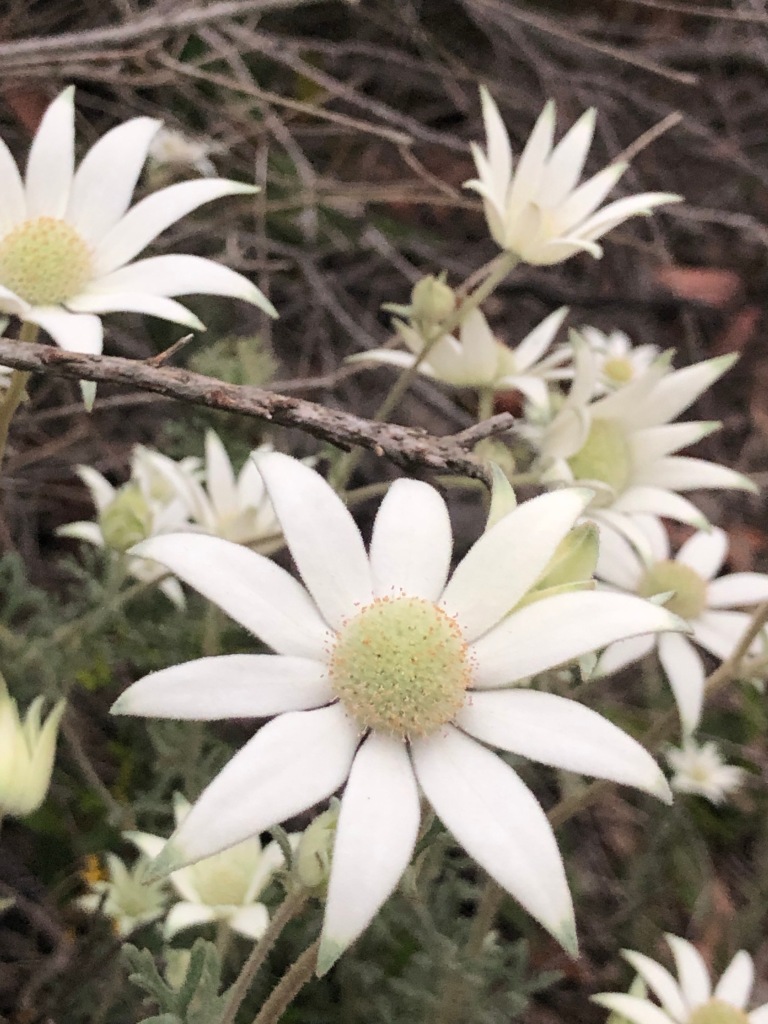
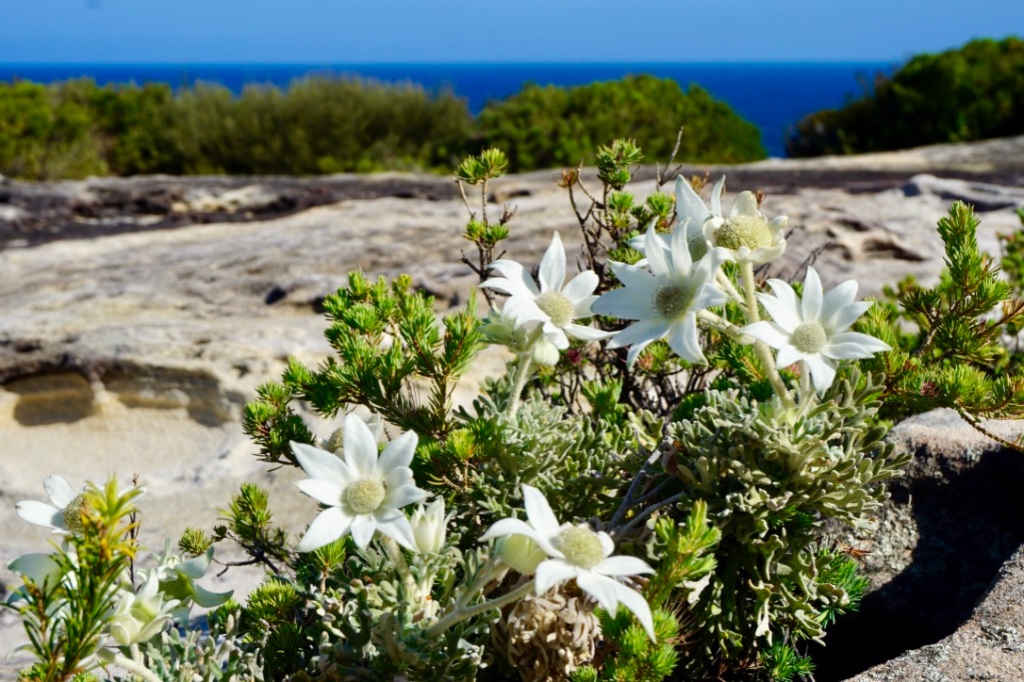
Flannel flowers were always highly prized in my childhood. With their creamy-white star shapes and grey-green foliage, they seem so insignificant and plain, until you touch them and you can feel the soft, velvety fabric feel that gave them their name. On close inspection you can see the pale green tips to each petal, and an echo of the same pale green in the centre of each flower. The daisy-like flowers point to the sky and a profusion of flowering occurs in spring and continues through to Christmas. However, in some secret places, I have found flannel flowers almost the whole year round. When the plant has finished flowering, it is almost impossible to find, even when you know where to look. Often there are other white flowers that distract and confuse — white spider flowers, for example. For me, the flush of flannel flowers lifts my heart because my favourite times are the warmer days, and flannel flowers give me notice to prepare for holidays and sunshine.

Fabulous flannel flowers!
Eucalypt flowers like a bridal veil.


From the late winter flowering of “eggs and bacon” which continues through the summer, to the various wattles which light up the bush with gold that looks so much better where it grows then even in a photograph. As a child I wanted to bring some home to my mother, who loves flowers. The springy, tough branch wouldn’t pick easily and I had to twist it, to wrench it free (losing a lot of the fluffy yellow blossoms in the process). When I arrived home with an armful of flowers for my mother, she immediately ordered me outside with it. Wattle drops flowers when in a vase, and my mother also blamed much of her asthma problems on wattle flowers. We now know, erroneously.

Wattle in bud — macro photo.
Deep inside a wattle bud — microscope photo.

At any time of the year, wattle is in flower, one variety or another. It is so distinctively Australian, our “green and gold”, like the sunshine of summer.

Fragrance is not something we usually associate with Australian flowers, but wattle, and even eucalypt, has a strong honey perfume when in flower. Australian honey (made by European honey bees which were imported in the early days of colonisation) has a stronger flavour than the delicate European floral honeys.

Many Australian native animals, birds and furry creatures, often feed on the abundance of nectar from many Australian flowers. Waratahs and Gymea lilies can visibly drip with nectar. And if you ever get the chance to get up close and personal with a brushtail possum you can smell the honey on its breath.

In our backyard, which has remnants of native trees and shrubs which we never cleared, the Christmas bush is in the first white flush of flowers. Most people know the Christmas bush as a profusion of tiny salmon-red bracts, overflowing vases on the Christmas dining table. But the true flowers are the white buds which cover the trees from September.

Christmas bush flowering early. The salmon-pink bracts come later.

As we drive through “the bush” we watch the seasons ebb and flow. There is always something in flower at any time of the year, and we watch the landscape change in colour and form, and mark the passage of time.

Flannel flowers on Sydney sandstone.

I Must Go Down to the Sea Again…

The weather is warming up here, Down Under. People are flocking to the beaches and in our area the tourists have been flooding in on weekends and in school holidays.

A busy day on our beach. No social distancing.
Peace at last…

But when school is back, and it’s midweek on a warm day, it’s time to check out the tranquility.

I’ve discovered that when the tide is washing in, the sea is icy. But when the sea has had a chance to warm itself on the shallow sandy areas, it warms up fast. When washing in, the cold from the deeper water floods in and my legs go numb. So where possible, I swim on the outgoing tide.

I watched him sail past — so peaceful!

My exercise involves wading in the water along the beach. The push and pull of the waves adds an uncertainty to my feet, which encourages my muscles to work harder to maintain balance. When the waves break, often at knee height, it’s like a refreshing spa as the foam ebbs and dissipates. Until the next wave.

Midweek early in the season, the beach is almost empty. Often the waves wash the sand clear of all impressions, and mine are the only footprints.

Life in the rock pools — ecological balance, or war of attrition? The limpet and the chitons (suit of armour) are herbivorous, but the brown-bobbled oyster borer is an active predatory snail.

I never take a towel to the beach. If I have driven the car there, I leave the towel in the car where it can stay warm, dry and sand-free. If I take anything at all, it’s a water bottle and maybe a book. I’ll sit directly on the sand, facing the water (never take your eyes off the sea). When I feel it’s time to go home, I put my book and water bottle away in my bag, then go into the sea to rinse off. Once clean, I walk back to my vehicle and go home.

A session at the beach is therapy. I get my exercise, physiotherapy, my Vitamin D and above all, a sense of peace that follows me for the rest of the week. When I’m writing my novel about the sea, I claim my time there as research. Blessed, calm research!

From my position on the sand with my book, I found myself inspected by a hungry seagull.

On the weekend the beach will be busy again. During Covid, crowded beaches are risky. On the weekend I’ll stay home. But during the week — I’m drawn back to the waves, to the sand, and to solitude.

Time to go home…

Cats of Greece

Often when I travel, I have a writing project I’m working on, with the travel providing further research opportunities. And sometimes a place will bring unexpected experiences. In Greece, every cat surely has a story.

Paleorchora, Crete, Greece. Adorable eyes and impossibly long whiskers.
Win win — any dropped titbits get scarfed down, which keeps rats away.
And any rats that do hang around… get scarfed down. Paros, Greece.

My first encounter with Greek cats was when our family visited Greece in 1989. We had gone for lunch to a taverna in a village to the east of Rethymnon. We sat in the shade of mulberry trees espaliered horizontally as an overhead canopy. Purple splotches showed where ripe mulberries had landed, and a number of cats prowled among the tables, looking imploringly at our meals. Below the apartment in Rethymnon on Crete where we were staying, we had seen some very large rats prowling a midden heap and decided against an evening walk down that lane. There seemed no reason for the cats in that area to look so scrawny and battle-scarred… hang on, those were very large rats, weren’t they?

Waiting for the next meal. Naxos, Greece.

Rats are everywhere around the world and there are parts of my own village that are to be avoided at night. Around our house, snakes move in to keep down the rats. It gives us a very strong incentive to get rid of the rats before the snakes move in. As for photos — it’s a lot harder to find snakes hovering around a table waiting for a titbit…

In Greece, the cats live in a symbiotic relationship with humans, and a predatory relationship with rats, mice and lizards. When we returned to Greece in 2018 I was ready to pay more attention to the cats. Allowing cats to roam and live freely is a very natural way to keep everything in balance. We’re just not used to it in Australia, where native wildlife is still very vulnerable to the hunting skills of cats.

Cats used to be worshipped in ancient Egypt. They have never forgotten this. Athens, Greece.
Our dining companion on Paros.
Owning the space — Naxos, Greece.

When we travel, we experience different lifestyles. What won’t work in Australia appears to work very well in Greece. In Greece, cats are indigenous creatures. Each cat has its own story, and even those who put down the occasional dish of food can only guess at some of their adventures.

Paros, Greece. This cat embodies what is fascinating about Greek cats — THEY own the place
and merely tolerate our presence.
Naxos, Greece. At a taverna on the beach near the harbour. A small boy was trying to play with the cat and poking it with a stick. He got scratched. There are warnings to not annoy the cats in Greece. I produced my bottle of hand sanitiser for the mother to apply to her mischievous son.
On Perissa Beach, Santorini, a cat with unusual appeal.
Fira, Santorini, Greece. Water is precious on Santorini, even the cats get bottled water.

Photographing cats in Greece is challenging — most of these images were taken very quickly, few cats were willing to pose. I had to be quick, and I had to be lucky.

While learning more about Greek cats, I once again found the connection with ancient Egypt. In Greece also, I was told, the god of cats is Bastet, the same as for Egypt. And the ancient Egyptian word for ‘cat’? It’s ‘Mau’!

On Naxos, Greece, outside the church of St Anastasia. This cat, we were told, is called Ares.
A ginger tom, named for the Greek god of war. How appropriate!

In Greece we found cats in many places. Some were battle-scarred veterans, others were exquisitely perfect kittens. All appeared to be more than tolerated, they were welcomed and supported. While many were not strictly pets, but opportunistic hangers-on, they all appeared to be accepted as part of the space.

Skulking under the skirts in a dress shop in the old town, Chania, Crete, Greece.
Same cat as above. Air conditioning condensation makes for cool, fresh water. Chania, Crete, Greece.
Fira, Santorini, Greece. Her place in the sun.

Truly, cats don’t have owners. They have staff.