We’d heard about this epic train, but nothing can fully prepare you for that first sight of the Ghan. It’s big.
Jeff, my personal ‘Mick Dundee’, according to the overseas passengers, with the bulk of the Ghan disappearing into the distance.
The company pulls out all stops to make this a full-on Aussie outback experience, and the train does not disappoint. A country singer entertained us on arrival at the station. ‘It’s Charles Darwin’s birthday today,’ he told us. ‘The city of Darwin was named after this great naturalist.’
A great way to be welcomed to this epic train trip.
Those in more distant carriages had the option of a bus to get them to their carriage. We were close enough to walk. There were 123 travellers with 47 staff to tend to our needs. Three crew cars, three power cars, a baggage car, a car car (ha!) three restaurant cars and three lounge cars. And guest carriages, of course. All hauled by two locomotives.
On board we were met by a cool breeze in the corridor as we were shown to our compartment. Everything we could need is there (apart from wifi!). Small bathroom, lounge seating which converts to bunk beds.
Our tiny cabin built for two on the Ghan.
The very next carriage to us is the lounge — open, relaxed and a good way to mingle. Beyond that is the dining room. Tables seat four, so if you’re travelling just as a couple you will find yourself meeting new people. Not all of them have English as a first language. The food was fabulous, need I say? And dietary requirements were most definitely catered for. Table service, menu selection, barista coffee from the bar, or anything else — all drinks on board were catered for, for the entire trip. Sherry nightcap? Certainly. Sparkling wine with dinner? But of course! Another? Don’t mind if I do.
The very comfortable lounge, with the bar at the far end providing any drinks on request.
With three scheduled stops along the way, we next had the pleasant task of deciding which off-train excursions to choose. Given how far I’d walked the day before in Darwin down to the rock-pool, I opted for the least physically taxing trip. The rock art tour of Nitmiluk National Park (formerly known as Katherine Gorge) was recommended.
Nitmiluk, formerly known as Katherine Gorge. It’s now completely owned and run by the traditional custodians of the area.
When the time came, however, we didn’t get to see any rock art because to get to it, we’d have had to change boats to one which had its jetty a few inches underwater from the recent metre-high river rise. Given there are crocs known to be in the area, this was considered too risky… instead, we relaxed, enjoyed the scenery and listened to the local ranger talk about the stories of his people. The area is called Nitmiluk, he told us, because in the local language ‘nitmi’ is the word for the type of cicada that makes a pulsing sound. ‘Nit…nit…nit…’ and ‘luk’ means ‘land’ or ‘place of’. It’s two words, not one, but when written down by English-speakers, it was written as one word. Even as he explained this, we heard the cicadas start up. ‘Nit…nit…nit…’
Can you see the crocodile in the rock? It was the only one we saw.
On the way back to the train someone remarked on some areas of recent fire.
‘That’s backburn,’ we were told. ‘That one was about two weeks ago.’
We expressed surprise at how much regrowth there had been in such a short time.
‘Yeah, it grows different up here,’ the ranger assured us. ‘We backburn in a checkerboard pattern, but only a cool burn. Never when it’s too dry, like it has been for so many areas over east. That’s when even a cool backburn can get away from yer.’ He went on to describe cool burns in the morning, when there is still dew on the ground. The checkerboard pattern allows for re-seeding of those native plant species that need fire to germinate, while still allowing adjacent areas to remain unburnt as a refuge for wildlife.
Ye’ve had a bad time over in the eastern states,’ he said. ‘Some areas that had been recently backburned burned again, several times. It’s been far too dry for too long.’
Due to the change in boat tour, we had a bit of extra time so driving back through the township of Katherine, the bus driver detoured. We were amused to hear him talk about how the push for solar panels for the town’s power supply ‘can’t come soon enough.’ We’d been led to believe that in this part of Australia where mining has been so important to the local economies, people were against renewable energy. Someone asked the driver that question.
‘Don’t get me wrong, mining has been good to this town. But we need something to transition to for when the supply runs out. And up here, we’ve got loads of sunshine.’
Another motivation, I suspect, is a chance to not have to rely on bigger territory-based energy supply from outside the town. Looking after their supply themselves, not having to rely on others. The people who make their living up in the north of Australia are fiercely independent and resourceful. If any people can make a good living up here, not just a scratched-out one, it’s these people. Territory people. They’re proud of their history, proud of their ability to pass their living onto their children and grandchildren. They are finding innovative ways to do this. The future generations up here are assured.
We arrived in Darwin to grey skies and muggy heat, but rain was only a distant promise. The hotel foyer smelt of mildew, a flood best forgotten and not mentioned, as there was no such odour elsewhere. The hotel foyer looked like the one in the famous video of Fatboy Slim’s ‘Weapon of Choice’. We half-expected to see Christopher Walken floating in the air above us.
We had a few purchases to make and a city to explore, so once we’d plugged in laptops to charge, we set out. I knew there would be time to write in the evening.
Out on the street the heat and humidity were breathtaking. In contrast, walking in to any shop bathed us in coolness. Many shops were closed, either to open later in the relative cool of evening, or simply shut for the entire wet season.
After our shopping we walked the long way back to the hotel past a huge banyan tree, a parasitic ficus that slowly destroys its host tree once it no longer needs it for support. Often in turn the older banyans are themselves parasitised by younger seedlings, accidentally planted in the droppings of bats briefly roosting.
The tangle of aerial roots of a banyan tree in Darwin.
Next day we had an early start for some group exploration of various waterfalls and other sights. At the foot of Florence Falls is a plunge pool which was wonderful to swim in. It was a pity to have to climb up the 135 stairs (I counted them all!) to get back.
Florence Falls ,in Litchfield National Park near Darwin, NT.Swimming in the plunge pool was worth the climb. That’s me in the blue swimsuit.
We visited other falls where swimming was not permitted, owing to the risk of crocodiles, both freshwater and saltwater. Along the way we spent time with various locals and heard some fascinating stories. While discussing crocodiles at Wangi Falls, a local cafe owner told us of the few incidents of croc ‘attack’ of tourists. In each case, he told me, it was freshwater crocodiles that had been provoked by the tourist victims. In one case a Russian tourist had ignored all warnings and been swimming. A one metre long ‘freshie’ had been quietly sunning itself on a log, statue-still. The tourist swam up to it and, thinking it might be dead, poked it repeatedly to see if it would move. And move it did. It bit he man on the side of his face. Nasty.
Wangi Falls. We were told it’s pronounced ‘one guy’. Crocs are around, but we didn’t see one.Cycads near Wangi Falls.
With the other case we were told of, a young woman saw the crocodile on a nearby rock and wanted a selfie with the croc in the background. While lining up her shot, she backed in ever closer to the freshwater croc which was apparently camera-shy and fed up with the intrusion. It bit her on the shoulder.
Naturally, both these tourists were annoyed and aggrieved, but they had been warned and got no sympathy. ‘Darwin Award contenders, both of ’em,’ the café owner told us. Honourable Mention, of course. They survived to pass on their poor survival characteristics.’ The Darwin Awards are not named after the city, surprisingly, given the number of risky situations a person could get into in the hazardous conditions.
Sunset in Darwin, as best as we could see it. Sunset doesn’t so much fall here, as slams down.
Darwin Awards are given each year to those individuals who do the human race a favour, evolutionarily speaking, by removing themselves from the gene pool, often in the most creative way imagineable. Swimming in Darwin Harbour is an example often given. ‘Yeah, we got a name for those idiots,’ one local told us. ‘Croc food.’
The rain started during the week. A slow, steady, soaking rain. Just what we needed. By Thursday, the road north was blocked by flooding. ‘Okay, Hughie, you can stop now.’
Flooding around Sydney while fires still burn further south.
But still it continued. Rain getting heavier. I tapped the side of the rainwater tank — almost full. Water bowls for the backyard birds were overflowing and the rainbow lorikeets, normally so enthusiastic about rain, had clearly had enough as they huddled bedraggled under the eaves.
Wet rainbow lorikeets. Normally they love the rain. But they’ve had enough.
With our upcoming trip to Darwin looming, we looked forward to getting out of the persistent wet. I had a lot of errands to run and every time I got out of the car, I got soaked to the skin. With the winds getting strong, I was having to clear the driveway of fallen branches. The road was littered with leaves.
On Sunday, the day before our morning flight to Darwin, we were desperately checking the status of roads, rail and air. The wind was due to ease, so the flight should be okay. The rain was continuing, we were getting about 100-160 mm (3-5”) each day. We decided to go visit family on the highway, a last visit before the trip. In case the plane crashed or something…
The drive out was challenging, with fallen trees and potholes. Soon after leaving the village we were stopped by a queue of cars behind a fallen tree. A group effort pushed it off the road sufficiently to let us get past. Further on, the torrents of water cascaded over rocks beside the road. It was all rain run-off grown to spectacular scale. Police had road-blocked the winding south road out. Beyond them we could see fallen trees and there was talk of rockfalls.
An overflowing drain beside the road.
By the time we drove home few hours later, the problems were even worse. Water sheeted across the road from run-off with nowhere to go. What had been a dry creek bed the week before was a raging torrent. Then we turned a bend and saw a car’s headlights, not moving. There was a tree down fully across the road. Not a huge forest giant, but big enough to not be movable by one person. The driver of the car had seen the tree come down right in front of her.
Downed trees across the road in the heavy rain.
A number of people came forward and with four people dragging, they got the tree far enough off the road to open one lane. For the rest of the drive we saw more fallen trees and rockfalls which had not been there on the way out.
An hour after we got home, the final link with the outside world was severed. That road was closed. And with heavy seas, we knew the ferry would not be running.
Next morning there was good news — the road out was open again. For now. We grabbed our luggage and got going barely before the sun was up. The road was a mess of washouts and more sagging trees. We had decided to catch the train rather than try to navigate the various flooded roads, traffic light failures and other hazards. When we finally got past the obstacle course to get to the station, we noticed that the car park of this usually quiet railway station was crowded.
On the empty train at last, destination city…
Wonder of wonders! There was a train just pulling in. Instead of continuing south, it was returning to the city, they told us. Empty train — we settled on board. Another passenger told of her harrowing drive around blocked roads to start her first day of a new job in the city. South of us, there were rock falls blocking the rail line. Others had also driven. That accounted for the full car park.
Half an hour later, the train terminated at a crowded midway station. We watched in dismay as the platforms filled up ten deep. We had luggage, we needed time to maneuver, we had no hope.
Crowded train platform, full trains or no trains.
We watched a train eventually pull in, already packed to sardine capacity. Maybe three or four people managed to squeeze on. Meanwhile another fifty or sixty arrived. A few more trains came through in quick succession — on the other platform, of course. Ours began to empty as people left. I suggested we consider getting a taxi direct to the airport. Jeff looked at the traffic reports on his phone and found that flooding had closed the road access to the airport terminal. Train was our only option. All around, people were trying to assure us, ‘the timetable says you should get to the airport just after nine am.’ But with all these problems, it was clear that State Rail had thrown the timetable out with the floodwaters.
Going nowhere fast.
After another two trains began to empty the far platform, we decided to move. Despite the bags, we took the stairs. The wait for the lift was too long.
It took three more trains before we felt we had a chance. We managed to squeeze on with our bags, standing room only, of course.
After that it was easy. We changed trains at the junction for the airport line which was mercifully empty. Here it was mainly travellers also with luggage. Some had already missed their flights. In five minutes, we were in the airport terminal and checking in our bags. We got through security with about forty minutes to go. Ahh! Breakfast!
We had timed it well. We got to the gate about a minute or two before boarding was due to start. That is when the fire alarm went off.
The alarm shut off then five seconds later, would get re-triggered by something. Jeff, experienced with fire alarms, considered that water might have gotten into the system. Boarding was tantalisingly close, but just as the door would open, the alarm would recommence and the door would be shut again.
Finally on re-set the alarm did not sound. Yes! The door opened and we shuffled forward. About half the plane had already boarded when we finally got through the gates. As we walked down the corridor to the plane, we heard the fire alarm start up again. Behind us. We kept walking.
Darwin, here we come! Goodbye rain!
Good bye to soggy Sydney as we climb above the clouds.
Hang on, the wet season has just arrived in the Top End… Noooo!
When we travelled in 2019 it was, as always, a time of adventure and surprise. One of those less pleasant surprises was on our first night in Hong Kong, when my emails to some addresses were bouncing. ‘Message temporarily deferred due to user complaints.’ Odd. As I was at the time also editing some narrative contributions for a group anthology, this was putting a big stick in the wheel spokes.
Clouds over Hong Kong in early June 2019.
The next day, our first full day on Hong Kong, was also the first day of the protests which have caused such consternation to the Chinese and Hong Kong governments. It took another day before the demonstrations settled. At about the same time my emails finally went through. I had written my blog about concerns for democracy but there was no way I was going to upload it while still in Hong Kong. Instead, I put it up after we got to London.
Editing while on the move can be challenging, but we had enough train trips and early nights to give me time to go over the work. I would send the files back to the various authors via email. From time to time, emails would bounce again (always to the same service providers) but this would resolve. Over time, however, this has become worse. When we got back home we had our service provider on speed dial and they assured us they were working on the problem. It seemed that some addresses from our very small, boutique service provider were sending out a lot of spam and the bigger service providers were flagging the whole company as a problem.
Eventually I was using other means to contact the people whose email I had trouble with. Phone calls, personal visits carrying USB memory sticks… not easy when you’re not in the same country.
Editing and writing on the go. We are so dependent on technology!
Roll forward to January 2020. We had an afternoon and evening in the city. We’d collected our emails that morning. Not as many as usual but, we figured, people are still in holiday mode. I still had a notification of a bounced email to a yahoo address, but they were now commonplace. I’d stopped reporting the problem.
We got home and found no new emails. Not even the expected three-hourly reminder of the bounced emails. Nothing. Zip. Nada.
Next morning, still nothing. Friday before a long weekend. We rang the service provider tech department. Meanwhile I began using Messenger to send out to a writing group committee. One of them had already sent me a message to say her email to me had bounced. But our service provider had no evidence of anybody trying to send us emails. Nothing was even reaching their in box. Their new patch had permanently cut us off.
The state of our email and internet service currently. A fixer-upper…
It took some time back and forth, but incoming emails were not happening. People sending us emails got an error message. I could send emails and people could receive them. ‘I can’t understand it,’ the tech guy said. ‘Your email address should never have been working. It’s been going via a route we didn’t think any customer would be using. We sacrificed it because we had to put a patch on our firewall because for months now, we’ve been getting flagged by big US service providers such as Yahoo as fraudulent, because some email addresses are apparently sending out large amounts of junk emails.”
My mind flashed back to that first full day in Hong Kong, to the overly-paternalistic Terms and Conditions of various hotel and airport wifi I logged into, and to the level of surveillance which we found afterwards was definitely happening at the time and since in Hong Kong. I mean — politically, I’m a nobody. A writer. But that day I suspect everybody was potentially a concern. And we were westerners who had just arrived there, the evening before the first big day of unrest. Was our email address being spied on? Piggybacked via a Trojan horse?
I mentioned my concerns to the tech guy, but he just laughed. I admit, it sounded like something out of a Star-Wars-inspired paranoia. ‘I blame the Chinese government.’ Yeah, right… and alien probes, too? Hahaha…
Hong Kong minions perhaps…
After another week or more of problems with emails and service, including thirty-six hours with absolutely no internet access at all, it now appears that the patches installed by the tech department in a desperate attempt to stem the outflow of random spam from somewhere in their client base, have had an unexpected fallout — us.
It’s been peaceful, of course, but the sort of peace you get in the eye of a cyclone. Somewhere in cyberspace there is a lot of furious activity going on which will eventually have an impact on us, but for now everything is still ominously quiet.
They gave us a new email address, but we’re still working out the bugs. I’m trying to track down people who I really need to hear from, but who I cannot contact because I could only submit my writing to them via their website. Which, of course, has my old, and now defunct, email address. Anything sent to that email address can never be received or recovered. Worse, they will get an error message suggesting there has been a security breach.
So, my message to the world out there — if you have tried to email me, and got an error message in reply, I am still here. Waiting with bated breath to hear from you.
And if you’re the Chinese government listening in and piggybacking on my emails — ‘These are not the droids you’re looking for. Kindly move on.’
RAIN. After months of fires, we have rain. It’s not enough to break the drought, it only reduces the fire risk rather than removing it, but it’s rain. Blessed relief, delightful moisture, filling parched throats, water tanks, dams and the thirsty land. Under these circumstances, the invocation, ‘Send ‘er down, Hughie!’ is uttered to the skies with a grin.
Teams of sewers working to make pouches for injured wildlife in care. A mammoth effort around the country. Some groups are even posting pouches from overseas!
I have driven through it only short distances. Other areas have had more rain than we have, but nowhere has had too much — always a danger after so long without. Sometimes there has been a roll of thunder across the skies, as if ‘Hughie’ is deciding where to send ‘er next.
Puddles! The first rain also brings the saponin-rich froth from the Australian native trees. The dripping gutter is making circles of suds.
We’ve seen footage of young calves experiencing rain for the first time. The joy of a child who has never felt rain on his face, water falling from the sky. We’ve fallen asleep to the patter of rain on the tin roof and the delightful trickle of it filling the rainwater tank.
Many areas have been badly burned, but this is Australian forest. We will get regrowth except in areas which were burned repeatedly before recovery could begin.
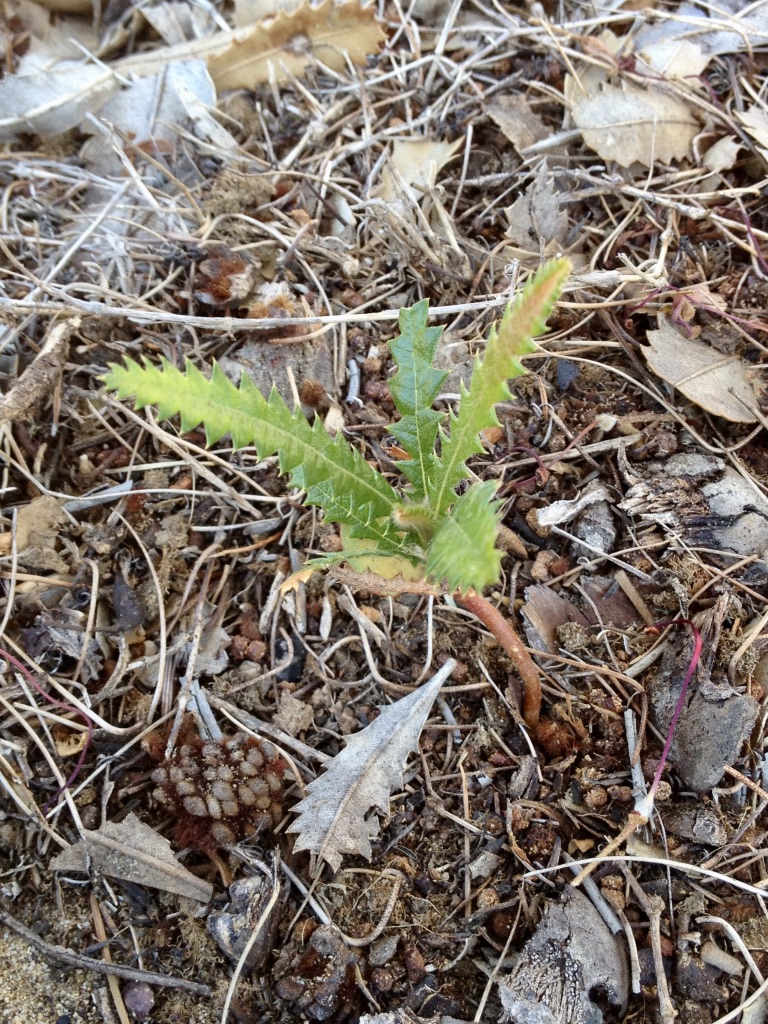
A burnt area begins to regrow as soon as the rains come.New life in bare ground — a baby Banksia serrata, its seed released by fire.
Wildlife which has survived is being fostered, with a view to eventual release when the forests have recovered.
A ringtail possum clings to the building’s brickwork. Many animals have been displaced this fire season. Many have died.
Through the drought we’ve been handfeeding lorikeets and providing g drinking water on tables and on the ground. We’ve seen small skinks desperate to reach the drinking water, and many birds have drunk and bathed in our makeshift bird baths. The nectar mix which we’ve fed birds while the flowers have been less abundant has also fed honeyeaters and even a friendly possum or two. A few over-ripe mangoes delighted the baby lorikeets which visit our table.
Special nectar mix for nectar feeders like these rainbow lorikeets. They have been missing their usual food sources because of the drought.
Rainbow lorikeets love the rain — around water they are like over-excited kids at a water park. Often the first we know that there is rain, is the sudden boost in sound of ecstatic birds, playing and delighting in the rain.
We will recover from the fires. It takes time, we need to be patient, but the rain is the beginning.
It’s no surprise that Australians of all species love to dance in the summer rain!
What is it about Christmas celebrations in a hot climate? We insist on clinging to the traditions of a colder place and serving up the bone-warming, steaming, fat-laden dishes designed to keep the winter chill at bay and a body alive until the first blessed shoots of spring emerged, months later. And we do this when the temperature outside is climbing above body heat; when the fires are raging on the hills and the beach beckons.
Summer Santas in the sun.
Here is a classic example of Christmasses from the past. Any resemblance to family members past and present is purely coincidental. Haven’t ALL Aussie families got memories along these lines?
We woke after sleeping in various unusual places, the result of a house literally bursting at the seams (I mean, have you seen the west wall? It’s falling off the house, there’s a gap you can see daylight through). The sounds of neck bones and other joints being cracked back into submission were drowned out by the clash of pans and clamour of hysterical activity from the kitchen. Breakfast? No chance. Christmas dinner preparations were underway.
Nobody could decide, months ago, WHICH hot meat to consume for Christmas dinner. Surprisingly, there was to be no traditional goose, although someone at the last minute bought a turkey buffet breast (‘it’s only the breast, it’s not huge or anything’) to supplement our repast. As if it would be in need of padding out!
So as one aunt rubbed salt into the scored skin of what looked like half a pig, another had her hand inserted so far up the chicken’s rear end you could see her fingers rippling under the skin, like some science fiction alien invader, as she prepared chicken galantine. To do this, you must remove the spine and rib cage through the neck, leaving the chook (Australian slang for chicken) intact so it can become a skin for more stuffing. Unfortunately, she chose a flavour-basted chook, the ones prepared by butchers with many small cuts made in the skin and flesh, through which ‘flavour’ is injected. And as she tried to separate the bones from the flesh of the raw chook, small rips kept appearing, which she stitched up with kitchen twine and an upholstery needle. The end result after stuffing looked less like a chook and more like one of Dr Frankenstein’s more novel experiments.
There was also a lamb roast, almost obligatory for any Australian celebration, although the teenage daughter had attacked it with a carving knife to leave deep gashes in which entire cloves of garlic and branches of rosemary had been stuffed. It now more resembled Birnam Wood trying to break into Dunsinane Castle, having been badly wounded in the process.
And the ham! It, too, was to be baked and glazed. The only problem was that although another ham had already been cut into for Christmas Eve supper, one of the uncles had decided to begin slicing the larger ham ‘because it made bigger slices’. And having finally wrested control back from the uncle, mother proceeded to begin the sad attempt of glazing and decorating an already butchered ham. Then the inevitable — how can one small oven succeed in roasting seared pork with crackling; a gentle slow roasted galantine, a turkey buff breast that could have come from a pteranodon and a HUGE pre-loved ham with chunks of pineapple and glacé cherries mountaineering using toothpicks as crampons? Five roast dishes, three different temperatures, one domestic oven.
’That’s why we always start early,’ announced mother, desperate to regain control. ‘Dad — fire up the Weber!’
The Weber is thankfully family-sized. By this I mean a small family could live in it. So while Dad struggled to get the heat beads lit, Mum heated up the oven. ‘We’ll cook the chicken and the pork in the oven, the turkey and the lamb can go in the Weber, and the neighbours have kindly offered to cook the ham in their oven. But of course, this means they’re coming for Christmas dinner as well.’
’Do they know what they’re in for?’ I heard someone ask, to be silenced by a glare from Mother.
‘Don’t be so cynical — it’s Christmas!’
Somewhere in there, the kids were clamouring to open gifts. Dad’s comment of, ‘I need a drink!’ led to the champagne being opened early, still warm. The family crammed into the living room, sitting on any safe horizontal surface including the floor, with the surfaces unsafe for sitting on already laden with pre-lunch nibbles, to sustain us through the arduous task of gift opening.
Eventually after many yells, both aunts and Mother arrived apronned and sweaty from the kitchen, to be handed a glass of warm champagne. ‘Well, isn’t this nice!’ said mother, as she flopped onto the arm of the couch. ‘Hang on — the oven!’ as she disappeared kitchenward.
Once Mother was hog-tied to the couch with her own apron strings, we could begin. The youngest child of reading age was delegated to hand out the gifts, one at a time. Each gift had to be opened with the entire family breathless with anticipation, then the receiver would hold the gift up high and announce in rapt delight, ‘Look — socks!’ Then the snap-happy uncle who had bestowed the gift had to take a photo of the recipient wearing the socks, another photo of the recipient smiling, and then explain how to work his camera so someone could take a photo of him with the sock-wearing recipient.
And so it went. Every so often it was discovered that Mother or one of the aunts had slipped the leash and escaped back into the kitchen, hidden in the clouds of steam from the cauldron containing the pudding, being given the five hours of boiling it should have had months ago. Cries of, ‘Mum!’ or ‘Aunty! Get back out here!’ were frequent, interspersed with mutinous muttering about Uncle’s camera. Only by now, more cameras had emerged, with photos now being taken of every recipient, ‘…for Aunty June who cannot be with us today.’
At last the gifts had all been handed out and the tree now looked much barer, while the floor was littered with mingled gifts and paper. Time to set the table.
Amazingly, the meat was all ready at the same time. Unfortunately, the family were not. As a result, the kitchen was full of dishes of meat in various stages of cooling to salmonella-loving temperatures while the vegetables were being cooked. The table had been decorated with a large vase of Christmas Bush, loving hand-crafted centrepieces at every place; several glasses per place and a Christmas cracker each. Candles burned with a fierce glow, adding even more to the sweatbox feel, now being enhanced by the pudding in its boiler. No room for the food! And also, no room for the children, who were to be seated at a complex array of play tables, card tables and an old door on trestles, all covered with a plastic tablecloth.
NSW Christmas Bush in the local park.
We will gloss over the bustle to and fro, of the undressing of the table sufficiently to allow some food to be placed there. At last people were seated and it was discovered that the platters could only contain small tokens of the magnificent roast denizens, all designed to be carved to an audience. So the family trooped into the kitchen, trampling small children underfoot, to watch the ceremonial carving of the roast pork, the turkey buff breast, the chicken galantine which now filled an entire baking dish on its own and the massacred lamb, its rosemary branches now seared and blackened as if by a bushfire. We had a sense of anticlimax as we went back to the dining table, each carrying a plate loaded in the kitchen. We carefully arranged ourselves so we could all sit AND reach the table somewhere, when the neighbours arrived, carefully balancing the enormous ham, the cherries and pineapple barely holding on. ‘That pesky parrot next door was out loose, it attacked us for the fruit as we came round here. Where will we put it?’ So again, we had to troop out to the kitchen to watch the magnificent ham being carved.
The amazing retro glazed ham. Who wants hot baked ham in a heatwave?
‘We didn’t want to arrive empty-handed, so we went out and bought some barbecued chicken,’ they explained, as they produced still more food.
We rearranged ourselves once more to accommodate the neighbours, now even more a feat of Tetris than before.
‘Hang on! I’ve got to get a photo of this!’ Uncle jumped up, followed by several other family members each with their camera.
‘Hold on, we can’t all take photos at the same time — who will be in the picture?’ Uncle complained. So everybody but Uncle sat down again while he took the photo. But trying to get a photo of so many hungry people, and have ALL of them with eyes open, facing the camera and smiling – not easy. At last it was achieved. Then the next person had to take their photo. And the next. Then Uncle noted, ‘You know — in every photo of Christmas tables, I’m never in the photo…’ so the neighbour kindly offered to take photos for all the camera-owners who were feeling left out. It took some time to give the neighbour a crash course in how to operate a dozen different cameras and even longer to again get photos where everybody was smiling, eyes open.
At last it was done.
‘Time to pull the crackers, everybody!’
Again, forks poised to mouths were put back on the plates. We picked up our crackers, and once more there was some fiddling while we arranged ourselves under Aunty’s direction. It appeared to be an ancient, mystic family ritual that required crackers to all be pulled at the same time, with hands crossed over so we all looked like strait-jacketed asylum inmates. Of course, the resemblance was increasing every minute.
We’re crackers at Christmas in Australia.
At last, crackers pulled to satisfaction, we had to put on the hats. Some of these were small enough to slide over the baby’s wrist while others could have been worn as a hula skirt by Fat Bastard.
Uncle took photos of everybody wearing their hats. This was much quicker now, because eyes rolling to the ceiling and middle fingers hoisted skywards now were seen as acceptable. This was the informal shot.
At last, we began to eat.
‘My meat’s cold,’ remarked Dad. ‘Hey, does anybody else want their plate warmed up?’ He carefully clambered out from his spot, unseating two people to each side of him in the process, who then figured that as long as THEY were up, they may as well heat theirs up, too. And the process continued around the table, like a nuclear chain reaction.
‘Don’t wait for us, just start.’ Dad yelled through the steam from the kitchen, which meant that OF COURSE we all had to wait. By now the sun was low on the horizon, lunch was still allegedly underway and the children were, to put it mildly, getting restless. ‘Mum, Warwick is poking holes in the plastic tablecloth.’
‘I am not! It was you! Besides, they’re disposable anyway…’
The tablecloth was duly inspected, to find that ALL the kids had been quietly poking holes in the edge, perhaps out of hunger and sheer frustration. At last the plate heaters returned and again, carefully eased back into their seats like contortionists. At which point Mum leaned across to Uncle and said, ‘Are you SURE you have enough food there? You didn’t get any of the turkey, and we got it for you especially.’
Uncle, to his credit, said he’d get turkey for his second helpings. Mother meanwhile was glaring around the table to make sure none of us were about to starve.
Just then the timer went off somewhere in the foggy kitchen. ‘The pudding’s done!’ Mother shrieked, knocking over two more relatives precariously poised on either side of her.
‘It will keep! Sit down!’ and the adult children on either side of her dragged her down into her chair and helped up the fallen relatives. People at last began to eat, to the murmured litany of mother complaining, ‘I don’t know why you treat me with such disrespect, I’ve been slaving away in the kitchen all day and what thanks do I get…’
A glorious Christmas cake, home-baked to a family recipe. ‘Merry Christmas’ ingeniously improvised with jelly snakes and scissors.
Every dish had to be tasted, by everybody present. All the children complained that the food was too spiced, too sweet, too different and please can we leave the table? Sweat streamed down every face, vast amounts of fat and carbs were consumed, belts were loosened and everybody insisted, ‘Next year we’ll just have seafood and salad!’
When we travel we stay in various places (of course!). I do know some authors who note the artwork on the walls of the places where they stay. Either in the rooms or corridors, the artwork is serving a purpose for the owners/managers of these establishments.
We tend to note these items peripherally, to feel them rather than see them; they are part of the ambience, nothing more.
But for me, I crave stimulus material. Yes, there is generally a reason why I have travelled to this place which means that the stimulus material is all around us, elsewhere. Not within the hotel. But we still spend enough time in the room or the corridors, to be influenced by this also. Does the place reflect the more wider environment?
And I’m noticing a pattern here. Going back over old photos, as well as casting my mind back through the memories, I’m realising that the determination to be generic in the artwork chosen is producing another genre in itself — the inoffensive abstract. The budget reprint. The ‘out of copyright’ prints occasionally, but more often, the ‘struggling artist who can give us what we want in return for minimal payment’ artwork.
There are abstracts, and there are abstracts. In the living-room area of our room in Melbourne the artworks were unsigned and very basic. Just circular swirls of paint with some metallic gold texture blobbed in. The colours chosen to match the décor, as if the artwork was produced by the decorator more as a sample palette than anything real.
Black/gold/red ‘negative-positive’ effect. Attractive, simple and very neutral.
In the bedroom were two pieces of slightly more complex art, but these are prints, carefully mounted, which appear to be identical. It is possible that one is a slightly modified pastel shade of turquoise while the other is slightly stronger in the blue tones, but with the room lighting it is difficult to tell. Again, generic and inoffensive. There should never be anything controversial of thought-provoking in the hotel. Perish the thought!
Identical prints except for slightly different shades. Since these were on different walls, we had to put them side by side to see if they were different colours or it was simply variable light.
Lifestyle shows on TV have demonstrated how to produce this sort of artwork with a canvas and some novel medium such as cornice cement left over from a renovation. These pieces can embellish a room in interesting ways, bit they add nothing intellectually. They are like a throw pillow on the couch adding interesting texture. They look good but all you really want is comfort.
So when I am momentarily stuck for inspiration while writing on the road, I roam the hotels and corridors and I’m left wanting. Occasionally I can luck out. In the corridor of the hotel in Athens, was some artwork clearly designed to hint at classical Greece, but there was something disturbing about the lack of faces in the figures. We walked past them many times over the week we stayed there, and each time I felt the non-gaze drawing me in deeper. The real Athens was outside, but these faceless figures hinted at something potentially nastier. I’m sure that was not the intention, but as a result, I valued that artwork.
Superficially romantic, on closer inspection these zombie-like girls were unnerving.
Back in Australia, in Canberra, one of our regular watering holes has taken the generic abstract to extremes. In the corridor and also in at least some of the rooms (we have yet to experience all of them) are a series of textured abstracts that perhaps hint at a desert landscape.
Abstract artwork in Canberra. There must have been twenty or more of these, just on the floor we were on.
At first seeming identical, I went looking to study them and realised that they do appear to have been individually done, but in such quantity that the artist is able to manually duplicate the work with a high degree of repeatability. As I wandered the corridors I noted one very unusual piece — the same abstract, but this time, upside down! Was this an attempt to look a little more different? Or an indication that these pieces are so banal that there is no right way or wrong way, there is just the splotch of colour on the wall whose main purpose is to alleviate monotony.
Artwork upside-down, with respect to previous, more numerous examples. I found two upside-down.
Also in this Canberra hotel the corridor walls are lined with photographs of Australian scenes including birds and animals. Each one has a price tag. For me, the stimulus from these (and I have looked at them often) was the realisation that, as a photographer, I can do at least as well. I’ve noted the images and the prices and started selling my own photographs. I’ve started learning and trying.
And it has made me realise that what drives me to try, and to improve, both in photography and writing, is comparison. How well did that photographer frame the subject? What photographic techniques were used? How can I use that technique? If I had used that in my earlier photos, how much better would they look?
One of my own landscape photographs, hopefully improved after seeing random hotel corridor samples.
And so with writing. I read other books and my mind analyses what worked for me. How did the writer manage the tension? How could I adapt that to my own writing? And then I give it a go.
As we travel, I take photographs which reflect some aspect of the experience of the place. It’s the intimate corners that hint at the human story so often unseen. So when I write in various hotel rooms wherever we are, it is not the generic inoffensive art on the wall that stimulates my imagination.
We’re on the move again, back in Canberra to visit family. With smoke blanketing Sydney, we looked forward to clearer air once we got south of the fires near Goulburn. And yes! We could see blue sky, even some wisps of cloud.
As we drove further through sparse straw-coloured pastures we could see farmers dropping fodder and desperately digging waterholes which, at best, contained only the dregs of small muddy puddles.
But we could breathe!
Looking across Lake George. Wind turbines make clean energy against a backdrop of fire. Note the slight reflection on the lake edge — that’s not water. It’s mirage. Lake George is dry.
Then last night, with windows open to catch the evening breeze, we smelt fire and our eyes started stinging. We had to drive back to our hotel through thick smoke, with yellow beams of light from every street lamp looking like painted cones on the scenery. Oncoming headlights were tubes of light in the darkness. And everywhere, the stench of burning.
The wind had changed.
The fires started weeks ago. Months. On 5 September 2019, to be exact, right at the beginning of spring. On 5 September NSW, Australia started burning. Then Queensland, within a matter of days. The eastern seaboard of Australia is still burning, with some fires too big to fight. They will burn until there is significant rain to put it out. The next rainfall is not expected for months. One fire, the Gospers Mountain ‘megafire’, covers an area bigger than greater Sydney. Sydney is one of the largest cities in the world by area. And just a note about Gospers Mountain — in Australia, what we call a mountain, most other parts of the world would call a molehill.
Burnt leaf, one of many, falling like black snow.
According to the reports, 2.2 million hectares (22,000 square kilometres or 8,500 square miles) have burned or are currently burning. That’s an area the size of Sicily. Or New Jersey. Or from New York to Philadelphia. By comparison, 906,000 hectares of the Amazon have burned this year, over a much longer period.
We live on the southern outskirts of Sydney in an area surrounded by bushland and sea. In our village, we live with constant summer precautions and fire warnings. On the hottest, driest days a lit cigarette tossed out of a car window can cause a major threat to life and property.
For months now, it’s been more than simply smoke on the horizon. Air quality has been as poor as some of the most polluted cities in the world, and visibility reduced to at times dangerous levels. Day after day. Week after week. And now month after month. Burnt leaves and ash are raining down everywhere, even hundreds of kilometres from the fires. Smoke is allegedly reaching as far as South America. We look to our weather radar for signs of rain and feel hope when we see the blue pixels moving across the screen. Then we realise — that is smoke, not rain. Smoke so thick that it fools the radar. Our radio station broadcasts fire updates every twenty minutes. It’s not uncommon to hear in these updates, ‘If you live in the X area [name of threatened village] it is now too late to leave. You must now seek shelter according to your personal bushfire emergency plan.’
Fires this bad create their own weather. Thunderstorms, dry as dust, with lightning strikes triggering more fires well ahead of the current front. Tornadoes of pure fire race along hilltops faster than a bullet train. Fireballs of superheated eucalyptus oil from the trees explode overhead. And always the wind that drives the fire on is itself created by the fire, the inrush of air to replace the burned oxygen.
We do get bad bushfires in Australia, but not this early in the season. Usually it’s after Christmas that the big problems start.
This year is different. It’s early. And unless it rains, it will continue.
We’ve had the first ever officially-rated Catastrophic Fire Danger in the Sydney area. Thankfully, in our area nothing was lit. A fire starting on that day would still be burning. That day, the entire state of NSW was under Total Fire Ban for the first time ever. And we weren’t even into summer!
Our firefighters have been working for months, nearly all of them volunteers. They are exhausted. We have a global network of firefighters and many swap hemispheres to help out their fellow firefighters when the fire season in their own region is over. But this year, fires have been still burning in California as our Aussie bushfire season began in serious earnest. Our northern hemisphere friends are themselves exhausted and our capacity to help one another is in danger. Still, they have come to help.
Australia is a big place. The area of NSW is about 810,000 square km. On 12 November 2019 there was a total of nearly 50,000 square km under Catastrophic Fire Warning, our highest rating. Fire that breaks out in a catastrophic region will kill and destroy. Another area, over 100,000 square km, was under Extreme Fire Warning. We were told to move to a safer location, but where? People who chose to leave our village due to the risks, found themselves in the path of fire elsewhere. When everywhere is Catastrophic or Extreme, where can you go? Nevertheless, the car is packed with bottles of water, snacks, pillows and a wool blanket. Why a wool blanket in summer? Because if your car is trapped by fire, you have a chance, a slim chance, or surviving if you lie on the floor of the car wrapped in a wool blanket.
No fire near us, but NSW is burning. Photo taken an hour before sunset, on 12 November 2019. Eerily quiet. No tourists, no kids swimming.
The area on 12 November that was classified as Catastrophic or Extreme fire danger was 150,000 square km. That’s about a fifth of the state.
Fire chiefs, both current and retired, have been trying to talk to our Prime Minister about their concerns, but have not been able to get an appointment. Finally they released a statement declaring that the increase in severity of fires, and the new patterns of fire that they have been seeing, are just one more result of current climate change. This is the new normal, folks.
Mid-afternoon, 3.30 pm, 5 December 2019. The birds are silent, they think it’s night.
Our Prime Minister Scott Morrison (affectionately known as ScoMo) is well known for his denial of man-made climate change. He regularly uses the phrase, ‘How good is…?’ in whatever he’s trying to promote. ‘How good is Australia?’
To reply to the Australian Prime Minister in his own phraseology: ‘Hey, ScoMo. How good is climate change?’
It’s going to happen at any time, but it’s a big nuisance when you travel — you drop something on your shirt or in your lap. Chances are it’s greasy or covered in sauce. You’re not going to be home for another month. What do you do?
Packing clothes
Packing for a long trip means being efficient with what you take. Careful thought and planning pays dividends. You plan on layers, you coordinate your clothing so you can mix and match. Scarves, light cardigans, gloves, tights, trousers, t-shirts. You pack wash and wear. You pack a few spares, but you won’t have enough. Or you can take older clothes which you can discard without a pang and replace them with souvenir shirts and fashion from the region you’re visiting. Roll your clothes for tighter packing. It’s also easier to find the item you want.
When on the road for a long time, carrying enough clothes for the duration is not practical. Also, sometimes the most careful plans go astray. Before our last trip, I had extra underwear and socks set beside my suitcase to squeeze into tiny corners. But somehow they got swept aside, and we got to our first destination, Hong Kong, to make the appalling discovery that I had two pairs of undies for our entire two months, and one pair of socks. Until I could buy what I needed, I was going to have to do regular washing.
Washing clothes
So how do you manage washing while travelling?
You can send your washing to the hotel laundry with prices ranging from $10–$20 per shirt. They come back so beautifully pressed that it’s a shame to crumple them up in your bag. You can look for a local laundromat, but you need a machine load and you have to wait while it finishes — time you could better spend exploring the place you’re in. Or you could wash in your room/apartment. Depending on what accommodation you have, you might be in a place which has a washing machine, in which case it’s a matter of planning your timing well. If you have to share the laundry facilities, pick a time that will least inconvenience others. It also means you are more likely to avoid queues. A time-share place where everyone checks out on the same day is likely to have a communal laundry in great demand on the day before checkout. If you’re bringing laundry detergent in your bag, pack tablets for front loaders. They’re more portable, and they will still work if you get a top loader.
On our trip, we knew of two places where we had a good chance of getting some washing done. In between, we spot-treated shirts and washed undies and socks even when we were only staying overnight. If we had a little longer, we’d wash as many items as we had space to drape around the room, and bless the hot weather.
What we do most of the time when travelling is a quick hand wash of our clothes as and when we need to. In my case, that was every night. I managed to buy some cheap socks, but undies were a problem. All that I could find were such poor quality they were semi-disposable, so I used them as emergency supply only, for when my washing was not quite dry.
Tips for washing on
the go
Wash more clothes in the rooms that have heated towel rails. That way a quick undies wash or sock wash overnight has a chance of being dry enough to wear (or pack) in the morning. That greasy food stain on a shirt? Hotel toiletries will see you through. Give the spot a rub with hotel soap then a scrub with shower gel or shampoo. I always pack an old toothbrush as an emergency nail brush/scrubbing brush. Chances are you didn’t have to get the whole shirt wet.
A wonderful laundry opportunity — rails, steam heater, toiletries on rack, plenty of fluffy towels. Glengarry Castle Hotel, Scotland.
Use a hair dryer on drying clothes — most hotel rooms have one.
Or dry your clothes in a sauna — I kid you not, our apartment in Avignon (more a bedsitter) had a spa and a sauna. The sauna temperature was set at 39C, which was the temperature outside in the street. So rather than sit in a sauna (and heat up our apartment unnecessarily) we chose to go exploring outside. Meanwhile the timber on the seat and on the walls of the sauna made a wonderful drying surface.
Even if you don’t turn on the heated towel rack, we found that a lot of bathrooms had built-in permanent underfloor heating (yes, even in summer), and were good places for overnight drying.
Some rooms are less spacious. In major cities (such as Vienna, here) space is at a premium. But, as we found, so are laundry costs when you use hotel services.
Use hotel towels to help wring clothes as dry as possible. In hot climates, wear clothes while wet. They
can dry on your body and also keep you cool. We were in the centre of France in
its hottest ever weather, 45C. When we got to Auxerre I found kids playing in
fountains. It was 5 pm and the temperature was still 42C. I handed electronic
devices to my husband (camera, phone, watch, car keys) and walked into the
fountain fully clothed. I was dry by the time we got back to the car, 100
metres away.
How to cool off on a hot day in France. Fountains in Auxerre. At 42C, I was dry before I got back to the car. Wearing wet clothes in hot weather is no hardship.
Washing yourself
— pack your own washcloth. Seriously. We were a bit horrified on our first long
trip to discover that, especially in Europe, the hotels did not provide washcloths.
So for our last trip, we packed our own.
It was not until we got to Scotland that we got an explanation. ‘Those washcloths go into very intimate places. We send them to the laundry, but how sure can we be that they have been sufficiently sterilised? We don’t want our guests to catch anything nasty.’
So from here, we’ll carry and use our own washcloths. We use microfiber cloths because they dry fast. They also come in handy on a hot day. Pack them in a ziplock bag and use them to freshen up. We had one nasty train trip in the heat in England — the air conditioning on the inter-city train had failed in half the carriages, so passengers were moved into the functioning ones. However, this meant that so many people were packed in that the doors between carriages wouldn’t close, so already struggling air-conditioning was trying to cool the ‘dead’ carriages too. Train staff were profusely apologetic and handed out a lot of bottled water. As Aussies we’re more used to managing in the heat but even we found it challenging. I would normally do my writing on the train, but that day was just not possible, it was too hot to think and despite having booked seats, we were too crowded to have the elbow room to type. We coped better in hot weather because we already had strategies. I wore a wet scarf around my neck on hot days. We carried plenty of bottled water — empty bottles weigh very little, and you can generally refill them easily. Re-use a plastic juice bottle for water, they’re tougher than plastic water bottles.
If you’ve had your busy day out sightseeing and you have another busy schedule organised for tomorrow, an early night gives you an opportunity to rest, and also to relax while your smalls dry. Climb into comfortable clothing (pyjamas, tracksuit or one of those gorgeous fluffy bathrobes loaned by the hotel) and, while you’re washing dries, it’s time to get some writing done at last.
Under the attic at Duke’s in the heart of London. Ready to get some writing done!
Wandering the streets of Melbourne, even in mournful weather, is an experience.
My childhood was filled with books and reading, limited only by my access to books. Other people’s preferences and tastes, from the scientists and academics next door to my father’s more earthy tastes in bush poetry and Australian classical literature.
An avid reader, I devoured everything and went into withdrawal in the absence of words. In desperation at the breakfast table (no books allowed) I would memorise the back of the cereal packet.
And now, in Melbourne, old memories come to life.
Melbourne — old, new and under construction.
Melbourne in my early understanding was a historic place, a place of culture, one of the cradles of the Australian nation. Publications such as the Age and the Bulletin were respected indeed. Those whose work was published in them became household names. Among them are A B ‘Banjo’ Patterson; Henry Lawson; and C J Dennis. All authors I read from an early age. Sometimes the dialect of those classic Australian writers was challenging, because language does change over time, especially slang terminology. But the sort of early Australian slang these writers used was often self-explanatory. As a child I struggled but still loved the cadence of the words, how they flowed. Now as an adult, I have rediscovered my old favourites. Reading them again feels like having a casual natter over the fence to an old neighbour next door, exchanging words as we might pass garden produce back and forth, a sort of cultural barter. I gain added colour in my understanding; they gain further steps towards immortality as their writing lives on in my heart.
Melbourne trams are a great way to get around.
Two days ago we tried to book last minute tickets to The Cursed Child but baulked at the cost and the need to be there on two consecutive nights. Instead we go to a night of live comedy at The Comics Lounge. Instead of The Cursed Child, we see some cursing men. It’s edgy, fun and innovative. Another flavour of Melbourne.
The Comics’ Lounge, a seat of the pants night of comedy in Melbourne. A proving ground of Australian comedy.
The next afternoon we see a play, Photograph 51, at the Arts Centre. It’s about the poorly-recognised contribution of Rosalind Franklin to the discovery of the DNA double-helix. The set itself is a spiral, slowly revealing itself as part of the world of the characters. So different from classics such as Shakespeare’s Romeo and Juliet, and the Melbourne production described by C J Dennis in The Sentimental Bloke.
Doreen an’ me, we bin to see a show —
The swell two-dollar touch. Bong tong, yeh know.
A chair apiece wiv velvit on the seat;
A slap-up treat.
The drarmer’s writ be Shakespeare, years ago,
About a barmy goat called Romeo.
From Songs of the Sentimental Bloke, C J Dennis, 1915
The Melbourne of today is an eclectic mix of art, design, practicality, multiculturalism and construction. On opposite sides of the street are the old and the new, the classic and the modern, often with scaffolding. Wherever we turn, we see something interesting and exciting. Outside the Victorian Library we see what appears to be a half-sunk pediment in the pavement. Is it a statement on the potential destruction of the library? Or rather a reference to its permanence through future ages? Nearby an antique street lamp has been painted in ornate colours.
Street sculpture outside the library in Melbourne.
We stumble into Melbourne Central with vague memories of the place from our visit when the kids were school-aged. Of course, everything has changed. It’s still an exciting place, but only if you’re there for the shopping. We are not.
Outside the library in Melbourne. Beautiful!
After a late breakfast (expensive) at the café next to our hotel, we’re now in search of an inexpensive top-up, a very light lunch. We’re also in search of ‘Little Athens’, the Greek part of Melbourne. I need a new briki to make Greek coffee at home. We have a map and find Chinatown readily. The red lanterns overhead are a dead giveaway, and the Greek section is the next street. When we find it, it’s marked with a Greek key on light poles and other structures, but there are Asian restaurants along the strip mixed in with the Greek shops. There are various cafés, a couple of restaurants and — oh, joy! A gift shop. And yes, they have brikis. A range of sizes and materials. The best ones are copper but I need a solid iron one that will work on an induction stove. Small, for one cup.
The Greek quarter in Melbourne.
We seem to be out of luck, until Jeff finds a red enamel one that likes the magnet on his phone case. Yes! If it attracts a magnet, it can be used on an induction stove.
Greek coffee coming up!
The shopkeeper wraps up the purchase and we chat about
Greeks in Melbourne, and his place in the community. He is curious about our
own interest in Greece, so we tell him our story (see earlier blog). We leave
having made another friend.
Next door is a cake shop and, as we’ve been looking for a snack to tide us over
until dinner, we drop in. Do they do Greek coffee? The presence of a Chinese
girl behind the counter would indicate otherwise, but she nods happily when we
ask. So we order two Greek coffees. ‘Metrio,’ Jeff tells her in Greek and she
nods again. We choose our sweet treat, and Jeff makes a beeline for the orange
syrup cake which we remember fondly as Eftichi’s favourite in Crete.
The coffee, when it arrives, is delicious. It is served with
the customary glass of water. At a nearby table, two men converse with
animation in Greek. We sit by the window in this unusual place, looking out at
the intermittent rain. This is very much Melbourne too, the intermingling of
cultures in an Australian city where Chinese girls serve good Greek coffee.
Multicultural Melbourne.
My mind wanders back to C J Dennis and The Sentimental Bloke. Those poems were written of a Melbourne a
century ago, of a working class man and his world as part of a growing city.
It’s not just a love story between a man and a woman, it’s also showing love
for the city, for life and for friendships. Around us we see delivery trucks,
young men pushing loads of boxed goods on trolleys. I think back to Bill ‘the
bloke’ with his ‘barrer’ delivering a range of goods in the markets, including
rabbits at times, and seeing his ‘peach’ the fair Doreen at work in Bourke St
sticking labels on pickle jars. ‘The Bloke’ refers to his mates and ‘the push’
or gang and the fights they get into in ‘Little Lon’ (Little Lonsdale St).
This Romeo ‘e’s lurkin’ wiv a crew —
A dead tough crowd o’ crooks — called Montague.
‘Is cliner’s push — wot’s nicknamed Capulet —
They ‘as ’em set.
Fair narks they are, jist like them back-street clicks,
Ixcep’ they fights wiv skewers ‘stid o’ bricks.
Wot’s in a name? Wot’s in a string o’ words?
They scraps in ole Verona wiv the’r swords,
An’ never give a bloke a stray dog’s chance,
An’ that’s Romance.
But when they deals it out wiv bricks an’ boots
In Little Lon., they’re low, degraded broots.
Wot’s jist plain stoush wiv us, right ‘ere to-day,
Is “valler” if yer fur enough away.
From Songs of the Sentimental Bloke, C J Dennis, 1915
‘Little Lon’.
And we are here. We walk along Bourke St, we cross at Little Lonsdale St.
We are from Sydney, but we are in Melbourne. Nobody gives us stick about it. Along with Sydney, this is where Australia started, where it grew and, looking at Melbourne’s many construction zones, where it is still growing.
‘The Bloke’ said it best — ‘Livin’ an’ lovin’ — so life mooches on.’




 Helen Armstrong - writing on the move