We’re in Canberra for a quick weekend. It’s not the best time, but we’ve been wanting to visit for several months but health issues got in the way. Now as we travel, Jeff is sitting very carefully due to bruises after a backyard tumble in the rain. He’s healing well but still sore. The laptop’s in the car and will get a workout with my own writing, and editing for others. As always, I do a lot of writing preparation while I travel.
As we turned onto the Federal Highway, we were delighted by how lush and green it all was. It was dust-dry a year ago.
Spring flowers in garden beds in Goulburn.Lush pasture on “the long paddock” by the highway. The fields are green.
We planned more frequent stops so Jeff could get out and walk around. We called it “taking Robert the Bruise out for a gallop.” At each stop, we wear our home-made face masks and if we can’t wash our hands in the rest rooms, we use our bottle of sanitiser which we keep in the car. Some of the rest rooms barely qualify for the polite label. On the Federal Highway to Canberra, the rest stops are named after decorated soldiers. There is a plaque detailing what each soldier earned his Victoria Cross for.
The toilets are basic but functional. Pit toilets, most of them, with tasnk water when there has been rain. The instructions are to keep the lid down on the toilet when not in use — the ventilation is designed to draw out unpleasant odours. Sadly, not everyone understands this. The stenciled warning on the path to watch for snakes can be daunting to many overseas tourists.
Rest stop at one of the “V’C.”s. Pit toilets, no power, no running water. Tank water only, when the tanks are full.The business end. Despite the primitive look, this is a very good facility for the conditions. Get used to it.Outside in the fresh air at the rest stop. Boxers Creek, somewhere on the highway to Canberra. Deciduous trees provide much-valued shade in the summer heat but let the sun in over winter when it gets very cold.
We made our next stop in Goulburn. Time for another walk around, and lunch. We avoided the usual fast food franchises and a pie shop we’ve learned to be wary of, and found a pleasant little cafe. Covid-safe rules meant we had to register. That is about to become law through our state, so it was good practice on so many levels.
Wide country town roads. Out little cafe was right at the far end (extreme left), next to an Indian restaurant.A meadow of these (non-indigenous) daisies brought back childhood memories. I spent many hours making daisy chains. If only I’d had the internet! I was bored out of my skull!
After lunch I wandered over to take the obligatory tourist snapshot of the Big Merino (dubbed “Rambo” by our family), yet another of the Big Things we feature in Australia to showcase the produce of the area. For those curious about matters of a biological matter, let’s just say that Rambo is a wether.
“Rambo” posing as only a merino can.
This is a major stopping point for the many trucks which are increasingly relied on to transport loads of freight up and down the eastern seaboard of Australia. On the freeway we meet many of these pulling their trailers carefully at the speed limit. This is a highly policed freeway with automated checks for the whole route.
Back on the road, we quickly came to Lake George which has more water in it than I’ve seen since I was a teenager. There were still sheep and cattle grazing, and the pasture looked lush. While there were shallow pools closer to the road, in the hazy distance we could see the new extent of the lake’s water. Even now, most of the lake bed remains as pasture.
A Southern Cross windmill on the lake bed draws up water for the stock. Lake George, Federal Highway, Canberra.
One last stop at a rest top on the edge of Lake George and it was time for the final run-in to Canberra. My husband limped over to take the wheel. He reckons he’s more comfortable driving.
Windmills in the furthest distance, then water (or a mirage?). Glorious pasture in Lake George. Looking from the west side to the east.Almost there! Look out, Canberra!
Only for a couple of days, Canberra, but we’re ba-a-ack!
I love doors. I adore a door with character, with history, with a story to tell.
Athens, near the Acropolis. Door handles removed, once-bright paint now faded and peeling.Athens, Plaka. Secure, private.
When travelling, it is the hidden corners that have surprises to spring. Imagination fodder a-plenty.
Weathered timber, old and detailed. Someone is restoring it.
Behind every door there is a story. Many stories.
A door can be classic, pristine, or modern. Or it can be in such decay that it has fallen into disuse.
The door frame and door are still old, but more recent than the old stonework. What was here before? Paros Island, Greece.
On our trip to Greece in 2018 I took many photos of cats and even considered a calendar devoted exclusively to Greek cats. My husband said I’d have no trouble finding twelve images for the twelve months. But when it came to doors, he said I would have a different door photo for every day of the year.
I don’t think these doors are in use. But once upon a time… Athens, near the Acropolis.
Sometimes the doors were open, sometimes the occupant was nearby, perhaps hanging out washing or watering the garden. On the Greek island of Paros, a sudden heavy downpour spilled women from doors with stiff brooms to scrub the street spotless and sweep the water into the centre channel.
After the rain I paddled barefoot. You can see the green broom head just in front of me, where a nearby woman is sweeping the water into the central drain. Paros Island, Greece.The spotless street, some rainwater still in the centre channel. After the rain on Paros Island, Greece.Your author walking along a street on Paros Island. Narrow stairs lead to apartments above. Doors below open directly onto the street.
In some areas the homes opened directly onto a road that was often barely a path. Some of these roads were so narrow that you could touch the walls on each side at the same time. Other doors opened out onto town squares. But always the colour, condition and individuality lent appeal. For each door photo, there was always something that drew me to it. It was the story it told me, each door telling me its own tale.
A glimpse of a garden in a large courtyard. Paros Island, Greece.Bougainvillea vines around the door and shuttered window. Paros Island, Greece. I love the knocker!
Since that trip to Greece I’ve heard many more stories in my head, told by many different doors in various parts of the world.
I have wanted my own street library for two years now, ever since I saw this fabulous one in Gerlingen, outside Stuttgart, Germany. The sight of a red British phone box in Germany drew us up sharp.
A surprising sight in Germany.Inside the brilliant street library in Stuttgart, Germany.Second-hand books for sale at our village market. Not since Covid, however.
A street library is a box of books that you have outside your gate. People can take a book that appeals to them, or leave one that they think others might like to read.
“But we have a library in the village!” I was told by friends last year. “Our community library needs our support.”
Our village library is normally open on Monday evening, Wednesday evening and Saturday morning. It has a small selection of books but its main community use is as a meeting place for author talks once a month. It’s also primarily a school library and school learning space. It’s also currently closed because of Covid.
No more browsing on the shelves. No more random finds. Meanwhile I was accumulating a lot of books that we needed to donate, and even the thrift shops were closed.
Municipal library — off-limits to browsing during Covid restrictions.
A neighbour said, “I’m desperate for something to read!” I met with her and handed over some of our car boot books, but that decided me.
It was time.
We could buy a street library kit for $90, or we could buy some materials ourselves. Or we could re-purpose something. That sounded best, for us.
The principles of minimal ecological footprint came into play.
It was community clean-up time, when we put rubbish out on the street. For local kids, it’s a fascinating opportunity to explore. A lot of adults, too, scavenge through the discarded furniture, broken pots, dead couches and dismembered fridges to see what they can take and use.
Another likely candidate, but we chose something else.
My practical husband was going to do the actual build, so he gave me a shopping list of sorts. He was pessimistic, however. ‘You need a hardwood piece of furniture, and not too big, please, I don’t want our front fence looking like a junk heap. It has to be hardwood, not MDF or plywood.’
Despite his pessimism, because these days most furniture items will not stand up to a little rain, let alone the occasional east coast low, I found several likely items. Of course, they were damaged in some way, or hopelessly out of fashion. Which suited me. We settled on a small bedside cupboard that was missing a door.
Old cupboard being refurbished. The workbench is an old ironing board, pressed into new service.
We found a part-used sheet of perspex which would do for a door, but how to keep it closed? My husband made a small metal frame to fit into the bottom of the small cupboard as base for a shelf and some perspex roofing sheet was cut down to make two shelves. The perspex door was attached with screws and hinges taken from an old laundry cupboard. He also grabbed the knob for good measure.
For closure of the cupboard door, my husband scavenged some magnetic strip from the seal of a fridge door. He glued the magnetic strip to the bottom of our perspex door so it would grip to the metal of the bottom shelf frame. It took a couple of attempts to get it right.
A friend brought me a box of trinkets from one of the rubbish heaps. Inside was a wine bottle holder in the shape of a kneeling butler. “It belonged to my friend who died,” she explained. “I don’t want Jeeves to end up in landfill.”
The wine bottle holder, dubbed ‘Jeeves’, wearing his face mask made from a torn shirt. The pot plant is a test to see what we can ‘persuade’ him to carry. It’s not just wine bottles.
Our cupboard needed legs, and another dump heap had timber offcuts. We cut four even lengths for legs which I painted with leftover fence paint. One leg was a bit long and had to be trimmed to fit, so I painted the offcut to look like some stacked books. Another offcut was rescued from a woodheap and one side didn’t look too badly worm-eaten so it also got painted.
Cupboard legs drying on the (matching, recently painted) picnic table. In the background was another piece of furniture which we left for now. Up for grabs!Scraps of old wood painted as books for the sign.
My husband sent me off around the village again, looking for a piano hinge. I didn’t find a piano hinge, but I did find some cut up pieces of a baby grand piano… there are so many stories on these rubbish heaps. A bouquet of bright silk flowers was on a nearby heap. Surely I could find a place for those?
Another rescued decoration.
Slowly our street library took shape. The various decorative pieces were attached last, but glued and screwed down firmly. ‘Jeeves’ forms part of the sign now. Due to Covid, Jeeves wears a home-made cloth mask customised for his caricature nose.
We ‘seeded’ the street library with a few books and some old magazines, then screwed the whole cupboard to our fence post. Even as we did this, a car stopped. Waited. Then as my husband walked back up the driveway to put his tools away and I stepped back to assess, the driver approached. The first customer!
The first customer — he’ll enjoy that book by Gabrielle Lord.
I recommended a favourite book of mine, and he dashed back to his car to get another book to leave in its place.
I’ll never see my book again, but I had enjoyed reading it and I know he will too. He’s not local, he was a traveller. And that’s okay. It spreads the idea far and wide.
It’s catching on fast!The street library is filling up. It also can share other goodies to the neighbourhood, such as bay leaves from our tree.
Our street library is now registered on Street Libraries NSW, and is filling up with some very interesting titles.
It’s fun to have a go and what’s available to hand can guide your style.
Sharing to the community. And when Covid is past, Jeeves will doff his face mask.
For nearly two months, our road access has been limited and when we need to go to “the mainland” as we call the city, it involves a much longer drive. But as we emerge from winter, the signs of new life are all around us.
Fringed lily — a special find!
When you live in a place like this, you get to know the secret spots, the wildness. The Aboriginal people described six seasons, and the flowering of certain plants would herald a season change. Each area had its own signals for season and its rules to follow. The time of Ngoonungi, for example, is heralded by the flowering of the waratah, and signalled time to move towards the coast. That’s supposed to be September and October, but with climate change the seasons are starting differently, flowers are out of their proper time. The waratahs began to flower this year in August.
Waratah — highly visible.Gymea lilies in bud.
Also notable in our area are the Gymea Lilies. The name sounds so pretty and sedate, like something you might find as a potted plant in a Victorian palm court. The reality is far more shocking. These bright red, untidy flowers the size of your head grow at the end of a stalk that can be 6 metres (20 feet) high. The base of the plant looks like flax, with lime-green strappy leaves in a clump from which the single stalk rises through winter with a tight bud at the top. Then at the end of winter the bud bursts open in a glorious splash of crimson. In the wild they are not known anywhere else but on Sydney sandstone, but they are so amazing to look at that the plant has been cultivated and exported more widely. There is nothing coy or polite about this plant. It screams its existence as it dominates the landscape. When the flower stalks are spent, they darken and blend in with the tree trunks around them. If fire comes through they will briefly flare again perhaps, or drop to the forest floor to decay and feed the next generation. The heat of the summer days splits open the seed capsules and the seeds fall to the leaf litter below.
Flowering from August are the tiny dancing ballerinas of the blueberry ash, Eleocarpus. They hang on the tree like corps de ballet from Swan Lake but soon change to small, purple berries.
On the side of the road, all these flowers in profusion.Watch where you put your feet! Colour is everywhere.A touch of sunshine.
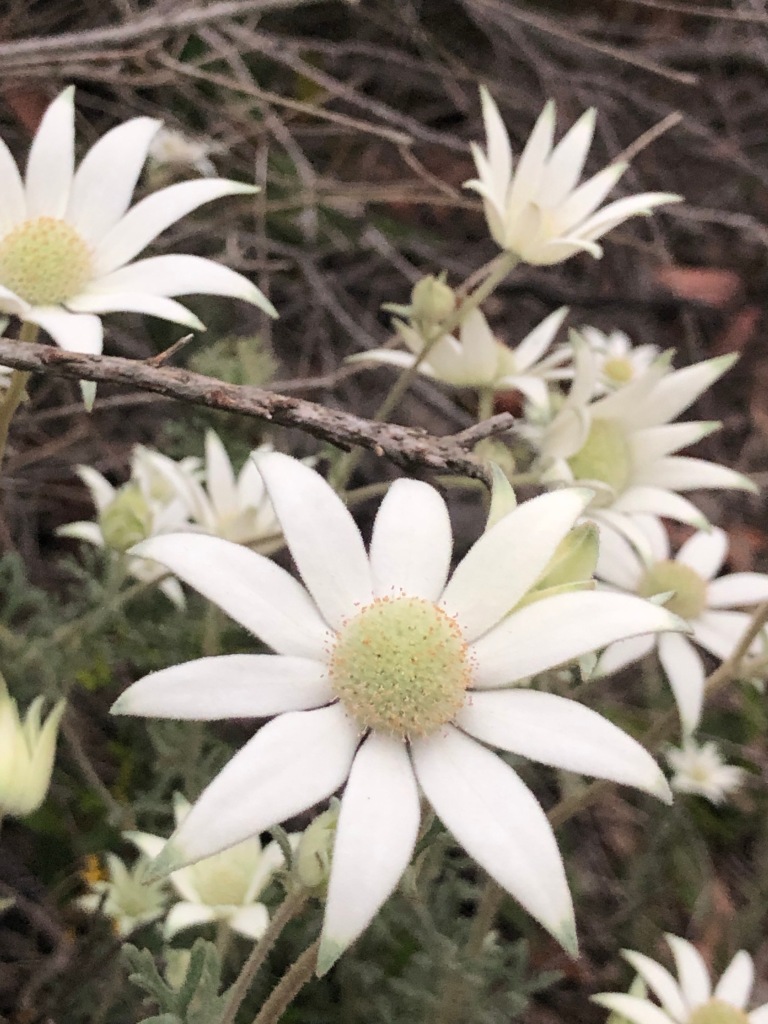
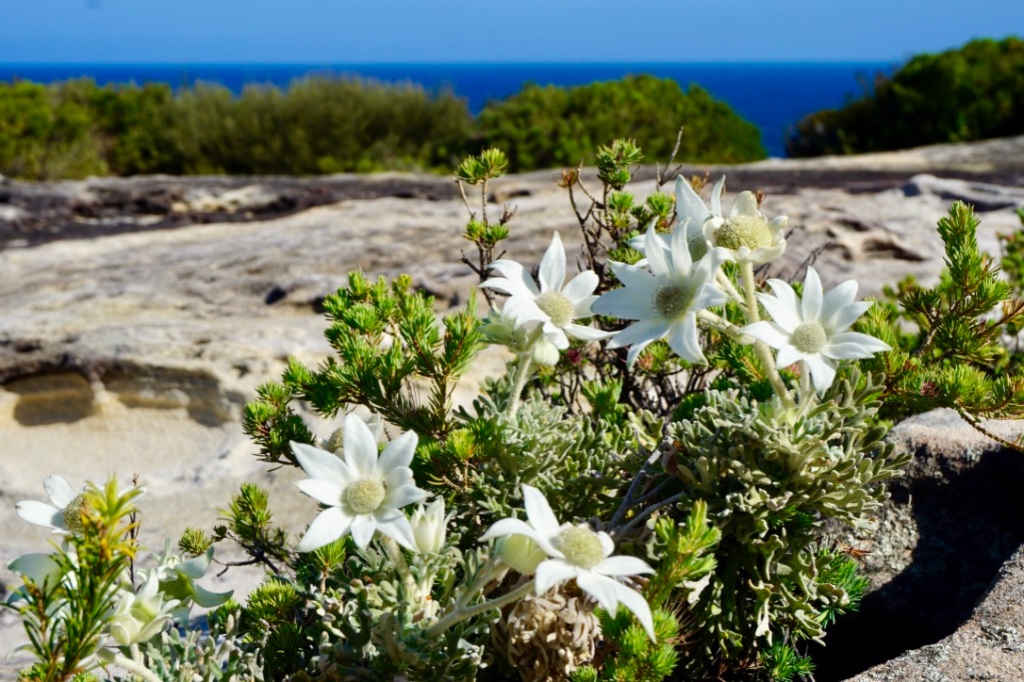
Flannel flowers were always highly prized in my childhood. With their creamy-white star shapes and grey-green foliage, they seem so insignificant and plain, until you touch them and you can feel the soft, velvety fabric feel that gave them their name. On close inspection you can see the pale green tips to each petal, and an echo of the same pale green in the centre of each flower. The daisy-like flowers point to the sky and a profusion of flowering occurs in spring and continues through to Christmas. However, in some secret places, I have found flannel flowers almost the whole year round. When the plant has finished flowering, it is almost impossible to find, even when you know where to look. Often there are other white flowers that distract and confuse — white spider flowers, for example. For me, the flush of flannel flowers lifts my heart because my favourite times are the warmer days, and flannel flowers give me notice to prepare for holidays and sunshine.
Fabulous flannel flowers!Eucalypt flowers like a bridal veil.
From the late winter flowering of “eggs and bacon” which continues through the summer, to the various wattles which light up the bush with gold that looks so much better where it grows then even in a photograph. As a child I wanted to bring some home to my mother, who loves flowers. The springy, tough branch wouldn’t pick easily and I had to twist it, to wrench it free (losing a lot of the fluffy yellow blossoms in the process). When I arrived home with an armful of flowers for my mother, she immediately ordered me outside with it. Wattle drops flowers when in a vase, and my mother also blamed much of her asthma problems on wattle flowers. We now know, erroneously.
Wattle in bud — macro photo.Deep inside a wattle bud — microscope photo.
At any time of the year, wattle is in flower, one variety or another. It is so distinctively Australian, our “green and gold”, like the sunshine of summer.
Fragrance is not something we usually associate with Australian flowers, but wattle, and even eucalypt, has a strong honey perfume when in flower. Australian honey (made by European honey bees which were imported in the early days of colonisation) has a stronger flavour than the delicate European floral honeys.
Many Australian native animals, birds and furry creatures, often feed on the abundance of nectar from many Australian flowers. Waratahs and Gymea lilies can visibly drip with nectar. And if you ever get the chance to get up close and personal with a brushtail possum you can smell the honey on its breath.
In our backyard, which has remnants of native trees and shrubs which we never cleared, the Christmas bush is in the first white flush of flowers. Most people know the Christmas bush as a profusion of tiny salmon-red bracts, overflowing vases on the Christmas dining table. But the true flowers are the white buds which cover the trees from September.
Christmas bush flowering early. The salmon-pink bracts come later.
As we drive through “the bush” we watch the seasons ebb and flow. There is always something in flower at any time of the year, and we watch the landscape change in colour and form, and mark the passage of time.
The weather is warming up here, Down Under. People are flocking to the beaches and in our area the tourists have been flooding in on weekends and in school holidays.
A busy day on our beach. No social distancing.Peace at last…
But when school is back, and it’s midweek on a warm day, it’s time to check out the tranquility.
I’ve discovered that when the tide is washing in, the sea is icy. But when the sea has had a chance to warm itself on the shallow sandy areas, it warms up fast. When washing in, the cold from the deeper water floods in and my legs go numb. So where possible, I swim on the outgoing tide.
I watched him sail past — so peaceful!
My exercise involves wading in the water along the beach. The push and pull of the waves adds an uncertainty to my feet, which encourages my muscles to work harder to maintain balance. When the waves break, often at knee height, it’s like a refreshing spa as the foam ebbs and dissipates. Until the next wave.
Midweek early in the season, the beach is almost empty. Often the waves wash the sand clear of all impressions, and mine are the only footprints.
Life in the rock pools — ecological balance, or war of attrition? The limpet and the chitons (suit of armour) are herbivorous, but the brown-bobbled oyster borer is an active predatory snail.
I never take a towel to the beach. If I have driven the car there, I leave the towel in the car where it can stay warm, dry and sand-free. If I take anything at all, it’s a water bottle and maybe a book. I’ll sit directly on the sand, facing the water (never take your eyes off the sea). When I feel it’s time to go home, I put my book and water bottle away in my bag, then go into the sea to rinse off. Once clean, I walk back to my vehicle and go home.
A session at the beach is therapy. I get my exercise, physiotherapy, my Vitamin D and above all, a sense of peace that follows me for the rest of the week. When I’m writing my novel about the sea, I claim my time there as research. Blessed, calm research!
From my position on the sand with my book, I found myself inspected by a hungry seagull.
On the weekend the beach will be busy again. During Covid, crowded beaches are risky. On the weekend I’ll stay home. But during the week — I’m drawn back to the waves, to the sand, and to solitude.
Often when I travel, I have a writing project I’m working on, with the travel providing further research opportunities. And sometimes a place will bring unexpected experiences. In Greece, every cat surely has a story.
Paleorchora, Crete, Greece. Adorable eyes and impossibly long whiskers.Win win — any dropped titbits get scarfed down, which keeps rats away. And any rats that do hang around… get scarfed down. Paros, Greece.
My first encounter with Greek cats was when our family visited Greece in 1989. We had gone for lunch to a taverna in a village to the east of Rethymnon. We sat in the shade of mulberry trees espaliered horizontally as an overhead canopy. Purple splotches showed where ripe mulberries had landed, and a number of cats prowled among the tables, looking imploringly at our meals. Below the apartment in Rethymnon on Crete where we were staying, we had seen some very large rats prowling a midden heap and decided against an evening walk down that lane. There seemed no reason for the cats in that area to look so scrawny and battle-scarred… hang on, those were very large rats, weren’t they?
Waiting for the next meal. Naxos, Greece.
Rats are everywhere around the world and there are parts of my own village that are to be avoided at night. Around our house, snakes move in to keep down the rats. It gives us a very strong incentive to get rid of the rats before the snakes move in. As for photos — it’s a lot harder to find snakes hovering around a table waiting for a titbit…
In Greece, the cats live in a symbiotic relationship with humans, and a predatory relationship with rats, mice and lizards. When we returned to Greece in 2018 I was ready to pay more attention to the cats. Allowing cats to roam and live freely is a very natural way to keep everything in balance. We’re just not used to it in Australia, where native wildlife is still very vulnerable to the hunting skills of cats.
Cats used to be worshipped in ancient Egypt. They have never forgotten this. Athens, Greece.Our dining companion on Paros.Owning the space — Naxos, Greece.
When we travel, we experience different lifestyles. What won’t work in Australia appears to work very well in Greece. In Greece, cats are indigenous creatures. Each cat has its own story, and even those who put down the occasional dish of food can only guess at some of their adventures.
Paros, Greece. This cat embodies what is fascinating about Greek cats — THEY own the place and merely tolerate our presence.Naxos, Greece. At a taverna on the beach near the harbour. A small boy was trying to play with the cat and poking it with a stick. He got scratched. There are warnings to not annoy the cats in Greece. I produced my bottle of hand sanitiser for the mother to apply to her mischievous son.On Perissa Beach, Santorini, a cat with unusual appeal.Fira, Santorini, Greece. Water is precious on Santorini, even the cats get bottled water.
Photographing cats in Greece is challenging — most of these images were taken very quickly, few cats were willing to pose. I had to be quick, and I had to be lucky.
While learning more about Greek cats, I once again found the connection with ancient Egypt. In Greece also, I was told, the god of cats is Bastet, the same as for Egypt. And the ancient Egyptian word for ‘cat’? It’s ‘Mau’!
On Naxos, Greece, outside the church of St Anastasia. This cat, we were told, is called Ares. A ginger tom, named for the Greek god of war. How appropriate!
In Greece we found cats in many places. Some were battle-scarred veterans, others were exquisitely perfect kittens. All appeared to be more than tolerated, they were welcomed and supported. While many were not strictly pets, but opportunistic hangers-on, they all appeared to be accepted as part of the space.
Skulking under the skirts in a dress shop in the old town, Chania, Crete, Greece.Same cat as above. Air conditioning condensation makes for cool, fresh water. Chania, Crete, Greece.Fira, Santorini, Greece. Her place in the sun.
When exploring the classic image of the university town in England, the image of punting comes to mind — pretty girls in frilly, flowing cotton dresses reclining in a punt on cushions while they trail fingers in the stream. Loving glances are exchanged with the handsome, young man poling the punt past the banks.
Watching for the punts.
In Canterbury, we decided to try the experience for ourselves. We discussed the idea with family members over a classic English breakfast in the pub. The ones who had been to Canterbury before took themselves off for shopping in the high street.
Again with the cousins, we queued for a ride. Each punt would only take a maximum of six, but when they took one look at me (no longer sylph-like) they cut our boatload down to four.
The cousins got into the first boat with much hilarity. When our turn came, the punter (the guy with the pole) looked nervous.
Punting in Canterbury, England.
‘I’m big, but I bend,’ I assured him. However, as I cautiously stepped in, the alarming wobble of the flat-bottomed boat quickly had me spread-eagled on all fours. It felt a bit like the final scene in The Italian Job where they’re desperately trying to balance the weight in the bus so they don’t go over. I could hear it playing in my head, ‘Lads, I’ve got a great idea,’ as my husband stepped in and the punt lurched alarmingly in the other direction.
Finally flipped onto my back like a struggling turtle, I managed to adjust my position in the required semi-reclining position. The next passenger looked unsure, perhaps with the stern of the boat now low in the water. ‘Is it safe?’
The punter assured her, and she stepped in daintily. Then finally the last of our party. A friend of one of the cousins, and her young son. The friend sat opposite me and her young son was welcomed on board to weigh down the prow, still pointing a little too much skywards thanks to my ‘excess baggage’. (I’m not overweight, just undertall). The kid was delighted and, fully laden, we were underway.
Yummy mummy riding higher in the water.
The punter stepped onto the large area (room for a picnic basket) just behind me and my husband, and pushed us off. We were not so low in the water, as it turned out, to be a concern, but it was low enough for our fingers to trail in the water. Of course I had to do that!
After the shaky start (which thankfully the cousins hadn’t seen or I’d have been teased mercilessly) we had a delightful and tranquil journey along the canal which was built by the Romans. I can well understand the delights of the activity, and the romantic reputation. Opposite me, our young friend would be described as a ‘yummy mummy’ indeed (unlike my ‘naughty nanna’ physique) and she utterly looked the part as we punted through willow fronds trailing in the stream.
Our punter first took us a little upstream and down a branch of the Stour River which flows outside the walls of Canterbury. It was very tranquil here, seemingly wild with lot of birdlife.
‘Hello, duckie!’
Each time we came to a bridge, the punter had to crouch down low as we passed underneath it. Above us the vehicles and foot traffic of Canterbury passed unheeding, but were in another world.
‘Ducka you heada, lowla bridge-e-da!’ (apologies to Italian friends)
About halfway along, we crossed punts with the cousins, who whooped and insulted as only Aussies do to the people they love. Then they disappeared back towards the town while we continued downstream to the mill.
Underneath some of those bridges it was dark and cool. We saw some interesting sights — pigeons nesting, a small statue of St Francis — and over some of them were Tudor-style houses, jettying out over the water. Ducks dabbled in the shallows and, despite the heat of the day, it was cool so close to the water.
St Francis, under the bridge in Canterbury, England, caring for the unregarded creatures.
I was still fantasising about romantic picnics on the river, where the punter poled us where trailing willows lent their privacy and shadows to a sense of seclusion, when we arrived back at the steps under the road bridge and our ride was over.
Of course the cousins were watching from the bridge as I did my utmost to remove myself with some semblance of dignity. And failed, of course.
But at least I didn’t capsize the punt!
Up on the bridge, we looked down into the water and saw, almost hidden in the water weeds, the sculptural shapes of mermaids, ‘swimming’ on the bed of the river. Beyond the mermaids were more gardens which we left to explore, as the punt loaded up with the next passengers.
Mermaid in the river, Canterbury, England.‘Merlin! Put the kettle on!’
The romance of the place still washed over us as we explored the gardens and wondered about the immense girth of the oak tree there. Could Merlin be comfortably living inside, ready with a soothing cup of tea for stray visitors with a strong imagination?
Punting through the gardens — an experience not to be missed.
At the Tower of London, even the ravens were complaining about the heat.
It was an English summer beyond all recognition. London was burning, metaphorically, with Hyde Park a dustbowl and Green Park the colour of pale straw. Even us Aussies felt parched. We were glad to make our way to Canterbury for a big family celebration.
Our pub (you couldn’t call it a hotel) was the Miller’s Arms, right across the road from the old mill and the mill pond. How to describe it? Built in 1876 to house the mill workers (hence the name), it’s a friendly, homey little pub with rooms upstairs which, surprisingly, have all the mod cons. The rooms are each named for a character from Chaucer’s Canterbury Tales. Other family members were staying there too, so on the afternoon of our arrival we gathered in the pub with a large jug of Pimm’s between us, to cool down from the fierce summer heat.
Our first English pub experience.The mill race.How’s the serenity? The mill pond, Canterbury.
The next day we went exploring. Across the lane the mill pond slid gently towards the remains of the old mill wheel sitting above the race, where water was controlled in a small but forceful stream. More water flowed under an arched brick road bridge. Crossing the mill pond via a small footbridge, the gardens opened out with roses climbing old brick walls and even the occasional squirrel playing under the trees. Blackberry brambles were taking over in places, with ripe berries sharing space with flowers. We walked towards the high street and could see the spire of Canterbury Cathedral like a compass point in the sky.
The newbie on the street.Canterbury Cathedral in the summer sun.
The streets of Canterbury were like nothing we had seen before – narrow, shady and lined with quaint, mullion-windowed shops displaying a wide variety of wares. Between the jettied floors of the buildings with each successive storey overhanging the one below, the sky was a thin sliver of cloud-spattered blue overhead.
The high street was perhaps a little more conventional, but still distinctively different and English to our inexperienced Australian eyes. Beyond was the railway station and bus terminal, and from there we were able to see the old city walls.
“Let’s walk the walls!” announced one of the cousins, and when we climbed to the top we could see across the city with a clear view of the cathedral. There was a faint breeze up on the top of the battlements, and the Dane John Gardens below were a combination of brightly coloured flower beds and tall trimmed trees that looked like fluffy soldiers on parade. We descended into the gardens and explored further.
I never found out what these trees are. Note how brown the grass is. It was worse in London.Inside the grove of whatever-they-are. Welcome shade.
Beside the next part of the wall we saw a man wheeling a bicycle.
“Hot enough for yer?” he asked as he wiped his forehead.
“It’s a bit warm,” we replied.
His face lit up. “You sound like Aussies!” he exclaimed.
“Sure are,” we told him, “and this is hot by Aussie standards.”
“I’d love to chat a bit more to you about Australia. I’ve always wanted to go there.” He stopped at a door in the wall and opened it.
Inside we could see a riot of colour, a postage stamp image of the larger town parklands behind us. I exclaimed in wonder. “You live here? This is your garden? How delightful!” “Come on in for a chat, please do,” he said. “Oh, won’t this be a surprise for the missus! I’m always talking about Australia! And now I meet some!”
‘The missus’ seemed a bit underwhelmed. Clearly, she didn’t share his enthusiasm for inviting strangers in. “He’s Welsh,” she explained to me. “Very impulsive. I never know who he will bring home!”
She did her best to be gracious, however, despite what her plans for the moment might have been. And as I and the others wandered over her garden, identifying plants with delight and (in my case) photographing the flowers, she quickly warmed to these garrulous strangers invading her personal space. Meanwhile her Welsh husband was plying the men with questions, and I could hear their happy chuckles as I continued my detailed inspection of this tiny Canterbury garden inside the city wall.
Inside the secret garden within the wall.From the garden inside the walls.
I was running out of stamina (sadly, I never have enough) and when the others wanted to continue their walk around the walls, I chose to head back through Dane John Gardens. More flowers, and some park benches to sit on and let my sore feet recover. And, getting back to our room, I had more writing to do. How could you come to a place like this and not write?
Even the park benches were special!English gardens are a riot of colour in summer.
Later that afternoon, my husband and I walked by the river Stour in the cool shade, into a common area that was mostly a small patch of wilderness. There was a fallen log where we sat and listened to the birds. On the way back, we picked a few blackberries.
It had been my first whole day in England outside London, and it was beautiful.
An evening stroll by the River Stour, Canterbury.Blackberries by the river — the perfect end to a glorious day!
Travel introduces you to new people and situations. Being able to take notes on the go is important, so when in transit I have my phone with me, my laptop within reach and a small sound recording device. You never know when something odd or interesting will happen.
I’ve already written about the intrusive train tourist, who was so desperate for our attention that she kept sabotaging my typing on the train. And as long as I wasn’t typing, I could focus on her, couldn’t I?
Then there was the southern Baptist preacher whose wife was feeling ill on the bus, so he gave her an impromptu Bible study — from memory. I’m not sure if it made her feel better, she opted to stay behind on the afternoon tour that day. He later told us that he sent his kids to an all-white private school because the state they lived in was desegregated and he didn’t want his kids mixing with the black kids. He actually wasn’t a bad old stick, he just hadn’t ever been taught to think more broadly. He did attempt to speak French on our tour through Normandy, but his loud morning greeting of “Barn Jewer, everybody!” was a wake-up call with a difference.
The waterlilies in Monet’s garden, Giverny, France. One of our stops on the bus tour.Inside Monet’s house.
We also found we were often valued for our Aussie freshness and frankness. In Paris, for example, we were saying goodbye to our fellow tour members who we’d become close to in our week together. Most, like our friend the southern Baptist preacher, were from the US.
“So are you staying on for a few days?” Jeff asked one of our new friends, “or are you leaving at sparrowfart?”
The southern Baptist preacher overheard, just as our young friend looked at Jeff, puzzled. “Sparrowfart?” she asked, eyebrows furrowed.
Not wanting to further scandalise our US friends, I stepped in to explain. “He means really early, just as the birds are waking up.”
There was a brief pause while the mental cogs clicked. Our young new friend smiled broadly, but behind her the loud guffaws from the southern Baptist preacher told us that he also understood.
Last day on tour in Paris. The obligatory tourist selfie pics taken of us by a fellow tour member.All we saw of Notre Dame, from the tour bus. Scaffolding everywhere.
All experiences are worthy of note. The best gems are often tiny and can easily slip through your fingers. Writers should always be paying attention to these magic moments, the mental snapshots. And take notes — a mental snapshot will only last until the next memorable moment eclipses it.
In Scotland, in Dumfries, we attended a gathering at Gilnockie Tower. Looking down to a meadow below the tower, we could see tents and canvas marquees of a small village fair. Beyond the meadow, the river was fringed with willows. We could have been back in the time of Johnnie o’ Gilnockie, or perhaps even Lang Sandy. But no, we were there to celebrate the fiftieth anniversary of the Apollo 11 moon landing, and Neil Armstrong, descendant of Johnnie.
Part of the modern Armstrong legacy — a footprint cast from Neil Armstrong’s spacesuit. From the museum in Gilnockie Tower, Dumfries, Scotland. It is claimed that Neil Armstrong took a piece of Armstrong clan tartan to the moon.Modern Armstrongs still wave the banner.
Our son is a re-enactor, he fights in armour with a broadsword. So it was natural we should gravitate to the re-enactors there. These were musketeers and we enjoyed a chat. Clearly members of a family, with a couple of friends thrown in. Their tartan proclaimed them Scots, and clansmen. And the young man who came to talk to us had a Scots accent you could cut with a sgian dubh.
The statue of ‘Lang Sandy’, Alexander Armstrong, who was executed by the English with his sons in 1606. The three musketeers — re-enactors at Gilnockie Tower, Dumfries, Scotland.
What follows now is my poor attempt to transcribe how his reenactment group teaches history with dramatization.
In 1650, Oliver Cromwell is invading Scotland. He knocks on the door of the castle. “Open up in the name of the Lord Protector!”
The little hatch opens on the door. “Hoo? Hoo is it?”
“It’s the Lord Protector! You must open the door!”
“It’s hoo?” asks the doorman through the hatch.
“The Lord Protector, Oliver Cromwell. Open up in the name of the law!”
“Naaw, niver heard of ye.” And the doorman shuts the hatch.
Pounding on the door again. “Open up!”
The hatch opens. “Hoo is it?”
“It’s the Lord Protector! Oliver Cromwell!”
“Lord Protector, ye say? Why didnae ye say so?” The door opens. “Aye, I ken ye noo. Ye got that wee bitty mole just there…”
Cromwell shoots the doorman and proceeds. His guard calls out, “Make way for the Lord Protector!”
A Scottish guard emerges. “Hoo?”
“The Lord Protector, ye daftie!”
“Och, aye, I see it the noo. Ye got that wee bitty mole…”
Bang! Cromwell shoots the guard.
Another guard emerges, sees the bodies on the floor. “Ye’re a wee bitty sensitive about that mole, ain’t yer?”
Apparently they get criticized for levity while teaching history.
The musketeers’ camp, Gilnockie Tower, Dumfries, Scotland.
A year ago, July 2019, we arrived in Avignon just as the annual Avignon Festival was beginning. We planned this deliberately. In 2018 we’d arrived in Avignon for just one night and discovered it was festival time. Our hotel in 2018 was well out of the city and the only way we could get around was by taxi. So we caught a taxi in to the centre of the town (glad we didn’t have our own car, there was nowhere to park) and spent the next six hours exploring this fascinating place. We only had a few hours to explore, and every street corner was another venue for spontaneous street theatre, amazing sights, buskers, promoters and just plain fun. We eventually had to go back to our hotel, pack our bags and regretfully catch the TGV (Trés Grand Vitesse, or Very Fast Train) next morning for Paris. If only we’d known!
So in 2019, we made sure we’d arrive in Avignon at festival time, stay in the heart of the old town, ‘le centre ville‘, and stay for three days at least.
We arrived at 2.23 pm. The heat had been crazy for days, not helped by car air-conditioning that would only work on heat mode. In the end we’d forgone conversation as we drove down the autoroute at 130 kilometres an hour with windows down wearing wet scarves.
The car’s GPS has been programmed to show places to eat. As we drove into Avignon it went crazy.
Plenty of places to eat! We’d had no lunch.
We were told that if we had a hotel reservation, we could drive in to drop our bags. They opened the centre ville barriers for us, but once inside, the security people sent us back outside. Rinse, repeat… so we decided to return the car and get a taxi in. The car return place was not at the city train station, but the more distant TGV (Sydney residents, think Countrylink) train station. It took us until 3.30 pm to return the car. And from then on, we waited for a taxi. And waited. And waited. The scorching heat was unrelenting and my head was pounding. After over an hour, we met an English speaker who lives in Avignon. They tried to ring for a taxi. We’d have another fifty minutes wait, minimum, they were told. Festival time!
Avignon – le centre ville.
We decided to catch a train. We’d waited so long that one was nearly due. Only another half hour by this time.
We finally got back into Avignon by 5 pm and it took another half hour before we dragged our bags through the streets to our appartement. We had to telephone the owner and he sent someone to meet us with the key.
Our front door. It opened into a deep, dark, and above all cool stairwell.
By then I was bordering on heat stroke. We’d been out in the sun waiting for a taxi in 39 C heat. Once inside the small door which opened directly onto the street, we were in a large, utilitarian open space that was shady and cool simply from the heavy walls of the old building. Steps led upwards to our floor. No lift.
Looking up the stairwell. A place of cool tranquillité after the street bustle just outside the door.
Our room was a large, open space with a bed and a small kitchenette. From there, a corridor led off with windows and a tiny balcony, too small except for the most sylph-like Juliet.
Our bed in the appartement was on the floor. Almost.The sauna in the appartement. It became a handy place for drying our washing over the next few days. We did not turn it on.
The first thing we were shown in our room was the sauna… I kid you not. There was a small sauna in our apartment. After being so cold in UK, we’d been experiencing France’s hottest ever weather, while travelling in a car with air conditioning set only on HEAT.
I passed on the sauna at that point. The temperatures outside were the same as the sauna’s, I figured there was no point heating up the appartement when all we had to do was open a window to get the same effect.
The view from our appartement’s Juliet balcony.Watching the Festival go by… this man was across the street from our appartement, a perfect, cooler vantage point.
Next to the sauna was a shower which I got into immediately, fully-clothed with cold water only, to try to reduce my core temperature. The concierge was still with us and thought I was nuts. I was too hot to care if I added to the legends in Europe of ‘crazy Australians’.
Next to that was the loo, and after that at the end of the corridor was the jacuzzi. Colour changing mood lighting throughout. Lots of ice in the freezer. A convenience store next door. Windows looking out onto the massive street party through le centre ville of Avignon.
I was still recovering from the heat but after an hour or so I was ready to brave the streets.
Avignon festival had little snippets of street theatre as people promoted shows. We’d think, we might go to this one. Or maybe that one. Talking to the performers who were busking on the streets to promote their shows, we met some fascinating people. Some of the French-speakers spoke English well enough so we could converse. Other performers were from other parts of the world and a couple of shows were in English only. Many were pure music, which is a universal language. And mimes everywhere, with hand-juggling displays too.
Posters everywhere, advertising performances. More posters…
We missed out on one show we particularly wanted. When we turned up to buy tickets, they were sold out, so we bought the CD and tickets to something else. They advertised a lot of the shows at the Festival with the line, “La salle est fraiche!” In other words, air conditioning is a huge selling point in 38 degree heat.
Our French would not have been good enough, this looked like an amazing show.
We also took some time to explore the older, more historic places. We’d seen Palais de Papes in detail in 2018, so this time we explore THE bridge. It’s now a bridge to nowhere, but back in the day it was a border crossing of great importance.
A real drawbridge! Squee…A gateway for maintenance, the little dragon keeps watch. Sadly, weighed down by yet another ‘love lock’.Sur le pont d’Avignon. No, we did not sing…Lavender fields below the bridge. Glorious!Narrow little streets in Avignon, down near Palais de Papes.
Festival time in Avignon is a time when people break the rules and nobody cares.
Translation: ‘It is forbidden to attach bicycles to the railings.’ Yeah, right…
If they’d attached the “velo” to the sign itself it would have been funnier. But there’s so much else attached to the “grille” that maybe he couldn’t see the sign. There were many more bikes chained to the same railing too.
Our first evening was spent having a meal in the main square. All around us, the Avignon Festival played out in all its crowd, noise and colour. There was fierce competition for cafes. The best ones had chilled mist sprays which triggered every minute or so. I was right underneath one. Just what I needed!
Colour, light and fun everywhere.Jeff posing with a fellow nerd. Great fun, this guy! Sadly, we couldn’t get tickets to his show either. Plenty of great food. Spoilt for choice!
Next morning we visited the baker next door for fresh, warm croissants. The town seemed very quiet so early, everyone else must have been sleeping off the previous night’s massive street party. It’s street party every night during the Avignon Festival.
Promoting ‘Le Petit Prince’ by Antoine St Exupery.
Over the next few days we explored special places, took in a show (we struggled with the French, but the music was wonderful) and totally blew our minds. Back in our appartement, having a multi-coloured soak in the jacuzzi indoors while watching and hearing the festival outside through the open window, the incongruity of it seemed so normal.
Too much Festival?A hedonistic love-fest.What more can I say? We loved Avignon too.






 Helen Armstrong - writing on the move