On our last full day aboard Southern Aurora we woke somewhere in NSW, with another early start. We were just sitting down to breakfast as we reached Albury railway station on our way back into Victoria.
Breakfast — fruit compote, yogurt, toast, cereal.
Buses were waiting for us when we got to Benalla railway station. Once again we were kept in our Covid bubbles and had each been allocated to a specific bus depending on our train carriages and dining room seating plan.
The buses wound their way up into Victoria’s high country where our first stop was Chrismont Wines, a cool-climate vineyard in Cheshunt.
The views from the balcony at Chrismont were gorgeous. If I lived there I’m sure I’d never get any work done. We had a birds’ eye view across the vines, to the road and mountains beyond.
rom the balcony at Chrismont Wines, Cheshunt, Victoria.
After a sampling of their best wines we all had lunch together before leaving to drive to Milawa, a small village in the heart of foodie country.
Our first encounter with Milawa was back in 1999, when our family spent a week in Bright. During our stay we drove around the Victorian Alps area as well as the gourmet areas nearby. Our cheese-loving daughter was delighted when we stumbled on Milawa Cheese Company. We’d also stopped in to Milawa Mustards and sampled some delicious relishes and mustards. As we were travelling with a family and on a tight budget, we bought mustards, relish and cheese, then stopped at the bakery for some crusty warm bread rolls. Then we drove out of town to find a quiet spot to have a family picnic on this glorious fresh local produce.
Gateau du fromage — Milawa Cheese Company stack of their best cheese wheels.
We’d told our now-adult children of our expectation to visit Milawa Cheese Company and knew they’d want us to ‘stock up’. The family favourite is Milawa Gold, almost impossible to find outside Milawa. It’s a creamy, strong-flavoured cheese, bold and with bite. Once tasted, it’s unforgettable.
We made a bee-line for the cheese counter and selected our favourites. The staff on the train had offered to store our perishable packages for us, in the fridges on board.
From Milawa we wound our way back on the buses through Wangaratta, to re-board the train in Albury.
Historic Wangaratta. Photo taken from the bus as we sailed through. Next time…
Before we left Albury there were more speeches, and a surprise (for me). I don’t know why I hadn’t realised, but the staff on board this historic train were volunteers. They worked hard, their service and courtesy was gold standard, but they were there because they loved the train and the historic railway journeys.
Waiting for dinner — all this was served by volunteers!
The journey back to Sydney could have been sombre, as our adventure on Southern Aurora was drawing to a close. But we still had dinner, and breakfast next morning, to keep our mood relaxed and golden.
Dawn somewhere around Moss Vale.Breakfast in Bundanoon? Bowral? Somewhere in the misty highlands…
The train was taking us through a damp and misty Southern Highlands as we enjoyed breakfast next morning. After packing, we moved to the lounge car to chat to our new friends and listen to their excited arrangements for their next trip with St James Rail (stjamesrail), and Owen Johnstone-Donnet.
There are tours which take you to wonderful places; there are tours where you get to knew some wonderful people. There are tours where they spoil you rotten. We’d just had all three. Can’t wait for more!
Journey’s end on Southern Aurora. For sixty years, this sign shone through the night between Sydney and Melbourne from the back of the train. No longer in public service, she’s now a touring train for heritage rail enthusiasts.
We’re ready to journey again.Back in our cabin again.
It was time to once again board the Southern Aurora and head north.
Dual gauge track at Melbourne’s Southern Cross station.In Melbourne, officials came out to watch the Southern Aurora‘s departure from Melbourne on this historic occasion. We were also on the evening news! That’s Owen Johnstone-Donnet on the right, the St James Rail Tour Director.
Violet Town is a small Victorian country town that under many circumstances you’d blink and you’d miss it. It’s a pretty place, as many country towns are, with a railway station and level crossing. It’s reason for existence was purely as a stop on the rail line to Melbourne.
But in 1969 all that changed. On 7 February at just after 7 am, the Southern Aurora collided head-on with a goods train at an estimated combined speed of 172 km/h. Nine people were killed and 117 were injured. Both drivers were among the dead. The fireman of the goods train jumped clear at the last minute. The locomotive of the Southern Aurora and several of the leading goods carriages became airborne. Spilled fuel caught fire and added to the problems. It was an appalling mess.
Immediately afterwards, volunteers got busy searching for survivors, setting up communication and transport and providing what assistance they could.
The Southern Aurora had gone through three red signals and should have been stopped on a siding waiting for the goods train to pass. Instead, it sailed through without a pause.
What happened? It took a while to work it out, but it appeared that the Southern Aurora driver had a heart attack and was either unconscious or dead at the controls. But there should have been a back-up — the fireman and the guard should have been watching the signals in case the train disobeyed them. The fireman should have alerted the driver and/or the guard, and the guard had the ability to independently stop the train.
Passengers gathered together at the Southern Aurora Memorial Gardens to learn more about the community response to the crash.
The inquest laid the blame with the Southern Aurora’s driver, fireman and guard. A bit unfair on the driver, since he was determined to have been dead at his post before the first signal was missed. It was believed the fireman had been boiling the kettle instead of checking on the alertness of the driver when the Vigilance Control alarm went off (after the train went through the first signal to stop) and the guard was claimed to have been dozing on and off and not watching the signals reliably. Other possible problems were not openly criticised but perhaps should have been. The doctor who cleared the driver to work even with a pre-existing heart condition. The Vigilance Control system should have been automated. The means for the guard and fireman to watch the signals needed cleaning and was difficult to monitor. And perhaps the relationship between the driver and the guard — the driver was in charge, the fireman may have been reluctant to challenge him or take control. That might have caused sufficient delay and confusion in the fireman’s mind, to allow the disaster to play out.
Following the inquest a number of improvements were made, notably to the Vigilance Control system, which now requires both driver and fireman to cancel it once triggered. The various factors which contributed to the Violet Town crash have been analysed and are no longer possible. Train travel these days is much safer as a result.
Due to the length of the train, it was unable to simply drop us off at Violet Town and wait. Instead, we were dropped off at Euroa railway station and took buses to Violet Town to have a good look at the Southern Aurora Memorial Garden there. We were met by local officials who explained what they have done here by creating the Southern Aurora Memorial Gardens.
The headlines of the day. This accident led to a lot of improvements in train safety nationwide.
The Gardens have a theme of Helping Hands, to honour all the people who stepped forward to offer assistance. Staff, passengers, injured, whole, locals, travellers — people just stepped up. The paths at the Memorial Garden are embedded with positive words reflecting the best of the human spirit. Courage. Hope. Generosity. Kindness. Love.
A central feature of this memorial is a sleeper carriage from a similar set to the ones involved in the accident. There are murals around the park, depicting various scenes from the 1969 incident.
The gardens are a place of peace, remembrance and recognition of what we all can do together when we step up to meet needs.
This is a small town where something big once happened. People came together to help under horrific and extraordinary circumstances and this should always be remembered.
The official notice is on the old Southern Aurora sleeper car in the gardens.
Our food-filled adventure on Southern Aurora took a different turn in Melbourne.
While Southern Aurora waited for us somewhere at a siding in rural Victoria, the tour group was spending Anzac Day 2022 on the historic Puffing Billy steam train in Victoria’s Dandenong Ranges.
We had an early buffet breakfast in the hotel. Plenty of choice, and freedom to move around and make our selections, so we felt no impetus to eat everything put in front of us as captive diners. As a result, I was beginning to feel less over-full as we set out from Southern Cross for Belgrave, on the Victorian METRO rail service.
When we got to Belgrave we left the suburban train and walked down a ramp through leafy bush to the Puffing Billy platforms.
The Puffing Billy station at Belgrave.There she is!Loading up. We were a train load of enthusiasts.
This narrow-gauge line was opened in December 1900 as a way to open up the remote areas in the Dandenong Ranges. It quickly became a tourist attraction, but it was a vital supply line to the people who chose to live in these hills. Not just mail and newspapers, but equipment, tools and even livestock. It made living in the Dandenong Ranges a viable concern. However, it was an expensive one and was eventually downscaled in importance as a result. When a landslide blocked the line in 1953, it was the final blow and the line was closed.
Public interest stepped in, boosted by media coverage. The Puffing Billy Preservation Society was formed and a combination of volunteers, CMF (Citizen’s Military Forces, these days called the Reserve Army) and also with a nod from the state government, bypassed the landslide and got the line reopened in stages.
At 11 am at Belgrave there was a short Anzac Day remembrance, and then we boarded the train. Again, in keeping with staying in our own Covid bubble as far as possible, we were allocated a carriage.
Fern fronds for peace. They were a bit sad by the time we got up to Lakeside, but there were plenty of fresh fronds to replace them.Simple, but heartfelt. Remembrance message chalked on the side of the engine.
PuffingBilly’s carriages are open at the sides, a wide sill on each side with horizontal bars ensuring people can’t fall out, even if they choose to sit on the sill with their legs hanging out (surprisingly permitted along the first section of track where we were going).
The open carriages allowing people to sit on the sills, if they choose.…and we’re off! Thanks, mate.
As we wound up higher into the Dandenongs we could see small villages along the track, some of which were still having their Anzac Day services. People not involved with the services were waving to us as we passed, the little steam train clearly a local favourite.
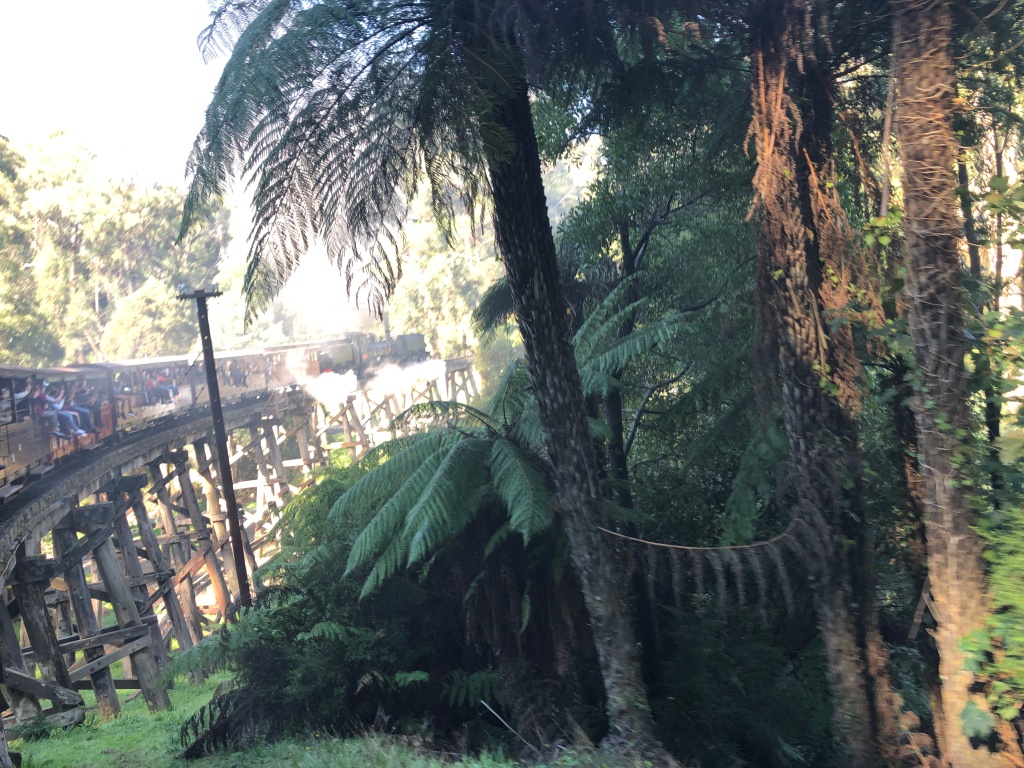
Riding on the sills as we go over the trestle bridge is apparently a ‘thing’. Starting our wind up into the Dandenongs. Ours wasn’t the only train doing trips.The Anzac Walk parallels the train track.
There was a walking track for part of the way along the line as well, the commemorative Anzac Walk. QR codes allow walkers to hear the stories of the Emerald Anzacs who served. The vegetation varied between tall timbers or groves of palms.
The view of Melbourne from up in the Dandenongs.
Up at Lakeside we had lunch organised for us all (of course! More wonderful food!). We had some interesting speakers over lunch. One man, Graeme Legge, represented Emerald RSL (Returned Services League). He was born in Emerald, grew up there, his father served in WWI. He told us that 32 local Emerald men died in WWI and local communities developed the Anzac Walk to commemorate their sacrifice.
We had some time to wander around the beautiful and historic station, looking at some of the displays on the history of the Puffing Billy, before our return trip later in the afternoon.
In the small museum at Lakeside you can learn more about the history of Puffing Billy.Happy engineer.Yours truly, grabbing a moment on the footplate.Beautiful countryside. Plenty of fern fronds.
Back in Melbourne we took advantage of the complimentary dinner that our tour host had arranged for us, although we still didn’t have room for much.
Back at Southern Cross in time for dinner.
After dinner we decided to forgo the bright lights of Melbourne and instead avail ourselves of the free wi-fi (sadly lacking on the train) and catch up on emails.
Sitting with legs out the window is definitely not permitted on Southern Aurora.
We’d boarded this special anniversary run of Southern Aurora the evening before. A few wakeful moments but we slept fairly well and woke to dawn light streaming in our window, and southern NSW countryside flashing past. Just in time for breakfast. Because we’re early risers, we blessed being allocated to the first sitting.
The mist lay low on the paddocks as NSW countryside flashed past our window. Our table mates were a little late, there were a few missing heads in the dining room for the first breakfast sitting at 7 am.
We rolled in to Albury Station soon after breakfast (for us). The second sitting was going to be later, it had to wait until after the morning border crossing ceremonies.
Albury Station, NSW, in the early morning.
With the early morning sun splashing gold over the heritage-listed Italianate station buildings, we gathered to hear some short speeches including one from sitting Federal MP, Sussan Ley. She mentioned the previous MP, Tim Fischer, who was well-known for his obsession with trains, including Southern Aurora. Tim’s funeral train also passed through Albury, paying respects for the many years of hard work he put in there. According to his wife Judy, Albury Railway Station was one of Tim Fischer’s favourite places. We certainly admired it for its architecture, its planning and the amazing length of it — 455 metres, the longest in Australia!
Still travelling — the Boomerang Bag that also went round Europe twice. Albury Station, NSW. The longest platform in Australia! April 2022
We left Albury just as “second breakfast” began. Although it was for other passengers and not us, we were finding that the food on offer, both the quality and quantity, was making us feel like well-fed hobbits. Instead of thinking of food, I took the opportunity to attempt a shower, in a tiny cabin bathroom of a train on the move.
The trick to showering on the train is to strip off in the cabin, outside the bathroom. Leave your clothes within reach outside the bathroom door. Toiletries (soap, shampoo etc) can fit neatly on the shelf under the mirror. Go into the bathroom, close the bathroom door, then slide the shower curtain around to also cover the bathroom door. There was a very thoughtfully-provided grab rail to hold onto when the train was going around a bend. Because the bathroom is so tiny, it’s easy to reach whatever you need.
I was sitting in the lounge car sewing when we pulled in to Violet Town to be met by some local dignitaries for the occasion. Southern Aurora has a special connection with Violet Town, which I will go into in a later episode.
We left Violet Town just as the first sitting of lunch began. Lunch? Who’s got room for lunch? But it was so delicious we managed to force it down. Other passengers at nearby tables were exclaiming in delight at the food. “As good as ever,” they said. “These St James Rail tours are about the food as much as the adventure.”
We weren’t going to starve, then.
It was mid-afternoon when we finally arrived in Melbourne, at Southern Cross Station (formerly Spencer St Station). We were to spend two nights in Melbourne in a hotel across the road from the station, but coming back to the same compartment on Southern Aurora after that. The staff (who had been waiting on us with such professionalism for our meals) were going to stay on the train while it parked at a siding somewhere out in the country. I hoped they were going to get some well-earned rest.
Southern Cross Station, Melbourne. April 2022
We left our bigger bag in the cabin and took a change of clothes in our smaller bags to the hotel.
And at the hotel, we met our first glitch. They were not ready with all the rooms. Despite knowing how many were arriving, and when, despite the bookings having been made several months ahead, they were not ready. We actually didn’t mind very much because being fed so well and so frequently, we had a sort of detached attitude soaking into every pore. But the hotel staff were profusely apologetic, and invited us to partake of their Swiss-influenced ‘death by chocolate’ happy hour.
It’s amazing how much chocolate you can still stuff in, even when you are full as a tick.
While we were tasting little pots of mousse or indulging in chocolate truffles, our tour organiser Owen was working hard on our behalf. He couldn’t get us into rooms any faster, but he did manage to gain a concession.
“I’ve asked them to compensate you in some way for the inconvenience of having to wait for the room,” he began.
I downed another chocolate truffle. Inconvenience? Oh, yes, I suppose so.
“They’ve offered you a complimentary dinner in the dining room,” he beamed.
Dinner? Where would we put it?
“Tonight or tomorrow night, what is your preference?”
“Tomorrow. Definitely tomorrow.” We were very much in agreement. Maybe by tomorrow night, we’ll be able to squeeze in a morsel of food.
Our room was finally available, so we dropped off our bags and headed out to explore Melbourne. Along the way we decided to find something very light for dinner. Soup. We headed for Chinatown which we found was packed. Really packed. There were long queues outside some places. We weren’t keen on crowds (Covid makes a person a bit paranoid) so we kept moving on.
Melbourne, April 2022
Finally we found one place that seemed to have room. We had to wait, but that was okay. As we waited, I realised that it was the same place we’d visited in February 2020, just as the pandemic was starting in China. Back then, Melbourne’s Chinatown was almost deserted. We’d been the only customers for dinner in this very restaurant. Back then, we’d been served by an older Chinese woman who treated us like beloved children who needed to be nourished. And here she was again! Of course she did not remember us, but we remembered her.
A quieter Melbourne Chinatown, February 2020
I felt so bad for her when all we could order was one bowl of soup each.
She didn’t know that we were in no danger of starving.
The Southern Aurora looking good for sixty years old.
In the lead-up to Anzac Day we signed up for another trip. A very special one.
The Southern Aurora was a luxury train when it first began its regular commute between Sydney and Melbourne. The full commute on the one train was only made possible when the standard gauge track was completed between Sydney and Melbourne in 1962, with the first freight train completing its run on 3 January 1962. The first passenger train to go the whole distance in the one trip was the Southern Aurora, making its debut trip on 12 April 1962.
Train spotters at the ready. Many of them follow their favourite trains by car, appearing at the scheduled stops along the way. That’s dedication!
Often used as a business train, Southern Aurora would welcome you on board in Sydney in the evening, perhaps have dinner in the dining car with a friend while the train sat at Sydney’s Central Station, then you would settle into your sleeper compartment for the night as the train worked its way through the rat runs of tunnels on the beginning of the overnight journey to Melbourne.
A nightcap, perhaps? The lounge car had a bar, or you could simply retire early after the luxury of a shower in your own bathroom.
The Southern Aurora was the first train in the world to feature showers in the cabin bathrooms. It took decades for the rest of the world to catch up.
When rail was first built in Australia, there were different gauges in different states, which meant that those travelling interstate by train had to change trains.
Before 1961, the overnight trip from Sydney to Melbourne was punctuated in the wee small hours by the announcement, “Albury — all change!” and the grumbling of passengers as they emerged blearily into the darkness and cold of the Albury night to change trains for the next leg of the journey. The rank of the passengers did not matter. Some celebrities who travelled from Sydney to Melbourne and had to endure the train change included Agatha Christie, Don Bradman, H G Wells and even the famed race-horse Phar Lap. Australian opera star Nellie Melba (my one-time namesake, who made her professional debut as Helen Armstrong) travelled between Sydney And Melbourne by train, also having to endure the necessary train change in the night.
When travelling from Sydney to Melbourne in 1895 (pre-Southern Aurora days) celebrated US author Mark Twain commented on the lack of uniform gauge that necessitated this. “The oddest thing, the strangest thing, the most baffling and unaccountable marvel that Australia can show… think of the paralysis of intellect that gave this idea birth.”
The completion of a standard gauge track all the way from Sydney to Melbourne in 1962 finally made the trip possible on just the one train.
Our trip was on the sixtieth anniversary of that first Southern Aurora trip. It was going to involve a little more than just overnight.
Jeff, masked, paces the platform before boarding.
As with a lot of adventures these days, there is always uncertainty about whether it is safe to travel. We had to prove we were Covid-safe by having a negative RAT on the morning of departure and show certification of our vaccination status. For us, we had the added problems of landslides on our road due to flood damage. Rain had kept falling and we had to allow extra time to get in to the city. Landslides to the south on the rail lines had caused a lot of problems too. For the organisers, this was particularly problematic as the usual location for the storage of these heritage carriages was cut off by landslides and floods. Luckily most of the carriages had already been out and in use before the landslides. However, the planned locomotives were still trapped behind the earthwork barriers and replacements had to be found.
With the combination of floods, landslides and Covid we spent the week before departure carefully avoiding crowds and gatherings. We weren’t going to miss out!
Of course we arrived early to Central Station. Due to Covid (and perhaps the later afternoon hour) there was no café open on the concourse, and we had an hour to kill before check-in, so we dragged our bags downstairs in search of caffeine. We knew we’d be fed on the train, so we avoided food.
On the way. By train, of course! Covid restrictions apply.
Back upstairs, we noticed that all the other people checking in were on a first-name basis with the organisers. Everyone knew each other. A good sign — repeat business with the company.
This was very much a ceremonial event. Although we were early, the trainspotters were even earlier. Also gathering on Platform 1 was the Railway Band, ready to give us a proper send-off suitable to the historic occasion.
Railway Band getting ready. Southern Aurora got a wonderful send-off.
Some speeches, some music as the sun set, and soon we were ready to board. Some important announcements — the rolling stock is sixty years old, treat the cabin with care and respect. Special instructions regarding toilet-flushing were shared. Get it wrong, we were warned, and the carriages would run out of water. As the only toilets on board were the ones in our cabins, we had to get it right.
Finally we officially boarded, found our cabin and headed to the dining car allocated to us, for our first meal on board.
The menus were recreations from the originals.Dinner on board, at Central Station. First course…
The problem with the landslides had robbed the train of a dining car, so there had to be two meal sittings. We were lucky to be in the first sitting, although it did mean early rising. For us it was no hardship, it meant we could watch the sunrise from bed.
In order to reduce Covid risks, we were allocated the same dining partners for our four-seat table for the trip. We also were required to wear masks when out of our cabin and moving about the train. Two carriages per dining sitting, and we were kept in those carriage groups as much as possible for all the other excursions on the tour, as our own Covid-safe bubble.
After a delicious (and very filling) dinner, we rolled back to our cabin and investigated the mysteries of the bathroom. It was tiny, but comprehensive. The shower head was on one wall, there was room to stand as long as the toilet and basin were folded up into the wall. To use the toilet, you had to fold it down. Leave it down to flush, we’d been warned. Don’t fold it back up while it’s still flushing or the mechanism could go doo-lally and not shut off the flushing water. The other passengers in the carriage would be very unhappy when the water ran out. There are very few opportunities these days to refill a carriage’s water supply.
The basin also folded down from the wall to use, but it would automatically empty as it was folded back up.
Compact and a little challenging. The pile of fluffy towels that had been left for us had nowhere to go, so I stacked them on the shelf in front of the mirror. I had just washed my hands when the train lurched a little, and the pile of DRY fluffy towels tumbled into the basin full of water.
Bathroom in the cabin. The top metal bit is the basin, the bottom one is the toilet. Close the door first, you won’t be able to close it afterwards. Note the wet towel…
Train travel is not without its challenges. I wonder how Nellie Melba would have handled this sort of Pullman-class bathroom catastrophe. After hanging the towels to dry, we climbed into our bunks and settled down for an early night.
I was woken during the night by lights shining in the window — we’d stopped in Goulburn to pick up another engine and driver. As we got underway again, the gentle rocking of the train soon lulled me back to sleep.
What adventures would tomorrow bring? Watch this space…
My hand-sewing binge has gotten a little more out of hand.
Rocking the ruff. With pseudo-Tudor headband, 18th century-style hand-sewn shirt pretending to be Tudor, and the attempted pair-of-bodies from an old tablecloth and cable ties as boning. And bootlaces. Sanity has taken a holiday, it seems.
Regular readers will know that I sometimes attend medieval fairs. I also sing with a choir that performs medieval and Renaissance music, in historical clothing. After sewing myself a 15th century kirtle during lockdown in 2021, a fellow chorister asked if I’d make him a ruff. I’d never considered it before. In the end he bought himself one. But he’d started me digging again.
With my first ruff I used an old cotton sheet, using a rotary cutter to ensure the strips of fabric were perfectly even. I did a narrow hem top and bottom and rolled the fabric tightly, ready for work. Before stitching the ruffles I looked at a lot of videos and settled on the following for a guide in how to stitch the outer edges of the ruffles together. https://www.youtube.com/watch?v=fHuDl0_Yoqg Probably not canon, but who knows?
I also followed another video https://www.youtube.com/watch?v=VlcGaXql1P0 on how to stitch top and bottom of the neck edge to a neck band. There are other videos which show this.
Some makers are reenactors like me, they break rules in order for the end product to be easy to manage. For example, I don’t consider squishing the neck-side down into a single seam, to be a true ruff. But that’s me. I want to be able to throw it in the washing machine (in a delicates bag!) and not need to starch it. These is for a stage costume.
I finished my first ruff and wore it to our Christmas concert in the heart of Sydney. During Covid lockdown we had nowhere in the city to change, so we travelled on the train in costume. That’s one way to get a seat!
My ‘back story’ as chorister is ‘seamstress’.Costumed carolling choristers on the train. Masks mandatory on public transport because of Covid.Post-performance in the city. ROH, unmasked!
By the end of the evening, my ruff was a little the worse for wear. I also found that my new red mask stained the ruff pink. Thankfully, it was the neck band (generally not seen) that bore the brunt.
Feeling tired and very ruff. Coming home on the train at the end of a long day. Rather crumpled.
So I resewed it. That required a new neck band (made out of the same old cotton sheet). The ruffles are stitched to each edge of the band, leaving all the fabric in the middle unattached and free (like many a Lord in Tudor court…)
The re-sew looked more even, but it’s still too densely packed. Back to the drawing board…
My grandson’s ruff taking shape.
My young grandson wants ‘to dress like a Tudor prince’ so I made a small-scale ruff for him. It’s blue, which was a banned colour in the court of Queen Elizabeth I (blue being the colour of the flag of Scotland, over which her hated cousin Mary ruled) but at the time of Elizabeth’s younger brother being King, that was not an issue. His outfit should hopefully be ready for Book Week at school in August.
My grandson, rocking the ruff. And a Tudor cap, just like Edward VI wore. Now for the rest of the costume, and he’s set for “The Prince and the Pauper” by Mark Twain, for Book Week. In August.
So now my guide on how to make a ruff. Remember, I hand-sew so I can still travel around, only not just with a notebook and camera, but also with a needle and thread.
I’ve found stitching the edge of the ruffle can be done discreetly and holds the ruffles in position. That first link shows how.
Then as the length of ruffle gets longer, start attaching it to the band.
Measurements I use are easy to code, depending on what you want. My first white cotton ruff, and now my new one, were done with X = 1”.
For my grandson’s tiny ruff, X = 1 cm.
Here are the measurements I’ve learned through this process. On your long trip of fabric (historically, linen) I marked intervals along one edge with a very fine soft pencil (I use a propelling pencil so it’s always got a fine point).
Measuring the intervals and stitching the ruffles together. A task to do on the go, this all fitted neatly into my pocket.
Instead of using pins I mark intervals from the left-hand top edge of X, 1.5X, X, 1.5X and so on. When sewing (according to the Elizabethan Ruff Tutorial) you insert the needle two dots across, stitch the two points together then travel the needle back inside the tiny seam to the previous dot. Then stitch through two dots ahead again. And keep going!
Depending on what material you’re using, you might find it starts to get a bit too long to handle. That’s when you start to attach the ruff to a neck band. Make the band the length of your neck plus a cm or two for comfort. A ruff needn’t be uncomfortable! Make the ruff 2X in width. Slightly narrower is okay, don’t make it wider.
Now mark the band with the pencil at 0.5X intervals. Offset top and bottom by 50% (which means the top, say, is 0.0, 0.5, 1.0, 1.5 etc, the bottom is 0.25, 0.75, 1.25 etc). How far it stands out from the neck depends on how wide you cut your strips, and is completely independent. Cut them too wide, though, and it will be more inclined to flop and need starch.
My most recent ruff was a cheat – I bought 6 metres of ribbon (A$3 a roll) and some op-shop lace (3c a metre!). No need to hem the ribbon, which saved me a lot of time and effort.
I tried machine-stitching the lace to the ribbon, but the ribbon didn’t like it, it puckered. Hand stitching was almost as quick and much neater.
By marking the points with a soft lead pencil instead of using pins, it means I could carry the work in progress in a pocket at times. With the last one, I had the lace on a card and the ribbon on a roll, so I worked out of a shoulder bag. I’ve sewed on buses, on trains and in the car. Waiting around at various places. Watching TV, or even historical clothing YouTubes!
I finished sewing the ruff at choir practice and took a quick selfie to see how it looked.
Measurement needs to be as exact as possible, I use a pacer pencil with 2B leads for marking. With a roll of fabric, I used safety pins to stop it unrolling and tangling in my bag (or pocket). The satin ribbon/lace ruff was maybe three or four days of hand-sewing. The neck band can be machine-sewn from cotton or linen, but be accurate! I used press-studs on the neck band to fasten this one. Definitely not canon!
I sewed an extra flap on the neck band so the press-studs aren’t pressing into the neck. The more trad option is narrow ties, but for this one, the ties would have to match, and that ribbon is too slippery. It’s horrible to sew, even slightly rough skin on my thumb was snagging the ribbon and pulling threads.
Testing headwear. Not quite right. Work in progress.
I have a month to be ready for the next costumed outing with the choir. First step, padding…
With the ruff done, it’s time for me to move to the next part of my Mary Queen of Scots gown. But where to start?
I’ve mentioned before, how I went a bit nuts during last year’s four-month lockdown and immersed myself in historical clothing, mostly from 13th Century to early 17th Century.
Does my ruff look big in this? Trying on an 18th Century puffy sleeve shirt (hand-sewn from an old sheet) which MIGHT pass muster for Tudor clothing. Maybe…
One of the choirs I belong to performs medieval and Renaissance music, and we perform in costume. I mentioned this in Travelling in Costume — at Christmas! helenjarmstrong.home.blog/2021/12/17/travelling-in-costume-at-christmas/
Over summer I got busy sewing more costume items, working at my own pace with no deadlines. Hand-sewing can be taken anywhere and I often sew while a passenger either in a car or by train. I discovered that old flannelette sheets make an acceptable visual substitute for wool, while being more lightweight for a warmer climate.
Sewing in lockdown while getting my dose of Vitamin D.
–
Backyard fitting. It still looks like a flannelette sheet. Needs work…I bought the braid. It was $3 a roll. I needed three rolls exactly. Which makes this a $9 coat.There we are! A bit of braid and he looks much happier.
Before I rediscovered hand-sewing, I got involved in Boomerang Bags in our village. We are a group of volunteers who make cloth bags from discarded, donated fabric. Another group near us formed as an offshoot of our group originally. I met up with one of them while browsing a new second-hand fabric shop which has opened in our district. I’d gone there looking for more old flannelette sheets (no such luck).
The rest of the same flannelette sheet — 13th Century hose. Not joined in the crotch. Currently worn with lightweight cotton trousers underneath. Braes next!Back view, to show the seam down the back of the leg. Functional, not glamorous. The grin on his face is because a couple of neighbours stopped to stare.Explaining to the neighbours with maille coif. Also unwittingly demonstrating why codpieces were ‘a thing’.
I was exclaiming over some lace I found, when my fellow Boomerang Bag sewer from the neighbouring group heard my voice (we couldn’t really see each other’s faces, current guidelines are for mask-wearing in shops). Her sewing group had plenty of sheets, she told me, which their group won’t use.
There was a brief lull in the rain on the day when I visited her home to collect the fabric. At the last minute she warned me that she had just been diagnosed with Covid, so we did a quick outdoor transfer of bags. I didn’t get a chance to check the fabric until we got home several hours later. It all needed to be transferred from my husband’s car to mine.
When I inspected it, I found to my joy that there were several flannelette sheets. They were old, badly pilled and had no other use. A tablecloth was a bit too worn and had a couple of stains. Ideas!
My car was full to the back of the seats with bags of fabric. “Not a problem,” I told hubby. “I’ll hand it over at our next sewing bee on Wednesday.”
The next day one of our kids tested positive for Covid. We were locked down.
I got sewing. No sewing machine, but I’m getting more confident with my hand-sewing.
Women in Tudor times wore a precursor to stays, called “pair of bodies”. They were in two parts, laced at the front and back, stiffened with bundles of reeds. The purpose was not to tightly lace a person into their clothing, but to provide a smooth shape in order to better display the fabric of their clothing. Fabric was expensive and labour-intensive to make, and the best was on display.
Ready for cardboard mock-up.
Because a pair of bodies was something all women wore, often as part of their undergarments, it was worn to death. Literally. Few examples survive, because these were patched, re-stiffened, repaired, re-lined and re-purposed until they fell apart. When people died, their clothing (including underclothing) was too valuable to throw away, it was passed on, until the next wearer passed on…and eventually the underclothing itself died in service.
As a result, few examples survive. But when Elizabeth I died in 1603, an effigy of her was commissioned, along with clothing to her measure. The dressed effigy was paraded through London, with the queen’s body, on the way to Westminster Abbey. This pair of bodies is still on display there, perhaps the best remaining example in the world, as it was never worn by any person living or dead, and never simply passed on to the next wearer.
We learn a lot from portraits also.
So here we were in lockdown, and I still need to keep working on my costume project for the dual purpose of dressing up at medieval fairs, and being suitably attired for the Renaissance choir performances.
I drafted the pattern for a pair of bodies to my own measurements. http://www.elizabethancostume.net/corsets/pattern.html I started with cardboard, wrapped myself in it to check and moved to a fragment of old, stained curtain for a fold-up pattern.
Cable ties at the ready. Strong scissors are enough to cut them to size.
An old, stained and frayed tablecloth became the mock-up. A practice run.
Because this is for a costume rather than true historical accuracy, I had no qualms using heavy-duty cable ties for boning. In Tudor times bodies were often stiffened with buckram, a sort of heavy linen canvas liberally coated in glue made from rabbit skin. Not exactly washable… I did consider making my own modern and washable buckram using acrylic house paint instead of rabbit glue, but I wanted to play with boning. I’ve never done it before and it looked like fun.
As this was hand-sewn, I was able to take it with me. When we were allowed out of lockdown to at least shop for food, I would take my sewing bag with me and work on the bodies in the car (hubby driving). Doctors’ waiting rooms too, got a close-up look at my stays in development.
The first few ‘bones’ in place. In Tudor times they used bundles of reeds to stiffen the ‘bodies’, or buckram. Lacing is the elastic from a dead fitted sheet. This is just a mock-up, after all.
Because I carry a seam-ripper in my pocket, spare thread in my bra and my current sewing project in a cloth bag, I’m at the ready for any other sewing tasks that come my way.
Yesterday on the train in Melbourne, while I was hand-felling some seams in a chemise, hubby said, “I need to put a few stitches in the strap of my shoulder bag.” He quickly added, “I don’t need you to do it, just give me some thread when we get back to the hotel, I have a large needle in my pack.”
I reached into my sewing bag, pulled out a bargain-shop array of sewing needles and invited him to select one. I threaded the needle for him (challenging on a moving train!) and he got to work, both of us sitting side-by-side on the train, sewing companionably.
I’d started the boning at the back for the lacing. Then I tied myself in and realised, it was too big. So I took to it with scissors and hacked out the centre. Did I cut too much? I’d have to do all the boning, and sew it all up closed, before I could know.
With a long trip coming up (another post coming soon, I promise – with REAL travel!) I wanted the job done. And I did it, by one day. I laced myself in and found that it fits. A bit rough, the final result may need to be re-made, but I’ve learned a lot in the process.
Laced in,front and back. I need to make a few adjustments. Better lacing, for a start!
And isn’t that what life is about?
Two days before we travelled, I was finally able to drop off the spare fabric I’d been given.
We’re in a La Niña event, they tell us. We’ve had a wet summer and now we’re enduring a sodden autumn (that’s fall, for those of you in the US). Weeks with hair and clothes constantly damp. I keep a change of clothes in the car, for when I get soaked. Spare shoes. Towel. Pillow.
Overflowing gutters.
Our main access road crosses a weir which floods when the river is full. Some factors which aggravate the flooding have also been aggravating a lot of my neighbours also. When the river is high, the word is out: “Don’t spit upstream.”
The weir, just about to spill over onto the road.
The recent flooding rains have been catastrophic for so many people in other parts of the state. When the rains moved south to Sydney, a new phrase entered our vocabulary — “rain bomb”.
I have experienced such events before. Being in a rain bomb is like stepping into an industrial-strength shower. You‘re soaked to the skin in seconds.
Drenching rain — we can get 100 mm in half an hour.
Yesterday I went to the weir to see how it was faring. It started raining as I arrived so I set up in the cafe under their wide veranda and watched the deluge on the river. It was bad — a family of ducks decided to shelter from the rain under my table. I sat and worked on my writing for the couple of hours I had.
A happy duck, not needing to escape from any rain. Another day…
Later after the rain eased, I walked across the weir and noticed how hard it was flowing. It began to spill over onto the road as I was there.
When I went home, I sent another lot of photos and emails to various government departments. Management of our road during a flooding deluge is not working, and I’ve been digging in to find out why, and trying to get action. Just one more thing that gets in the way of my writing.
Today I had a choice to make. Go out, or stay home? I’ve got a book talk to attend. And not just any book talk.
Traffic camera image. Very useful — definitely time for a detour!
Of course, the rain starts just as I’m loading the car. I’d checked the traffic camera that covers the weir. No passage there, it’s Niagara Falls. The café I visited yesterday will have closed due to flooding today.
I’m in for The Long Drive.
It’s getting heavy as I throw my bags in the car and jump in before getting soaked. The towel is getting a lot of use these days, as I mop the water that tried to follow me in.
Just out of the village, the rain bomb hits. The sky is the colour of liquorice and the water hits the windscreen like a fire hose. Wipers on max only channel the worst. Headlights on, fog lights on, even though it’s mid-morning. I’d pull over but the side of the road is damaged from past storms. The ground is so waterlogged that huge holes appear in the road almost overnight. Trees, roots loosened in the mud, can topple without warning if you just sneeze in the wrong direction.
Passers-by dragging a small fallen tree off the road. Bigger ones can take out the road.
There was almost a week of relatively fine weather (only a little rain) so most of the potholes have been patched. We’re starting over. I give it a day, if that. As I drive, I peer through the rain to scan for bad potholes. Over the last few weeks there have been many popped tyres and bent wheel rims from people hitting a pothole that was hidden under a puddle.
Left? Or right? Flood sign closed in this photo, so we can head right.
A slow crawl of cars goes past in the heavy downpour, slinking their way slowly in single file, like saturated chickens huddling together for fear or warmth. Safety in numbers. Headlights on, wipers at full speed.
The rain has eased a little as I drive past the road to the beach. I see some men dragging gates shut. I didn’t stop to ask, but it’s likely the road has been closed due to tree fall.
The road winds down to the valley, and mist is thickening around the road from the thundering waterfalls. Water is pouring across the road, taking gravel with it. Potholes are already forming, patches breaking down.
Behind me, cars are building up. I let the cars past then pull in to look at the old upstream weir. This was thankfully replaced some years ago by a bridge, but it still shows us how badly the river is flooding.
The upstream, now-abandoned weir. Thank goodness for the bridge!
I turn back, cross the bridge, and begin the climb uphill. Tall cabbage-tree palms line the road, with blood gums and other eucalypts straining to maintain their grip on the friable cliffs. Halfway up, here is an incongruous sight — a traffic light. About a month ago, the outer lane of the road partly collapsed and is in need of rebuilding. Until that can happen, the road has to be single lane. I wait at the red light, and soon a string of cars trails past.
Temporary traffic light in the middle of the wilderness. Half the road has fallen into the valley. It will be months fixing this.
Green! I move into the single lane, hoping the road holds. The lights are on a timer and I shudder at the memory of a friend who moved forward on the green light, then found herself caught behind a cyclist, struggling up the hill in the single lane, taking so long that the automated timer changed at the other end and they were met by oncoming traffic where none should have been.
Out on the highway, another rain bomb hit. This is the pattern — drenching rain, low visibility, damaged roads. Then it eases, until next time.
I got to the book talk with time to spare. It’s not raining. It’s as if it only rains on our village, or near the river, guaranteeing that we will be flooded in for weeks. I know that’s not true, I’ve attended meetings with this writing group in the last few months where the deluge was so bad that water was flooding in the door. Not today, thank goodness.
The Torrent is a new crime fiction book set in a fictional town in the NSW Northern Rivers area, three months after a serious flood event. The main character, a detective who is about to go on maternity leave with her second child, is given a cold case to work on, a man who was found drowned in that deluge. Everything is not as it seems. There are murkier depths that are shockingly uncovered, even with all the workplace politics trying to interfere.
The author is Dinuka McKenzie, a pocket rocket of a human dynamo, a young woman with drive and passion for writing. Her talk about her writing process is very useful.
Fan-girling big time. It was worth braving the rain bombs to hear the author talk.
The book was only launched last month, but I’ve already read it and thoroughly enjoyed it. It breaks a lot of stereotypes but only benefits from this. The plot is delightfully complex and very satisfying. This is a detective novel that doesn’t cheat.
Keeping it real, keeping the book honest, is very important. When bits aren’t working, the author tells us, you need to dig in and fix it. Focus on the problem. Because when it’s fixed, you’ve got something great.
Like the road, I think. The weir.
I’ll have a lot to think about on the long drive home. There’s no rush. If I have to pull off the road when the rain bombs hit, so be it.
It’s been a busy morning, with the feeling of nothing achieved.
We’re getting a new oven installed, it’s been occupying precious space in the garage. The builder and electrician arrived and hubby takes over while I go to my office to make some phone calls.
Some time later, I note suspicious silence. It seems the old oven was definitely old technology. Well, it is over forty years old… The new oven needs a higher wattage which, for this old house means some new wiring. A bigger job than was anticipated. No new oven tonight.
Phone calls done, some layout work for a brochure, some emails about editing are coming in later.
Solitary swimming
I grab a quick lunch and read my book for a few minutes. I’m reading Christine Sykes’ Gough and Me, which is about her journey as a child of a working-class family growing up in the same street as Gough Whitlam, whose many social policies as Prime Minister changed the directions her life would take.
The book reminds me of the poem by Robert Frost, The Road Not Taken. I take a few minutes to put a photo together with the poem. It reminds me of the turns in the road in our lives, and how where we end up is the result of cumulative choices and circumstances.
No emails yet. The sun has come out. Time for a quick swim and my dose of Vitamin D.
The beach was closed yesterday. Three headlands north there was a fatal shark attack. There are still helicopters overhead. Our small estuary beach should be safe, it’s too small for a Great White to lurk. I hope. I’ll stay in the shallows, others can swim further out.
The house is empty (for a change) so I stroll out naked to the clothesline to fetch my bikini. Every bit of sun helps. I’m no sylph-like model, my body is more Divine. But I’m determined to wear a bikini. It’s convenient, it covers my nakedness sufficiently to help me avoid charges of indecent exposure, even if the sight of me in bikini on a mobility scooter has sent fear into the hearts of local men, apparently. Coming back from the beach a few months ago, during lockdown, a neighbour (herself definitely sylph-like) had laughed and commented that with the hat on my head and mask on my face, there was more fabric on my head than the rest of my body.
The surge of the waves is like the ebb and flow of life. Don’t drown!
As Popeye said, “I yam what I yam.” It’s not as if I’m unaware of my weight. Some kid pointing, “Look at the funny fat lady!” is not going to lead to me looking down at my body in horror, exclaiming, “Where did THAT come from?”
I have reached that stage of life when my enjoyment of sun and sea is greater than my fear of criticism.
Today I drive the car. I throw my long, loose dress on the car seat. In my cloth bag is my phone, the car keys (remote – YES!), a water bottle and my book.
I’m in luck. There’s a parking spot.
I grab my bag and lock the car with a brush of my hand. It’s a short walk but it takes me past a building site. Will they comment? I don’t care. Decades ago I would have sucked in my tummy. Decades ago when I thought I was fat. When a doctor told me that I was overweight and would need to lose weight or I would have trouble conceiving. I weighed 65 Kg back then and by modern standards, I was small to average.
I wish I was as skinny as I was when I first was told I was fat.
Another couple are walking behind me, but they continue along the path to the next beach. As I walk down the path I can see the water is crystal clear, I can identify the darker patches indicating the rocks in the deeper water, but the colour of the deep blue fades to turquoise closer to the shore.
There are no footprints. The shoreline is smooth and pristine. I am completely alone.
As always, the fear of sharks surges. When there are more people, I can tell myself that the shark is more likely to choose the person further out. But here, I would be the only morsel.
Maybe the water’s cold. I put my bag down and head for the water to put my foot in. It’s a little cooler than it has been, but I estimate it’s still about 22 degrees (Celsius).
I want to read my book first. It’s been engrossing, reading the story of a woman who achieved so much with a life regularly impacted by her experience of a great man. At every turn she took, opportunities opened up. She started her working life hoping to be a secretary like her aunt and make something of herself, but her achievements took her much further. She became part of a government administrative stream that would not have been possible but for the influence on the country of Gough Whitlam. She made a much bigger impact than she could have hoped for as a child. She left footprints.
I finish the book with a satisfied sigh. Time for a swim.
Bikini at the ready. Book, bottle of water, bag.
I stand up, coated in sand. I never sit on a towel. The sand is warm and soft, and even on a towel, I’d get sand on me. So I embrace the sand as inevitable, and keep any towel dry and clean back in the car.
The waves embrace me and surge round my legs, the bubbles tingling like a spa. The sand rinses off my legs, my belly and my arms. There is a surge this way and that, it pulls me here and there, but I am in control. Never take your eyes off the horizon so you can see the waves approaching. The waves surge up the beach and I glance back to make sure my bag is safe. My footprints as I entered the water have been washed away.
I can feel the sting of the sun on my shoulders, it is time for me to go. Those emails I’m expecting may have come in. I’ve had my break.
Hat, sunglasses, bikini, beach. I’m no oil painting, but there’s nobody here to see.
I wait for a friendly wave to give me a push back out of the water, and head to my bag. As I flip the bag onto my shoulder, I glance back at the water. My footprints are already washing away.
My body feels cool and clean. Only my feet are in contact with the sand, and walking back to the car now will keep it that way. There will be no drying myself on a sandy towel.
Back at the car, I carefully undo my bikini clasp and slip into my dress. The bikini top then easily slips off and I throw it into the car floor, on the rubber mat. I discreetly ease down my bikini bottoms and drop them onto the rubber mat too. I am naked under my dress. No need to spread a towel.
Once home I rinse the bikini and hang it on the line. Then I head inside for a cold shower.
Our first trip after a four-month Sydney Covid lockdown was to meet this glorious chronological creation.
My husband Jeff retired in November 2019 and immediately expanded his engineering hobby activities. His ‘gateway habit’ is live steam, notably miniature live steam trains. However, he’s been learning machining from scratch and in the process has made connections with some very deep pockets and deeper obsessions in miniature crafting.
Even before he retired, he had been following information online and via a forum on the Antikythera Mechanism which had been dredged up from an ancient shipwreck off the shore of the Greek island of Antikythera. With my own background in science and interests in ancient Greece, I also became engrossed in the work of Chris Budiselic (better known by his YouTube handle Chris from Clickspring) as he theorised that this mechanism was an ancient chronometer. By studying detailed scans of the original mechanism and trying to physically recreate the device, Chris found his work causing considerable excitement in the world of horology. Jeff and I were both excited when Chris reached the point of professional publication. [https://osf.io/preprints/socarxiv/fzp8u]
Along the way, Jeff noticed other articles about an amazing astronomical skeleton clock being crafted. It had been commissioned in 2003 by American Mark Frank as a specialised addition to his vast collection of timekeeping devices. After three years of designs the actual work commenced in 2006 and was expected to take three years. Fifteen years later it is, at last, finished. The clock’s functions include: 400-year perpetual calendar; equation of time; sidereal time; sun/moon rise and set; moon’s phase and age; tides; solar/lunar eclipses; planisphere; tellurium; and full-featured orrery to Saturn with functional moons.
It also tells the time.
A delightfully complex timepiece.
We were particularly excited when we realised that the clock was being built a couple of hours drive away from our home in the highlands south of Sydney.
We watched the reports of the clock, now finished and needing to be readied for shipping to the US. Jeff had made contact with the clock maker and we had an invitation to go see the clock, which was being monitored in running condition prior to packing it up. Mechanical devices need debugging as much as computer software. However, while Sydney was in lockdown, we were unable to travel.
In early November 2021 we at last had permission to leave our neighbourhood. Jeff rang Master Clockmaker who is a very private person and has asked us to not identify him in this article. He was very happy for us to visit to look at the clock. We chose a weekday to avoid any crowds (we’re still being careful).
The day was overcast at home, but as we drove south a light misty rain grew heavier. Fog clouded the road and we took our time. Everything was soft green, blurring into the distance. It was as if we were driving back into the past, to a time when craftsmanship was prized far more highly. The temperature dropped as we drove into the Southern Highlands area past heritage houses with clipped cypress hedges.
Winding, misty roads as we head to the Southern Highlands.
We finally pulled up in an industrial estate at an engineering warehouse. Master Clockmaker met us at the large Roll-a-Door and ushered us past plastic-wrapped pallets into a small workshop. One more door and there it was, in all its golden glory.
Here it is with Jeff, for scale.The necessary precision of these skeletonised gears is breathtaking.
The skeleton clock is about the size of a large old-style valve television and even though skeletonising the gears has reduced its weight, it still weighs over 125 kg. It is so much more than just a clock. When we saw it, it was keeping time to about a second a week, which for a mechanical device is very good. It will run for a week on one winding, and the spring system is a little different to what we think of in a standard mainspring. The double-spring system uses a roll of sprung steel under tension which winds itself down from a point of high tension to low tension. If it breaks, it will not turn to shrapnel and destroy the delicate mechanisms. It’s also much more efficient at even transfer of energy, so you don’t get any “winding down” or slowing effect. A clock needs to measure hours at the same rate when freshly wound as when it is almost time to wind it back up again. Winding a clock is putting energy into the system, from the hand of the person doing the winding. Then the clock neatly dispenses its dose of energy to its gears, tick by tick, second by second.
Winding handle in place.
Any detailed mechanical clock requires gears to operate. The teeth on the different gears help define the hours, minutes and seconds, among other functions. The more the clock is required to do, the more gears. For a large, complex clock, solid discs for gears means a very heavy device indeed. More weight not only means more metal, but more importantly means a greater moment of inertia (I’m digging back to my senior high school Physics here, in rotational mechanics). A greater moment of inertia means more rotational torque. The classic example of rotational torque is an ice skater doing a spin — as they pull their arms and legs in close to the axis of revolution, the rotational inertia falls and they spin faster. You can duplicate this on an office chair, by spinning on it with your arms and legs out, then pulling your arms and legs in. Don’t get dizzy! And make sure the boss is nowhere near.
The back of the clock.
The force needed to drive such a complicated mechanism is therefore greater with solid gears, and to turn all this uses a hand-wound mainspring (in this case, a double-spiral of sprung steel). With a heavier apparatus either a bigger spring is needed, or you’d have to wind it a lot more often. The original design for this clock included four slowly falling weights, 25 Kg each, to provide the driving force.
But if the gear discs are mined out, the weight is reduced. Less mass in a gear and it will turn much more easily. A solid brass disc can be reduced to a thin hoop of little more than gear teeth. The result is beautiful, almost lacy in appearance but still very functional. The workmanship has to be meticulous even by clockmaker standards. The skeletonising when done well is a very fine balance between function and efficient operation. The beauty in this case is also evidence of skill and deserves to be on display. When you’re this good at clock-making, you want to show off, at least to other clockmakers.
Three bells chime the hours.
I’m told there are lot of ‘complications’. (Yeah, really?)
In horological terms, a ‘complication’ is an advanced feature, such as a striking mechanism in some clocks that show little characters doing fun things. Some articles include software such as you’d find in a smart watch, an added feature which is implemented by software, as a complication. But for most purists, it’s the mechanical marvel of a more traditional timepiece complication that makes them so special. My brother-in-law had a grandfather clock which showed the phases of the moon. A single complication was the most common finding, if there were any at all. Sadly, that clock was damaged beyond repair when a small kitten climbing behind it knocked it over.
The Strasbourg Clock in Alsace, France, has a number of complications which include a parade, at solar noon, of Christ and his apostles. It is worth looking up [https://en.wikipedia.org/wiki/Strasbourg_astronomical_clock]. As a child I was fascinated with the scale model of the Strasbourg clock in what was then the Sydney Technological Museum (now incorporated into the Sydney Powerhouse Museum). But then the Sydney model stopped working and, as the man who had made this model had died, for many years was unable to be repaired. It takes a special mind indeed, and a dedicated craftsman, to be able to fathom the workings of another’s genius creation.
Zodiac with orrery. Note the ring around Saturn, and even its larger moons which also revolve around the planet.The Master Clockmaker showed us how the complications have been made modular for ease of service.
But let’s go back to Moss Vale in November 2021.
The Astronomical Skeleton Clock has over 52 complications. Among other features, it has a built-in model of the solar system, so not just the phases of the moon can be seen, but the orbits of the planets. With some of the planets, the larger moons can also be seen, tiny seed pearls on fine wire. The planets have been crafted from semi-precious stones and the orbit of each is also controlled by fine gears within the clock.
Tools of the craftsman.An early ‘mock-up’ of the project, gilded timber (on its side to the back) with artwork of the rings in development.The scrapheap — gears with broken teeth, pieces not quite right or surplus to requirements.
Master Clockmaker ushered us around the workshop rooms, showing us various mock-up stages of the Astronomical Skeleton Clock. He showed us another of his clocks, literally coal-fired. There was a beautifully-polished brass flue leading from a small enclosed brazier in the base. The fire was to provide thermal compensation to warm the mechanism of the clock and thereby reduce temperature problems in colder climates. It had zinc bimetallic strips to compensate for fluctuations in temperature, and is a replica of one in Buckingham Palace.
The ‘coal-fired clock’. A modern reconstruction. The brass flue is hidden in plain sight.The drawer for the coal brazier hidden in the base.
The craftsmanship of Master Clockmaker was clear in quiet ways, in his neat storage of tools, in the range of well-used utensils and in his box of scraps. A work of art like this doesn’t get made without tears along the way. A wheel with names of world cities in order (for time zones) had needed to be replaced when an observant fan following the construction online noticed that two cities were listed in reverse order. Master Clockmaker gave this now-useless piece to Jeff, who promised to send it to the sharp-eyed observer.
A delighted selfie — ‘Duncan Luddite’, delighted with his own piece of the Astronomical Skeleton Clock.
Some tiny but detailed fragments had been replaced when there was perhaps a variation in design, or perhaps the item was not quite the right size. I held in the palm of my hand a tiny, metallic sun which had been crafted by the cire-perdue or ‘lost wax’ method, which is sacrificial on the original artwork. To replace it would have needed an entirely new piece to be made.
Detailed rejects. If you look at the clock photos carefully, you will find the pieces that were perfect enough for the clock.
Jeff was losing himself in the technical brilliance, but for me — I couldn’t go beyond the sheer, exquisite beauty of the work.
Although it was spread over about fifteen years (with time off for other side jobs), the project took twelve years to make, the work of a genius craftsman. A once-in-a-lifetime creation, brilliance and perfection. Master Clockmaker has also ensured that each complication was able to be readily separated from the whole timepiece, for servicing and maintenance. It has been thoroughly documented and the knowledge has been passed on. Unlike similar projects in centuries past, this clock will be able to continue and be maintained long after its creator has gone to that glorious workshop in the sky.






 Helen Armstrong - writing on the move